

Maddy summaryHB 5047 requires utility providers (including municipal, cooperative, and private electric/gas companies) to automatically enroll eligible customers in winter protection programs. Specifically, it mandates automatic enrollment of senior citizens (65+ or 62+ as of October 2023) starting November 1, 2025, and households with children under 16 starting September 1, 2025. Providers must identify eligible customers using methods like phone calls, mail, or bill inserts, and provide detailed program information via bill inserts 2 months before enrollment. Annual reports on enrollment numbers must be submitted to providers’ governing bodies by April 28 each year, beginning in 2026. The bill amends Michigan’s public utilities code (MCL 460.9o, 460.10t, and adds 460.9x) to implement these requirements.
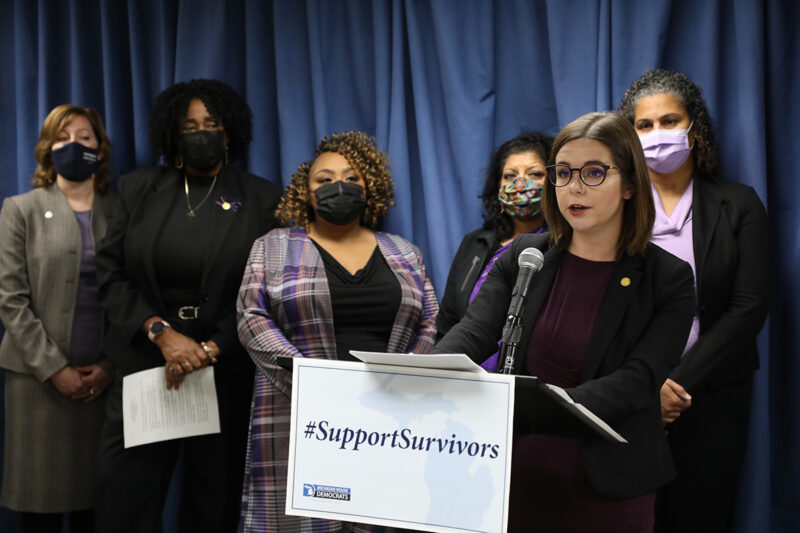
Rep. Laurie Pohutsky
Sponsored bills
Maddy summaryThis resolution (HR 178) designates September 20-27, 2025, as "Michigan Trails Week" to celebrate the state's extensive trail system. It recognizes that Michigan's over 13,000 miles of trails support tourism, local businesses, public health, and environmental conservation. The resolution encourages residents and visitors to explore, maintain, and advocate for trails during this week, while directing copies to the Michigan Department of Natural Resources and Michigan Trails and Greenways Alliance. As a ceremonial resolution, it does not create new laws or allocate funding.
Maddy summaryThis resolution declares September 15-October 15, 2025, as Hispanic Heritage Month in Michigan. It is a symbolic state recognition, not a policy change, affirming the observance of Hispanic and Latino American contributions to Michigan and the nation. The resolution does not create new laws, allocate funding, or affect specific groups; it simply aligns Michigan with the existing national observance established by federal law in 1988. The declaration enables state agencies and communities to organize events celebrating Hispanic heritage during that period.
Maddy summaryHB 5004 amends Michigan's unemployment benefits law to clarify the requirements for workers who leave jobs due to medical reasons. To qualify for benefits, an employee must obtain a medical professional's statement confirming that continuing work would harm their health and must have made good-faith attempts to secure alternative work or a leave of absence with their employer. Without these steps, the employee is presumed to have left work voluntarily without good cause, disqualifying them from benefits. This change directly affects Michigan workers seeking unemployment benefits after a medical leave, ensuring eligibility aligns with documented medical necessity and employer cooperation efforts.
Maddy summaryThis bill modifies Michigan's unemployment benefits formula to increase payments for workers with dependents. It changes the weekly benefit rate calculation starting January 1, 2025, setting a new $12.66 per dependent amount (up to 5 dependents) with a $446 maximum weekly benefit - higher than the current $362 cap. The change directly affects unemployed Michigan residents who claim benefits and have dependents, as their weekly payments will increase based on these updated formulas. The bill does not alter eligibility rules or dependency definitions, only the monetary amounts used in the calculation.
Maddy summaryHB 5008 amends Michigan's unemployment benefits law (MCL 421.62) to decrease the maximum percentage of wages that can be garnished for repayment of improperly collected benefits, from 50% to 20%. It directly affects unemployed workers who overreceived benefits, requiring them to repay the excess but limiting wage deductions. The bill also adds new hardship waiver criteria, allowing full repayment relief if a claimant’s household income is at or below 150% of the federal poverty level, or if overpayment resulted from agency errors. It maintains a 3-year deadline for the unemployment agency to seek repayment, except in cases of identity fraud or intentional fraud.
Maddy summaryHB 5000 increases Michigan's unemployment benefit payments for workers with dependents. It amends the calculation method to use 5.1% of the highest-earning quarter's wages (up from 4.1%) plus higher per-dependent amounts. For claims filed after January 1, 2025, the weekly rate rises to $12.66 per dependent (max $446); after 2026, it increases to $19.33 per dependent (max $530). This directly affects unemployed Michigan residents claiming benefits who have dependents, raising their weekly payments through 2028 and beyond.
Maddy summaryHB 5006 amends Michigan's unemployment insurance law to clarify how the state recovers benefits paid to individuals who weren't entitled to them. It sets a 3-year limit for the unemployment agency to seek repayment (except for identity fraud cases), limits deductions from future benefits or wages to 50% per payment, and establishes three specific situations where repayment can be waived: if the overpayment resulted from incorrect wage information provided by an employer, if the recipient's household income was at or below 150% of the federal poverty level, or if the overpayment was due to a clerical error by the agency. The bill also specifies that waivers apply from the date of the error or application, and requires refunds for any payments made after a waiver is granted. This directly affects individuals who received unemployment benefits they didn't qualify for, changing how the state enforces repayment and grants relief.
Maddy summaryHB 5005 amends Michigan's unemployment benefits law to clarify when workers who leave jobs without notice may still qualify for benefits. It adds a new exception (subsection (iv)) allowing domestic violence victims to claim benefits without disqualification, provided they meet requirements under Section 29a. The bill also reinforces that workers absent for 3+ consecutive days without contacting their employer are presumed to have left voluntarily - unless they qualify for one of the specified exceptions. This change directly affects workers who leave employment due to domestic violence or other qualifying circumstances, ensuring they can access benefits without penalizing their former employers financially.
Maddy summaryHB 5007 amends Michigan's Employment Security Act to update how "employment" is defined for unemployment benefits eligibility. It changes the standard for classifying workers as employees (requiring benefits coverage) versus independent contractors, effective January 1, 2026. Under the new rule, most workers must be classified as employees unless they meet all three strict criteria: no employer control, services outside the employer's usual business, and the worker operating as an independent business. This directly affects employers and workers in Michigan who currently classify individuals as independent contractors, particularly in gig economy and service roles. The bill maintains current rules (using the IRS 20-factor test) until 2026, with specific exceptions for certain visa holders and federally certified employers.