

Maddy summaryThis bill requires individuals in Michigan to obtain a license before purchasing, carrying, possessing, or transporting any firearm, including both pistols and other firearms. It establishes specific eligibility criteria for licensing, such as being at least 18 years old (21 for pistols), being a U.S. citizen or legal resident, and having completed a pistol safety training course. The legislation also mandates that law enforcement officials issue licenses to qualified applicants without unnecessary delay, unless there is probable cause to believe the applicant poses a threat or would commit a crime. Additionally, the bill requires firearm sellers to complete and submit license forms documenting each transaction, with specific reporting timelines for pistol purchases.
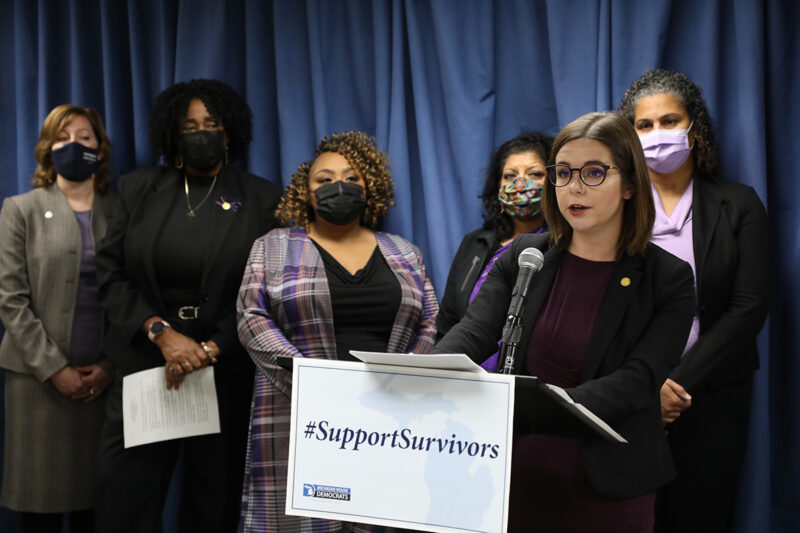
Rep. Laurie Pohutsky
Sponsored bills
Maddy summaryThis bill amends Michigan state law to clarify that local governments are allowed to impose certain restrictions on firearms within their jurisdictions. It permits municipalities to regulate how employees carry guns at work, set rules for open carry in government buildings, and establish age-based supervision requirements for pneumatic guns. The legislation also allows local authorities to prohibit threatening displays of pneumatic guns and to ban open carry in their facilities, except for law enforcement officers. These provisions aim to give communities more flexibility in creating their own firearm safety policies while maintaining state-level oversight.
Maddy summaryThis bill prohibits individuals from carrying firearms in specific state buildings, including the Michigan State Capitol, the Anderson House Office Building, and the Binsfeld Senate Office Building, with exceptions for security personnel, peace officers, and licensed concealed pistol carriers serving as legislators. It also expands existing restrictions by banning firearms in polling places, early voting sites, and within 100 feet of ballot drop boxes for 40 days before an election, while allowing law enforcement and licensed carriers to carry in these areas. The legislation applies to various other locations such as financial institutions, churches, courts, theaters, sports arenas, day care centers, hospitals, and licensed liquor establishments, with similar exemptions for security staff, peace officers, and permit holders. Violations of these provisions are classified as misdemeanors punishable by up to 90 days in jail, a fine of up to $100, or both.
Maddy summaryThis resolution urges Congress to pass legislation requiring the President to end U.S. military involvement in the conflict with Iran. It directly addresses the current hostilities that began on February 28, 2026, and calls for the withdrawal of American armed forces from the region. The bill cites the recent missile strike on an Iranian school that killed many children and the resulting regional instability as reasons for ending the conflict. It also highlights rising fuel prices caused by disruptions to shipping through the Strait of Hormuz. The resolution is non-binding and serves to express the intent of its sponsors rather than create immediate legal obligations.
Maddy summaryThis bill designates a specific section of M-5, also known as Grand River Avenue in Wayne County between 8 Mile Road and Telegraph Road, as the "PV2 Joseph R. Blake Memorial Highway." It directly affects the Michigan State Highway Department by requiring them to update official records and signage to reflect this new name. The legislation amends the Michigan Memorial Highway Act to formally establish this memorial designation for the roadway. This change is primarily commemorative and does not alter traffic rules or funding allocations for the highway. The bill is sponsored by Representative Laurie Pohutsky and is currently under review by the Transportation and Infrastructure Committee.
Maddy summaryThis bill designates March 12, 2026, as Endometriosis Awareness Day in Michigan to raise public understanding of the condition. It does not change laws or allocate funding but serves as a symbolic gesture to highlight the health challenges faced by individuals with endometriosis. The resolution encourages education and support for those affected by the disease without implementing new policies or regulations.
Maddy summaryHB 5706 amends Michigan's vehicle code to establish a reimbursement mechanism for local law enforcement agencies that assist with certain vehicle crashes. The bill creates a funding pathway where local police departments can receive financial support from the highway safety fund when they provide assistance at vehicle crash scenes. This provision directly affects local law enforcement agencies and the state highway safety fund, allowing for reimbursement of costs incurred during crash assistance operations. The bill is tied to companion legislation HB 5705 and requires both measures to be enacted together for the changes to take effect.
Maddy summaryThis bill allows local police departments in Michigan to request reimbursement from the state police for expenses incurred when responding to incidents on state-owned freeways and highways. The reimbursement is only available if the state police did not have officers available to respond, explicitly requested the local agency to respond, and the local department created an official report of the incident. Local agencies must submit reimbursement requests quarterly, and the state police director will set annual reimbursement rates and report on the number of reimbursed responses by county and local government type.
Maddy summaryThis House resolution calls on Congress to investigate individuals linked to Jeffrey Epstein and require them to testify under oath. It directly affects high-profile figures across technology, finance, real estate, and government who have been implicated in Epstein's criminal network. The resolution asserts that current Department of Justice actions have failed to protect survivors or fully disclose information, citing concerns over redacted names and unredacted photos of victims. It seeks to use congressional authority to compel testimony from those who participated in or covered up Epstein's crimes. The measure was introduced in March 2026 and referred to the Committee on Government Operations.
Maddy summaryHB 5589 prohibits Michigan public schools from requiring students to use social media platforms for school-related activities, such as class assignments or club events. It directly affects students and school personnel by mandating that school boards adopt policies banning this practice. The bill defines "social media platform" broadly but explicitly excludes educational tools like learning management systems, teleconferencing services, and school-sanctioned digital learning platforms. This creates a clear policy requiring schools to avoid using commercial social media for educational purposes while allowing necessary academic technology.