

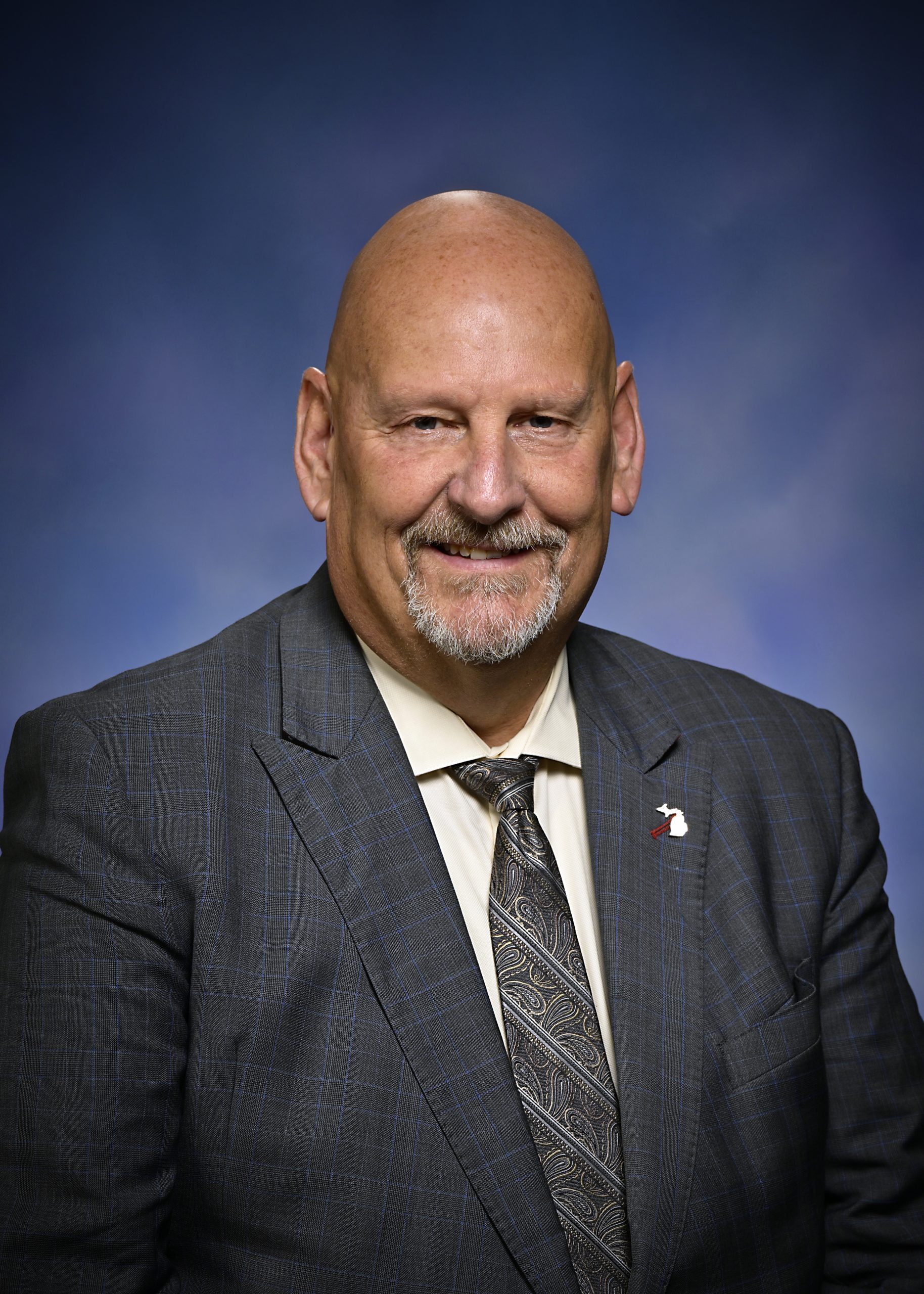
Photo of Curt VanderWall
R Michigan House · District 102 On the 2026 ballot

Rep. Curt VanderWall

Compare
Total votes
4,489
all sessions
Attendance
91%
420 missed
Higher than 83% of chamber peers
With party
97%
of cast votes
Higher than 75% of chamber peers
Bipartisan score
2%
crosses aisle rarely
Lower than 77% of chamber peers
Sponsored
653
bills & resolutions
Near the chamber average
Committees
4
assignments
653 bills and resolutions

Sponsored bills

Total
653
Primary
120
Co-sponsor
533
This page
653
matching current filters
Co-sponsor HB 4494
In committee · Michigan House · Co-sponsor
Gaming: other; redemption games allowed under penal code; revise. Amends secs. 303 & 310b of 1931 PA 328 (MCL 750.303 & 750.310b).

Maddy summaryHB 4494 revises the Michigan penal code concerning redemption game machines. The bill modifies the conditions under which these games are exempt from general gaming prohibitions, allowing for games determined by a combination of skill and chance. It significantly increases the maximum prize value for redemption games, permitting awards up to $500, which can include stored value cards redeemable at retailers. The legislation also introduces new regulations, such as limiting establishments to eight machines that award stored value cards and establishing penalties for tampering with certified game software. These changes primarily affect businesses that offer redemption games and their players.

In committee May 20, 2025 1 co-sponsor
Co-sponsor HB 4495
In committee · Michigan House · Co-sponsor
Gaming: other; redemption games allowed under penal code; revise. Amends sec. 16o, ch. XVII of 1927 PA 175 (MCL 777.16o). TIE BAR WITH: HB 4494'25

Maddy summaryHB 4495 proposes to amend Michigan's code of criminal procedure, specifically section 16o of chapter XVII (MCL 777.16o). The bill aims to revise the penal code to allow for redemption games. This change directly affects businesses that operate redemption games and individuals who participate in them by clarifying their legal status under criminal law.

In committee May 20, 2025 1 co-sponsor
Co-sponsor HB 4500
In committee · Michigan House · Co-sponsor
Health: screening; pilot program to assess the effects of PFAS on certain participants; provide for. Amends 1978 PA 368 (MCL 333.1101 - 333.25211) by adding secs. 5753, 5755, 5757, 5759 & 5761 to pt. 57A. TIE BAR WITH: HB 4499'25

Maddy summaryHouse Bill 4500 establishes a grant program for a research institution to conduct a pilot program in Michigan. This program aims to assess the levels of PFAS (per- and polyfluoroalkyl substances) in the blood of qualified participants and study their health effects. A dedicated PFAS pilot program fund will be created to cover grants, blood testing, and the development of educational materials. The Department of Health will oversee the program, select the research institution, and submit reports to the legislature on the program's findings and recommendations.

In committee May 20, 2025 1 co-sponsor
Co-sponsor HB 4201
Passed · Michigan House · Co-sponsor
Individual income tax: retirement or pension benefits; department of corrections retirement and pension benefits; exempt from income taxes. Amends sec. 30 of 1967 PA 281 (MCL 206.30).

Maddy summaryHB 4201 amends Michigan's income tax law to exempt certain retirement benefits from state taxation. It specifically adds a deduction for retirement or pension benefits received from Michigan's public retirement systems (like state employee pensions) or federal public retirement systems. This directly affects Michigan residents who receive these types of public-sector retirement benefits by reducing their taxable income. The change modifies Section 30 of Michigan's Income Tax Act (MCL 206.30) to exclude these benefits from taxable income calculations.

Passed May 20, 2025 1 co-sponsor
Co-sponsor HB 4499
In committee · Michigan House · Co-sponsor
Health: screening; pilot program to assess the effects of PFAS on certain participants; provide for. Amends 1978 PA 368 (MCL 333.1101 - 333.25211) by adding pt. 57A. TIE BAR WITH: HB 4500'25

Maddy summaryHouse Bill 4499 proposes to amend the Public Health Code by establishing a pilot program to assess the effects of perfluoroalkyl and polyfluoroalkyl substances (PFAS). This program would focus on "qualified study participants," defined as individuals who, on or after January 1, 2012, resided in specific counties while under 11 years old and used well water or a public water supply with elevated PFAS levels. The bill defines the criteria for these participants and the population ranges for the "qualified counties." It also outlines the involvement of eligible research institutions and a dedicated PFAS pilot program fund.

In committee May 20, 2025 1 co-sponsor
Co-sponsor HB 4118
Passed · Michigan House · Co-sponsor
Drains: financing; special assessments; provide for levy against DNR lands. Amends secs. 151, 154, 280, 468 & 520 of 1956 PA 40 (MCL 280.151 et seq.).

Maddy summaryHB 4118 amends Michigan's Drain Code to require that lands owned by the Department of Natural Resources (DNR) be assessed for drainage project costs based on the benefits they receive, similar to how townships, cities, counties, and state highways are assessed. The bill clarifies that drainage costs must be apportioned among these entities according to specific benefit-based formulas, including DNR lands as a distinct category. It also updates public notice requirements for bidding on drainage projects and reviews of cost allocations to ensure transparency. This change directly affects DNR lands and the entities responsible for funding drainage improvements, including local governments and state transportation authorities.

Passed May 15, 2025 1 co-sponsor
Co-sponsor HB 4076
Passed · Michigan House · Co-sponsor
Food: other; labeling lab-grown meat as meat; prohibit. Amends sec. 7129 of 2000 PA 92 (MCL 289.7129).

Maddy summaryHB 4076 prohibits labeling lab-grown meat substitutes as "meat" and requires sellers to use specific terms like "cell-cultured," "lab-grown," or "cultivated" on product labels. It directly affects manufacturers and retailers selling lab-grown meat alternatives, mandating clear labeling that distinguishes these products from traditional meat. The bill amends Michigan's Food Law to require these terms on sealed packages or bulk displays, ensuring consumers can accurately identify the product type. This policy change focuses on transparent labeling without altering existing requirements for traditional meat products.

Passed May 15, 2025 1 co-sponsor
Co-sponsor HB 4283
Passed · Michigan House · Co-sponsor
Energy: alternative sources; electricity generated from RICE generators; authorize use of to meet renewable and clean energy standards. Amends secs. 28, 29 & 32 of 2008 PA 295 (MCL 460.1028 et seq.) & adds sec. 34.

Maddy summaryHB 4283 amends Michigan's Clean and Renewable Energy Act to allow electricity generated from Reciprocating Internal Combustion Engine (RICE) generators to count toward meeting the state's renewable energy portfolio standards. This change directly affects electric providers, including cooperatives and multistate utilities, that must meet specific renewable energy targets. The bill adds a new provision specifying that RICE-generated electricity can be used as renewable energy credits toward compliance. This provides electric providers with an additional compliance option for meeting the state's renewable energy requirements.

Passed May 13, 2025 1 co-sponsor
Co-sponsor HB 4387
In committee · Michigan House · Co-sponsor
Individual income tax: credit; credit for qualified expenditures attributable to supplies, repairs, and restoration after a declared state of emergency. Amends 1967 PA 281 (MCL 206.1 - 206.847) by adding sec. 282.

Maddy summaryHB 4387 creates a temporary 2025 income tax credit for Michigan residents affected by a severe winter storm and ice storm declared a state of emergency by Governor Whitmer on March 31, 2025. It allows eligible taxpayers to claim a credit of up to $5,000 for qualified expenses directly related to repairing or restoring homes, property, or businesses damaged by the emergency - such as purchasing generators, chainsaws, or building materials. To qualify, taxpayers must reside in the declared emergency area, provide proof of expenses (including federal ID and property address), and confirm expenses weren’t reimbursed. The credit applies only to the 2025 tax year and cannot exceed the taxpayer’s total tax liability for that year.

In committee May 13, 2025 1 co-sponsor
Co-sponsor HB 4428
In committee · Michigan House · Co-sponsor
Health: pharmaceuticals; choice of formulation, dosage, and route of administration for opioid antagonists by certain persons and governmental entities if department of health and human services distributes opioid antagonists free of charge; allow. Creates new act.

Maddy summaryHB 4428 allows individuals and governmental entities receiving free opioid overdose reversal medications (opioid antagonists) from the Department of Health and Human Services (DHHS) to choose the specific type, dose, or delivery method of the medication. This provision applies when the DHHS distributes these medications to help reduce opioid-related overdoses across the state. The choice is intended to help recipients better address local needs. However, recipients cannot choose a specific formulation or dosage if doing so would jeopardize federal funding for the DHHS.

In committee May 7, 2025 1 co-sponsor
Showing 171 to 180 of 653 bills
Previous 1 … 17 18 19 … 66 Next