

Fairness for Landowners Facing Eminent Domain Act This bill limits the use of eminent domain by the holder of a certificate of public convenience and necessity to acquire land or property for the construction and operation of a natural gas pipeline facility. Specifically, the bill prohibits the use of eminent domain unless the holder (1) obtains all federal and state permits required by law for the construction and operation of pipeline facilities, and (2) complies with all environmental conditions appended to the certificate order. Additionally, the bill suspends eminent domain authority if (1) the holder requests a material amendment to the certificate, or (2) a federal or state permit held by the holder is vacated or remanded. The bill also sets forth a dispute resolution process and related requirements to resolve disagreements about accessing properties prior to acquiring them.
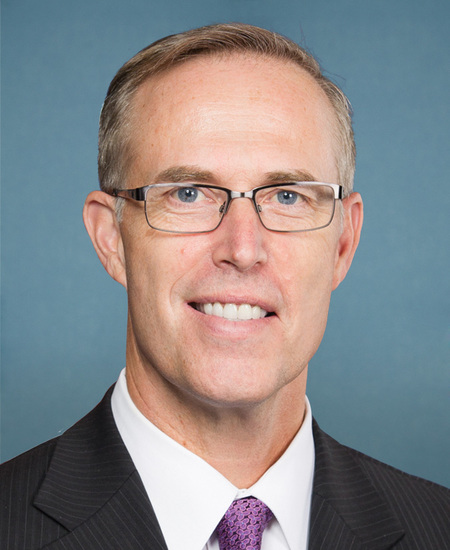
Rep. Jared Huffman
Sponsored bills
Preventing Outages With Enhanced Resilience and Operations Nationwide Act of 2021 or the POWER ON Act of 2021 This bill provides incentives for enhancing the resilience of the electric power grid to natural disasters and strengthening the emergency response and management of the grid. Specifically, the bill requires the Department of Energy (DOE) to establish an electric grid resilience program. Under the program, DOE must provide grants to states and Indian tribes for projects that enhance the physical resilience of the electric grid to natural disasters. In addition, DOE must establish a research, development, demonstration, and commercial application program to enhance resilience and strengthen emergency response and management of the electric grid. Under the program, DOE must award grants to improve the resilience of the electric grid by developing technologies and capabilities to withstand and address the current and projected impact on electric grid infrastructure of natural disasters, such as wildfires.
Ban Conflicted Trading Act This bill prohibits a Member of Congress or certain congressional officers or employees from (1) purchasing or selling specified investments, (2) entering into a transaction that creates a net short position in a security, or (3) serving as an officer or member of any board of any for-profit entity.
This concurrent resolution (1) affirms, on the 400th anniversary of the arrival of the first slave ship, that the nation owes a debt of remembrance not only to those who lived through the injustices of slavery but also to their descendants; and (2) urges the establishment of a U.S. Commission on Truth, Racial Healing, and Transformation to properly acknowledge, memorialize, and be a catalyst for progress, including toward permanently eliminating persistent racial inequities.
This joint resolution proposes a constitutional amendment declaring that women shall have equal rights in the United States and every place subject to its jurisdiction. The amendment prohibits the United States or any state from denying or abridging equal rights under the law on account of sex.
This resolution (1) supports the designation of a National Day of Reason; and (2) encourages all citizens, residents, and visitors to focus on the central importance of reason, critical thought, the scientific method, and free inquiry to resolving social problems and promoting human welfare.
Improving Training for School Food Service Workers Act This bill adds requirements regarding the availability of training that the Department of Agriculture provides under current law for local food service personnel in schools. The training must be scheduled primarily during regular, paid working hours; offered in-person whenever appropriate; and incorporate hands-on training techniques. If the training is scheduled outside of working hours, food service personnel must be informed about the necessity of scheduling the program and compensated for attending the program. Personnel may not be penalized for failing to attend a program outside of working hours.
Homecare for Seniors Act This bill allows tax-exempt distributions from health savings accounts (HSAs) to be used for qualified home care. Qualified home care means a contract to provide three or more of the following services in the residence of the service recipient assistance with eating, assistance with toileting, assistance with transferring, assistance with bathing, assistance with dressing, assistance with continence, and medication adherence. The Department of Health and Human Services must carry out a campaign to increase public awareness of the in-home service expenses that are eligible for tax-free distribution from HSAs.
Universal Child Care and Early Learning Act This bill provides funds to the Department of Health and Human Services (HHS) for an affordable child care and early learning program. Children who are at least six weeks of age but not yet required to attend school may participate in the program regardless of family income, disability status, citizenship status, or employment of a family member. Under the program, HHS must support sponsors (e.g., states, local governments, tribal organizations, and nonprofit community organizations) that provide child care and early learning services for families. Families must pay a subsidized fee, based on their income, for the services. The fees are waived for children from families with incomes below 200% of the poverty line. The fees are capped at 7% of a family's income regardless of the family's income level.
Accessible, Affordable Internet for All Act This bill reauthorizes through FY2026, revises, and establishes grants and activities to promote access to broadband internet and other telecommunication services. The bill addresses digital equity and inclusion through grants and by requiring studies on barriers to adoption of broadband services and related matters. The bill addresses broadband affordability and access. It (1) reauthorizes and expands various programs that subsidize or otherwise support broadband services for eligible households, schools and libraries, and tribal lands and populations; and (2) establishes a program for expanding broadband service for underserved areas and community support organizations (e.g., schools and religious organizations). Additionally, the Federal Communications Commission (FCC) must award grants and take other actions to expand programs that verify an individual's eligibility for subsidized services. The bill addresses broadband data collection, disclosure, and sharing. The FCC must (1) issue rules regarding the collection of pricing data and labels that disclose information about broadband plans to consumers, and (2) collaborate and share data with federal agencies and other stakeholders. The bill makes financing (e.g., low-interest loans) available to communities and public-private partnerships for broadband infrastructure investments. Additionally, the Department of Transportation must require states to install conduits for broadband cables as part of certain highway projects. The bill also sets up a task force on nationwide dig once requirements (i.e., policies or practices to minimize excavations of highway rights-of-way when installing telecommunications infrastructure). Further, the bill preempts state laws that prohibit certain telecommunications service providers (e.g., public providers) from providing high-speed broadband services.