

Maddy summaryThis bill establishes a special commission to study and recommend ways to increase voter turnout in Massachusetts. The commission will investigate the effectiveness of various election laws, such as voting holidays, financial incentives for voting, and ballot access for incarcerated individuals, using statistical models to measure their impact. The panel will also analyze policy preferences between voters and non-voters and compare Massachusetts' options with laws in other states. The commission is composed of elected officials, association leaders, and appointees from public interest groups, and it must hold public hearings before submitting its final report and recommendations within 12 months.
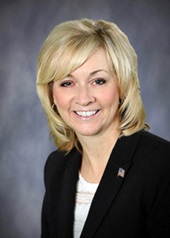
Rep. Kim Ferguson
Sponsored bills
Maddy summaryThis bill creates a new Board of Registration in Midwifery within the Department of Public Health to oversee the licensing and regulation of midwives in the state. The board will consist of nine appointed members, including experienced midwives, obstetricians, and a public representative, with a specific requirement to consider racial disparities in maternal health during appointments. Additionally, the legislation expands the state's allied health professions board to include lactation consultants and updates various laws to formally recognize certified nurse-midwives and licensed midwives in official definitions and hospital settings. The bill also mandates that the insurance commission cover postpartum depression screenings for state employees and allows coverage for medically necessary donor human milk for infants at high risk of certain conditions.
By Representatives Higgins of Leominster and Jones of North Reading, a petition (accompanied by bill, House, No. 2342) of Natalie M. Higgins, Bradley H. Jones, Jr., and others that the crime laboratory within the Department of the State Police conduct an audit of offender DNA profiles included on the state DNA databank system. Public Safety and Homeland Security.
Maddy summaryThis law bans the use of elephants, big cats, primates, giraffes, and bears in traveling animal acts, such as circuses and mobile carnivals, effective January 1, 2025. It prohibits anyone from allowing these animals to perform tricks or participate in entertainment while being transported in vehicles between locations. The ban does not apply to animals that live permanently at a fixed facility, veterinary transport, or film productions that do not involve live public exhibitions. Violations of the new rules can result in civil penalties ranging from $500 to $10,000 per animal involved.
The committee of conference on the disagreeing votes of the two branches with reference to the Senate amendment of the House Bill to ensure legal parentage equality (House, No. 4750), reports recommending passage of the accompanying bill (House, No. 4970).
Maddy summaryThis bill amends Massachusetts law to protect individuals and food establishments from civil lawsuits when they donate food, including items that have passed their expiration dates, to nonprofit organizations or other recipients. The protections apply as long as the donated food is not misbranded or adulterated and was handled in compliance with public health regulations, while also excluding cases involving gross negligence, recklessness, or intentional misconduct by the donor. By removing liability for injuries caused by the condition of such donated food, the legislation aims to encourage more people and businesses to contribute surplus food to those in need without fear of legal repercussions.
Maddy summaryThis bill creates a special legislative commission to study the intentional misrepresentation and misuse of service animals in Massachusetts. The commission will consist of seventeen members appointed by various government officials and representatives from disability advocacy, business, and service dog organizations. Its primary task is to review current laws, investigate the prevalence of fraud, and examine practices in other states to determine if new regulations or penalties are needed. Additionally, the commission will explore whether service animals should be required to have a certification or registration system. The group must submit its findings and recommendations by April 1, 2025, to state legislators and relevant committee chairs.
Maddy summaryThis bill encourages food donations by offering a tax credit of up to $25,000 annually to businesses that donate food to nonprofit organizations serving people in need. It also provides legal protections for donors and nonprofits by shielding them from civil liability if donated food causes injury, even if the food is past its expiration date, provided it was not handled with gross negligence. To claim the tax credit, businesses must submit a certification from the receiving nonprofit confirming the food was distributed without charge or only to cover handling costs. The legislation applies to farms, restaurants, and grocery stores within the state and requires that all donations comply with existing health and safety regulations.
Maddy summaryThis bill proposes banning the sale of cell phone location information to protect reproductive health access, LGBTQ individuals, religious liberty, and freedom of movement. It directly affects telecommunications companies and data brokers by restricting their ability to sell precise location data to third parties. The legislation aims to prevent the misuse of location tracking that could expose individuals to discrimination or surveillance in sensitive situations.
Maddy summaryThis bill updates Massachusetts laws to ensure that all children have equal legal rights and protections regarding parentage, regardless of their parents' marital status, gender, or the method of conception. It achieves this by replacing gender-specific terms like "paternity" and "mother" with the gender-neutral term "parentage" and removing distinctions based on whether parents are married. The legislation also expands legal definitions to explicitly include children born through assisted reproduction and surrogacy, ensuring that intended parents and surrogates are clearly recognized under the law. By amending existing statutes, the bill aims to create a consistent legal framework that treats all parent-child relationships equally without regard to how the child was born.