

Maddy summarySB 104, the "Fair Districts for Maryland Act," reforms how Maryland draws legislative and congressional district lines. It requires all legislative districts to be divided into three single-member delegate districts and establishes an independent Redistricting Commission to create these maps, replacing the previous process involving the Governor and General Assembly. The bill bans consideration of political party affiliation, past voting patterns, or individual residences when drawing districts, and gives the Maryland Supreme Court original authority to review plans if the Commission fails to act. This directly affects all Maryland voters by changing how district boundaries are determined, aiming to create more equitable maps based on population and community boundaries rather than political strategy.
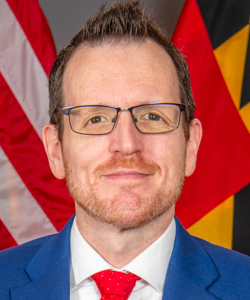
Sen. Justin Ready
Sponsored bills
Maddy summarySB 740, the "SFC Matthew Fast Act for Warrior Healthcare," requires all health care facilities in Maryland to screen every patient for military connection and document whether they are a "warrior community member" (defined as a service member, veteran, spouse, child, or stepchild of military personnel) in their medical record. Facilities must identify these patients as a vulnerable population and follow The Joint Commission’s national standards for health care equity. Starting in 2026, the state health department must annually report to the Governor and legislature on meeting the needs of military-connected patients. The bill takes effect October 1, 2025, aiming to improve health care equity through standardized screening and reporting.
Maddy summarySB 981 requires Maryland hospitals to provide free medically necessary care to patients with family income at or below 200% of the federal poverty level and reduced-cost care to those between 200-500% FPL who face financial hardship (defined as medical debt exceeding 25% of family income over 12 months). It mandates a 75% reduction in patient costs for individuals earning 201-250% of the poverty level and prohibits hospitals from filing lawsuits to collect debts under a specified low threshold. The bill also extends the time before interest accrues on medical debt and adds requirements for hospitals to clearly explain financial assistance policies to patients. These changes directly affect low- and middle-income patients with hospital bills and hospitals operating in Maryland.
Maddy summarySB 376 allows counties to conduct nursing home inspections upon request, shifting this responsibility from the state health department. The bill requires the Maryland Department of Health and the requesting county to share the costs of these inspections equally. It does not change existing requirements for annual inspections, unannounced visits, or complaint investigations (which remain under state oversight), but instead modifies how inspections are administered by adding county delegation as an option. This directly affects nursing homes (through potential county inspections) and counties (which gain new inspection authority).
Maddy summarySB 547 establishes a 18-member Commission to study whether pooling public employee health insurance purchasing across Maryland's State, counties, municipalities, and school boards would save costs while maintaining benefits. The Commission includes representatives from state agencies (like Budget and Management, Insurance Commissioner), local governments (counties, cities, school boards), labor unions (AFSCME, SEIU), and healthcare experts. It will analyze existing health insurance data to assess fiscal impacts and barriers to implementing a shared purchasing system. This bill creates a study group but does not change current insurance policies or require immediate action.
Maddy summarySenate Bill 116 requires Maryland's Department of the Environment, Maryland Energy Administration, and the University of Maryland School of Business (with coordination from the Department of Legislative Services) to study the environmental, energy, and economic impacts of data center development in the state. The analysis must evaluate effects on air/water quality, Chesapeake Bay goals, energy demand and costs, greenhouse gas emissions, tax revenues, and job creation. The agencies must complete a final report by September 1, 2026, for review by the Governor and legislature. The bill does not regulate data centers directly but provides a data-driven foundation for future policy decisions. It expires automatically on June 30, 2027.
Maddy summarySB 533 establishes a one-year-and-one-day deadline for Maryland law enforcement agencies to file administrative charges related to police misconduct complaints, starting from when the agency becomes aware of the incident. This applies to most cases, including those not requiring an administrative committee review, and ensures timely action on complaints from the public. For incidents tied to ongoing criminal investigations, the deadline extends until the criminal case concludes or the prosecutor declines charges. The bill aims to prevent indefinite delays in holding officers accountable while aligning administrative processes with criminal proceedings.
Maddy summarySB 372, the Preserve Telehealth Access Act of 2025, permanently extends current rules allowing audio-only telephone calls to count as "telehealth" for reimbursement purposes under Maryland's Medicaid program and private insurers. The bill repeals the June 30, 2025, expiration date for this provision in Maryland law, making it permanent. It directly affects the Maryland Medical Assistance Program, private health insurers, nonprofit health service plans, and health maintenance organizations (HMOs) that cover telehealth services. The key change is ensuring these entities must continue reimbursing for audio-only telehealth visits at the same rate as in-person care, without requiring video technology, for covered health services.
Maddy summaryThis bill renames Maryland's Chesapeake Conservation Corps Program to honor former Senate President Thomas V. Mike Miller, Jr. It updates the program's official name throughout state law to "Thomas V. Mike Miller, Jr. Chesapeake Conservation and Climate Corps Program" without changing the program's structure, funding, or operations. The renaming applies to all references in Maryland's Natural Resources and State Government codes, including funding provisions and program administration details. The program - administered by the Chesapeake Bay Trust and focused on environmental conservation projects - remains unchanged in its purpose and implementation.
Maddy summarySB 785 amends Maryland's unpaid parental leave law by revising the definition of "employer" to exclude businesses covered by the federal Family and Medical Leave Act (FMLA) for the current year. This change directly affects Maryland employers with 15-49 employees who are already subject to federal FMLA requirements. Under the bill, these employers would no longer be required to provide state-mandated unpaid parental leave benefits, as federal rules would take precedence. The law would take effect October 1, 2025.