

Maddy summarySB 651 allows Maryland counties to adopt local "good cause eviction" laws, preventing landlords from terminating residential leases or evicting tenants without a valid reason (like nonpayment or lease violations). If a county adopts such a law, landlords must disclose in leases whether they are subject to it and provide detailed ownership information (including all owners and properties they manage) using forms created by the state's Office of Tenant and Landlord Affairs. This directly affects tenants and landlords in counties that implement the law, requiring landlords to justify evictions and disclose ownership details. The bill amends Maryland's property code to establish these disclosure requirements and local adoption procedures.
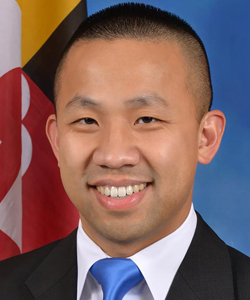
Sen. Clarence Lam
Sponsored bills
Maddy summarySB 440 would require Anne Arundel County to establish an Office of the Inspector General to independently oversee county operations. The County Council must pass a local law defining the Inspector General’s qualifications, term, powers, and duties, and include a dedicated budget for the office in the annual county budget. An Advisory Board (appointed by the County Executive and confirmed by the Council) would select and appoint the Inspector General and may remove them only for neglect of duty, malfeasance, felony conviction, or other specific reasons. The Advisory Board members cannot be current county, state, or federal government employees or officials. The office would be operational by October 1, 2025.
Maddy summarySB 978 requires developers applying for certain environmental permits (like for landfills, hazardous waste facilities, or pollution discharges) to submit additional documentation if the project is located near communities already facing environmental challenges. Specifically, applicants must include an Environmental Justice (EJ) Score for the area and, for projects identified as having high potential for harm, provide an Environmental Impact Analysis and an Existing Burden Report detailing current community stressors. The Department of the Environment must review these materials and can deny permits if the project would worsen health or environmental impacts on vulnerable communities. This bill directly affects developers seeking permits for large-scale projects in designated census tracts, aiming to strengthen community input and health protections during the permitting process.
Maddy summarySB 949 establishes rules for operating fully autonomous vehicles (level 4 or 5 systems) on Maryland highways without a human driver. It requires these vehicles to achieve a "minimal risk condition" if the system fails, display manufacturer certification labels, and meet federal safety standards. Transportation companies using autonomous vehicles must submit law enforcement interaction plans (detailing communication, towing, and recognition protocols) and proof of security to the state administration. The bill directly affects manufacturers, ride-hailing services, and other ground transportation companies operating autonomous fleets in Maryland. It treats the automated driving system as the legal "operator" for compliance with vehicle laws and crash reporting.
Maddy summarySB 171 establishes standardized procedures for political party central committees (county or state level) to fill vacancies in Maryland’s General Assembly when a Senator or Delegate position becomes vacant. The bill requires committees to: (1) advertise vacancies for at least 7 days with public notice detailing meeting times and application processes; (2) post all applications online for 30 days after voting; (3) hold public meetings for candidate interviews and voting; and (4) prohibit committee members who applied for the vacancy from participating in the selection process. These rules apply specifically to vacancies filled under Maryland’s Constitution and take effect October 1, 2025. The bill directly affects party committees managing vacancy fillings, not voters or candidates.
Maddy summarySB 628 changes how the salary for Maryland Registers of Wills is calculated. It replaces the previous $146,500 salary cap with a new formula based on the state's Grade 26, Step 20 salary scale for state employees. The Board of Public Works will determine each register's salary using factors like county population and office revenue, while removing an obsolete $12,000 minimum salary requirement for Baltimore City. The new rules take effect for salaries beginning October 1, 2025, applying only to new terms of office.
Maddy summarySB 624 requires anyone seeking to move human remains from a burial site to first obtain approval from the Office of Cemetery Oversight, rather than directly applying to a State’s Attorney. This applies to both marked and unmarked burial sites, with the oversight office now handling initial authorization instead of newspaper notices. The bill establishes new application procedures, delays relocation under certain circumstances, and directs fees to the Cemetery Oversight Fund. It also clarifies that remains must be reinterred in approved locations with specific documentation, while maintaining existing health permit requirements. The law amends Maryland’s Criminal Law regarding removal of human remains.
Maddy summarySB 426, the Procurement Reform Act of 2025, reorganizes Maryland's state procurement system by giving the Chief Procurement Officer more authority to delegate tasks and manage contracts. It modifies thresholds for public notices, reports, and small business preferences, and requires contractors over a certain value to submit workforce diversity plans. The bill establishes a new preference for businesses with "good labor practices," transfers the Employment Works Program to a new office, and clarifies rules for expedited contracts and apprenticeship requirements. These changes directly affect state agencies, contractors, and small businesses participating in Maryland procurement.
Maddy summarySB 560 updates Maryland's Commission on Health Equity by expanding its membership to include new state secretaries (like Secretary of Disabilities and Secretary of Housing) and additional community representatives (such as hospital staff, community organizations, and underserved patient advocates). It also revises the Commission's core purpose to explicitly require examining how access to transportation, transit services, and proximity to healthcare facilities impact residents' health. The bill mandates the Commission to develop a statewide health equity plan while analyzing factors like housing, jobs, and economic stability alongside transportation and healthcare access. This change directly affects how the Commission operates and directs its work toward addressing systemic health disparities.
Maddy summarySB 490 eliminates citizenship requirements for members of certain Maryland state boards, committees, commissions, task forces, and workgroups. It replaces these requirements with a new mandate that members must "reflect the full diversity of the State to the extent practicable," affecting bodies across health, environment, labor, and public safety sectors. The bill achieves this by repealing and revising specific sections in Maryland’s code (including Business Occupations, Health, Environmental, and Public Safety laws) that previously required citizenship. Key provisions remove barriers for non-citizens to serve on these groups while requiring diversity considerations in appointments. This change applies to over 30 existing state entities as detailed in the bill’s code revisions.