

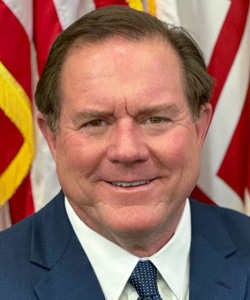
Photo of Tom Hutchinson
R Maryland House of Delegates · District 37B On the 2026 ballot

Del. Tom Hutchinson

Compare
Total votes
5,510
all sessions
Attendance
99%
34 missed
Higher than 76% of chamber peers
With party
96%
of cast votes
Lower than 78% of chamber peers
Bipartisan score
2%
crosses aisle rarely
Higher than 77% of chamber peers
Sponsored
479
bills & resolutions
Higher than 88% of chamber peers
Committees
1
assignment
479 bills and resolutions

Sponsored bills

Total
479
Primary
479
Co-sponsor
0
This page
479
matching current filters
Primary HB 739
In committee · Maryland House of Delegates · Lead sponsor
Public Utilities - Solar Energy Generating Stations - Local Approval

Maddy summaryHB 739 requires local governments to approve solar energy projects before the state can approve them. The bill prohibits the Public Service Commission from granting state approval for a solar generating station unless every county or city where the project is proposed has provided written consent. This directly affects solar developers, who must now secure local written approvals, and local governments, which gain formal authority to approve or deny projects. The key provision mandates that local consent is a mandatory step in the state approval process for solar energy facilities.

In committee Jan 29, 2025 0 co-sponsors
Primary HB 742
In committee · Maryland House of Delegates · Lead sponsor
Public Utilities - Solar Energy Generating Stations - Eminent Domain

Maddy summaryHB 742 prohibits solar energy developers from using eminent domain to acquire private land for constructing solar generating stations. The bill amends Maryland's public utilities code (specifically sections 7-207, 7-207.1, 7-207.2, and 7-208) to explicitly state that no person may exercise eminent domain rights for solar energy projects. This directly affects solar energy companies seeking to build facilities without landowner consent. The law takes effect October 1, 2025, and removes an existing legal pathway for solar developers to compel land purchases.

In committee Jan 29, 2025 0 co-sponsors
Primary HB 695
In committee · Maryland House of Delegates · Lead sponsor
Repair the Transportation Trust Fund Act

Maddy summaryHB 695 repeals a requirement that Maryland's motor fuel tax rates automatically increase annually based on the Consumer Price Index (CPI), changing how fuel tax revenue is calculated. The bill bans vehicle-miles-traveled (VMT) taxes and similar fees, including requiring devices to track mileage in private vehicles. It also sets specific farebox recovery targets for the Maryland Transit Administration (MTA), limits when MTA can raise fares, and removes public hearing requirements for certain fare changes. This directly affects drivers (through fuel tax changes), MTA (via fare rules), and local governments (by prohibiting new transportation fees). The bill modifies existing tax and transportation laws without adding new funding mechanisms.

In committee Jan 28, 2025 0 co-sponsors
Primary HB 548
In committee · Maryland House of Delegates · Lead sponsor
Public Safety - Militia - Active Duty Combat (Defend the Guard)

Maddy summaryHB 548 restricts Maryland's Governor from deploying the state militia (including the National Guard) into "active duty combat" without specific congressional action. It prohibits such deployments unless the U.S. Congress has passed an official declaration of war (per Article I, Section 8, Clause 11) or taken a specific action under Clause 15 to "call forth" the militia for federal purposes. The bill explicitly preserves the Governor's authority to deploy the militia under Title 32 of U.S. law for domestic support, such as disaster response within Maryland. This directly affects the Governor's power to commit state military forces to overseas combat roles without federal congressional authorization.

In committee Jan 22, 2025 0 co-sponsors
Primary HB 934
Signed into law · Maryland House of Delegates · Lead sponsor
State Board of Physicians - Performance of X-Ray Duties Without a License

Maddy summaryThis bill establishes a new regulatory framework for limited licensed radiologic technologists in Maryland, creating a specific license category for individuals who perform basic X-ray duties without a full medical license. The legislation allows unlicensed individuals to take X-rays only in a physician's office under the direct supervision of a licensed professional and restricts these duties to specific procedures like chest, spine, and extremity imaging while explicitly excluding advanced services such as CT scans, mammograms, and radiation therapy. To qualify, applicants must complete a standardized educational program with at least 115 hours of training and 480 hours of clinical practice, pass a certification exam, and maintain their status through continuing education. Additionally, the bill updates the composition of the state advisory committee responsible for overseeing radiation therapy and radiography regulations.

Signed into law May 16, 2024 0 co-sponsors
Primary HB 822
Signed into law · Maryland House of Delegates · Lead sponsor
Maryland Medical Assistance Program - Employed Individuals With Disabilities

Maddy summaryThis bill updates Maryland's Employed Individuals with Disabilities Program to ensure that people with disabilities can access medical assistance while working without facing strict financial or age barriers. It requires the Department of Health to provide services to applicants aged 16 and older and prohibits limiting eligibility based on earned or unearned income, assets like retirement accounts, or an upper age limit. The legislation also mandates that the application process use plain language and allows recipients to keep their independence accounts without restrictions on how they spend the funds. Additionally, the state must consult with a coalition of disability advocates twice a year to review and adjust program regulations as needed.

Signed into law May 16, 2024 0 co-sponsors
Primary HB 827
Signed into law · Maryland House of Delegates · Lead sponsor
Maryland Insurance Administration – Professional Employer Organizations – Study

Maddy summaryThis bill directs the Maryland Insurance Administration to conduct a comprehensive study of professional employer organizations within the state. The study will examine how these organizations are regulated compared to federal rules and other states, review their history and health plan benefits, and analyze requirements for businesses to join them. Additionally, the administration will look at how these groups allow small business employees to access large group health plans and assess potential impacts on the local small group market. The agency must submit its findings to the House Health and Government Operations Committee and the Senate Finance Committee by December 31, 2024.

Signed into law May 16, 2024 0 co-sponsors
Primary HB 1171
Signed into law · Maryland House of Delegates · Lead sponsor
Nonprescription Drugs and Devices – Provision by Registered Nurses and Sale of Contraceptives Through Automatic Devices

Maddy summaryThis Maryland law updates rules on how contraceptives are sold and allows registered nurses to provide certain nonprescription medications without a doctor's order. The bill removes criminal penalties for selling contraceptives through vending machines in schools and clarifies that only natural membrane condoms, not all nonlatex condoms, are banned from such machines. It also authorizes a committee to create a list of over-the-counter drugs and devices that registered nurses can dispense at local health departments. Additionally, the legislation defines key terms like "dispense" and "authorized prescriber" to guide how nurses handle these medications. These changes aim to improve access to reproductive health products and expand the role of nurses in public health settings.

Signed into law May 16, 2024 0 co-sponsors
Primary HB 1339
Signed into law · Maryland House of Delegates · Lead sponsor
Health Insurance - Hearing Aids for Adults - Coverage

Maddy summaryThis Maryland law requires health insurance plans and health maintenance organizations to cover hearing aids for adults who are prescribed, fitted, and dispensed by a licensed audiologist. The coverage applies to non-disposable devices designed to improve hearing in environments commonly experienced by adults and allows insurers to set a maximum benefit of $1,400 per ear every three years. If an adult chooses a hearing aid that costs more than the plan's limit, they can pay the difference without facing financial or contractual penalties for the provider. The law also permits insurance companies to offer benefits that are more generous than these minimum requirements. These provisions take effect on January 1, 2025.

Signed into law May 16, 2024 0 co-sponsors
Primary HB 557
Signed into law · Maryland House of Delegates · Lead sponsor
Sales and Use Tax Exemption - Aircraft Parts and Equipment - Repeal of Reporting Requirement and Extension of Sunset

Maddy summaryThis bill modifies Maryland's tax exemption for parts and equipment used to repair, maintain, or upgrade aircraft. It keeps the exemption in place for smaller planes under 12,500 pounds and larger planes used primarily in interstate or foreign commerce. The law removes the requirement for the state Comptroller to report annually on lost tax revenue and job changes related to the exemption. Additionally, it extends the exemption's expiration date from June 30, 2025, to June 30, 2030.

Signed into law May 16, 2024 0 co-sponsors
Showing 251 to 260 of 479 bills
Previous 1 … 25 26 27 … 48 Next