

Maddy summaryHB 1481 establishes Maryland's Adapted Vehicle Access Pilot Program to provide modified vehicles to eligible individuals who require a wheelchair for mobility, are licensed drivers, and qualify to operate adapted vehicles. The Department of Disabilities will administer the program, prioritizing participants in areas with limited public transportation access, and solicit donations of vehicles, modification services, and funds to support it. The bill requires the department to study the program's impacts on participants' independence, mobility, job opportunities, and reliance on public subsidies, with a final report due by December 1, 2028. The pilot program is set to run for five years, ending automatically on September 30, 2030.
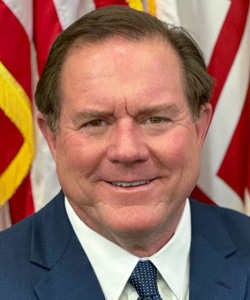
Del. Tom Hutchinson
Sponsored bills
Maddy summaryHB 699 defines "honorable discharge" for Maryland veterans' state benefits to include discharges that were less than honorable due to specific, protected factors. It directly affects veterans who received such discharges solely because of their sexual orientation or gender identity, or based on disclosures related to those factors (including statements/acts prohibited at the time), or because of PTSD/TBI diagnoses or sexual trauma disclosures made at VA facilities. The bill requires veterans to submit documentation supporting their discharge basis to access state benefits. It amends Maryland law to take effect October 1, 2025.
Maddy summaryHB 455 requires Maryland's Department of Veterans and Military Families to place American braille tactile flags in one or more state veterans' cemeteries. These flags, designed by the Kansas Braille Transcription Institute, allow blind and visually impaired visitors to experience the American flag through touch. The bill directly affects blind veterans and visually impaired individuals who visit Maryland's five state veterans' cemeteries. It amends state law to mandate the department designate specific locations for these tactile flags as a memorial feature.
Maddy summaryHB 509 establishes a Maryland Inventory of Cemeteries and Burial Sites Workgroup to study how to create a state-wide cemetery inventory system. The workgroup, composed of state officials, historical organizations, cemetery representatives, and local community members, will standardize definitions, review current county and nonprofit cemetery documentation practices, and study systems in other states. It will recommend a single data system design, identify the best managing entity, estimate costs, and propose funding sources for a state inventory system to begin in fiscal year 2027. The workgroup must report its findings to the Governor and General Assembly by December 1, 2025, and the bill expires June 30, 2026, without requiring immediate action. This bill directly affects county governments, historical preservation groups, and cemetery operators through its study of their existing practices.
Maddy summaryHB 938 requires continuing care providers (like senior living facilities) with a governing body to appoint an alternate member if only one resident representative serves on that body. The alternate can attend all meetings and vote only when the regular representative is unavailable. The bill also mandates that providers consult with resident associations before appointing an alternate and ensures residents can access nonconfidential meeting details within a month of approval. This applies to all continuing care providers in Maryland operating under the current governance structure.
Maddy summaryHB 535 establishes the Abandoned and Neglected Cemeteries Fund to provide care, preservation, and restoration for cemeteries in Maryland that are abandoned (where the operating organization no longer exists and ownership is unclear) or neglected (with maintenance citations, deterioration, or vandalism). The bill creates a voluntary income tax checkoff option on state tax forms, allowing individuals to contribute directly to the fund, which will also receive state budget appropriations and interest earnings. The Maryland Department of Labor will administer the fund, with money used exclusively for cemetery maintenance and restoration - supplementing, not replacing, existing cemetery oversight funding. The fund is nonlapsing, meaning it carries over year to year, and must be reported to the legislature annually.
Maddy summaryHB 448, the Modernization of Military Laws Act, updates Maryland laws to better support veterans, active service members, and military families. It standardizes key definitions like "veteran" and "uniformed services" across all state laws, requires the Secretary of Veterans and Military Families to create transition support policies, and eases voting access by allowing military members to file candidacy certificates remotely with an affidavit. The bill also updates housing and employment discrimination protections for veterans and clarifies election rules for service members. These changes directly affect military personnel, veterans, and their families across Maryland’s state government and election systems.
Maddy summaryHB 1069 prohibits Maryland insurers from including clauses that grant them sole discretion to interpret policy terms in health insurance, life insurance, and annuity contracts. It applies to all insurers, nonprofit health plans, and health maintenance organizations (HMOs) selling policies in Maryland. The law amends state insurance regulations to ban such clauses, requiring interpretations to align with Maryland law rather than insurer preferences. The prohibition applies to policies issued, delivered, or renewed on or after January 1, 2026.
Maddy summaryHB 32 establishes a Forensic Review Board within the Maryland Department of Health to review eligibility for release for people found not criminally responsible (NCR) at state facilities. The bill requires each facility to create a board of licensed healthcare providers that must annually assess NCR individuals and recommend to courts whether they should be discharged or released conditionally. It also creates a Community Forensic Aftercare Program to monitor people on conditional release. These changes replace current procedures under Maryland’s Criminal Procedure and Health laws, adding specific annual review requirements and written record-keeping for release decisions. The bill directly affects NCR patients in state facilities and their release pathways.
Maddy summaryHB 446 creates a new commercial fishing license specifically for harvesting blue and flathead catfish using trotlines in the Chesapeake Bay. It directly affects licensed commercial fishers by allowing them to fish in the main stem of the Chesapeake Bay south of the Chesapeake Bay Bridge, a location previously restricted by Department regulations. The bill prohibits the Department of Natural Resources from banning this activity within that area while requiring license holders to pay a $15 annual fee for a one-year license. This establishes a permanent regulatory framework for targeted commercial fishing of these species, rather than implementing a temporary pilot program.