

Maddy summaryHB 734, the Real Time for Violent Crime Act, prohibits incarcerated individuals convicted of first- or second-degree murder from earning sentence reduction credits (diminution credits) that shorten their prison time. It also limits sentence reductions for violent crimes to no more than 10% of the total sentence for those convicted of crimes of violence (as defined in Maryland law), and restricts judges from granting pretrial release to defendants charged with violent crimes if they have pending charges or recent convictions for specific violent offenses. The bill directly affects people serving sentences for murder or violent crimes in Maryland correctional facilities and changes how courts handle sentence reductions and pretrial releases for these cases.
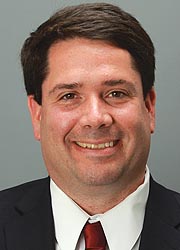
Del. Chris Adams
Sponsored bills
Maddy summaryHB 732 increases the required classroom teaching time for Maryland public school teachers on career ladder levels one, two, or three from 60% to 80% of their working time. This change directly affects teachers who are certified but not yet at the highest career levels (such as those pursuing a master’s degree or National Board Certification). The bill specifies that the remaining 20% of their time must be spent on activities like improving instruction, tutoring students, or participating in professional development. The policy takes effect July 1, 2025.
Maddy summaryHB 156, the "Fairness in Girls’ Sports Act," requires Maryland public and nonpublic high schools competing against public schools to designate interscholastic and intramural junior varsity and varsity sports teams based solely on biological sex. It prohibits schools from allowing students assigned male at birth to participate on teams designated for students assigned female at birth. The bill also prevents government agencies or athletic organizations from penalizing schools for maintaining separate teams for females, and allows students or schools harmed by violations to file civil lawsuits seeking damages, attorney fees, or injunctions. This law directly affects high school athletic programs and takes effect July 1, 2025.
Maddy summaryHB 652 prohibits Maryland's Department of Juvenile Services from hiring or retaining employees convicted of specific serious crimes, directly affecting individuals seeking or holding jobs in juvenile services. The bill bans hiring for 14 offenses including abduction, kidnapping, murder, rape, child abuse, sexual offenses against minors, and certain violent assaults. An exception allows hiring if the conviction was reversed or vacated. The law takes effect October 1, 2025.
Maddy summaryThis bill, known as the Ratepayer Protection Act of 2025, prevents Maryland state and local governments from suing businesses for financial or economic damages caused by global warming or climate change. It achieves this by adding a new legal provision that explicitly bars government agencies from filing such lawsuits, while clarifying that the law does not stop governments from enforcing existing environmental, health, or zoning regulations. The legislation defines "business" broadly to include various entities and financial institutions, and it takes effect on October 1, 2025.
Maddy summaryHB 1149 requires Maryland's Public Service Commission to analyze the full costs and benefits of different electricity generation sources for ratepayers. The study must compare costs under three scenarios: current natural gas/nuclear capacity, 8,500 MW offshore wind with storage, and alternatives using only natural gas, nuclear, or offshore wind with storage. It specifically examines reliability costs from wind intermittency and uses a standardized cost model to identify the lowest-cost options. The Commission must submit findings and policy recommendations to legislative committees by December 1, 2026. This analysis directly affects Maryland utility customers by evaluating how different energy mixes impact their electricity bills.
Maddy summaryHB 1414 amends Maryland's building energy standards to exclude certain public safety, emergency, and public utility buildings from the definition of "covered building." This means police stations, fire departments, emergency shelters, and utility facilities (like power substations) will no longer be subject to the state's energy performance requirements. The bill modifies existing law by adding specific exclusions to the "covered building" definition, removing these facilities from the annual emissions reporting and reduction targets that apply to other large commercial buildings. The policy change takes effect October 1, 2025, without altering the energy standards for other covered buildings.
Maddy summaryHB 773, the "Right to Teach Act of 2025," allows public middle and high school teachers in Maryland to remove students from their classroom under specific conditions: if a student repeatedly disrupts learning (with prior documentation) or exhibits severely disruptive, abusive, or unruly behavior that significantly interferes with teaching or other students' learning. Teachers must document the behavior, submit it to the principal, and send the student to the principal or guidance counselor. The bill prohibits county school boards from disciplining teachers for following these removal procedures and requires principals to use restorative methods for students referred to counselors. This law directly affects teachers, students, and school administrators by changing classroom discipline protocols and protecting educators from retaliation. It takes effect July 1, 2025.
Maddy summaryHB 1249 creates a new commercial license for harvesting blue and flathead catfish in Chesapeake Bay tidal waters. It allows license holders to use finfish trotlines up to 2,400 feet long, removes limits on hook numbers, and permits non-corrosive hooks - while requiring the Department of Natural Resources to establish a pilot program using electrofishing. The license costs $15 annually and is valid from September 1 to August 31. The bill also mandates a 2025 report to the legislature on harvesting, processing, marketing, and financing for blue catfish. This directly affects commercial fishermen targeting these species in the Chesapeake Bay.
Maddy summaryHB 1415 amends Maryland's building energy performance standards to explicitly exempt agricultural buildings from compliance requirements. The bill modifies the definition of "covered building" (currently requiring commercial buildings over 35,000 sq ft to meet emissions targets) to exclude agricultural buildings, which are defined as structures used for cultivating or producing agricultural crops, including greenhouses. This change ensures agricultural facilities - such as barns, processing centers, and greenhouses - are not subject to the state's 20% emissions reduction target by 2030 or net-zero requirement by 2040. The bill does not alter the core energy standards for other covered buildings but clarifies which structures are exempt.