

Maddy summaryHB 576 authorizes the Maryland State Archives to establish fees for record services through regulations, directly affecting the public, state agencies, and courts that access or request records. Key provisions include allowing the Archives to set fees as a percentage (capped at 2% of existing fees) or flat subscription rates for record preservation, requiring 7% of collected fees to fund an Archives Endowment Account, and setting a $3 fee for public copies of property plats. The bill also clarifies that courts may obtain land record copies for free with judicial approval while maintaining fee structures for other services like vital records and certified copies. These changes update existing fee authority in Maryland law without altering record access requirements.
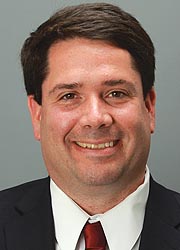
Del. Chris Adams
Sponsored bills
Maddy summaryHB 820 would require Maryland's Secretary of State Police to add a special endorsement to handgun permits for current or retired U.S. government employees who hold or held Top Secret or Sensitive Compartmented Information (SCI) security clearance. This endorsement allows permit holders to carry a handgun in any location where law enforcement officials are permitted to carry while performing their duties. The bill specifies that eligibility requires either current employment with such clearance or 10 consecutive years of clearance prior to retirement. It directs the Secretary to adopt implementing regulations and takes effect October 1, 2026.
Maddy summaryHB 455 requires Maryland's State Department of Education to certify nonprofit organizations meeting specific criteria as scholarship granting organizations (SGOs). It mandates the Department to annually submit a list of certified SGOs to the U.S. Treasury starting in 2027 and requires the Comptroller to provide online guidance for taxpayers claiming federal tax credits for donations to SGOs. The bill directly affects nonprofit SGOs seeking certification, eligible students receiving scholarships, and Maryland taxpayers claiming federal tax credits. Key provisions include standardized application processes for SGOs, annual financial reporting requirements, and public reporting of scholarship data like recipient schools and award amounts.
Maddy summaryHB 679 prohibits licensed healthcare providers in Maryland from prescribing, dispensing, or administering cross-sex hormone treatments (including estrogen, testosterone, or blockers) for the purpose of treating gender-related mental health conditions like gender dysphoria in minors. The bill directly affects minors under 18 seeking such treatment and healthcare practitioners who would provide it. Violating this law is classified as a felony, punishable by up to life imprisonment. The law takes effect October 1, 2026, and defines "cross-sex hormone therapy" as treatment to develop secondary sex characteristics for gender transition.
Maddy summaryHB 675 requires county police departments operating correctional facilities in Maryland to enter into federal immigration enforcement agreements by January 1, 2027 (with a possible one-time waiver to July 1, 2027). Non-compliant agencies must detain individuals for up to 48 hours and transfer them to federal authorities if requested, beginning July 1, 2027. If such an agency releases an individual who is later detained by federal authorities within five years, the agency must cover associated housing and court costs. The bill directly affects county law enforcement agencies with jails, establishing specific deadlines and financial penalties for non-compliance with federal immigration cooperation requirements.
Maddy summaryHB 673 prohibits local or state governments from restricting the sale, purchase, or use of consumer goods (such as vehicles, appliances, or other products) solely based on their energy source - like gasoline, electricity, natural gas, or propane. It repeals existing Maryland laws requiring low-emission vehicle programs and sales rules for zero-emission medium/heavy-duty trucks, ending those specific regulatory requirements. The law applies retroactively to all current restrictions and directly affects consumers, dealers, and manufacturers of energy-source-dependent goods. It does not alter federal emissions standards but removes state-level barriers to using diverse energy sources for everyday products.
Maddy summaryHB 690, the "Economic Competitiveness Act of 2026," lowers Maryland's corporate income tax rate gradually over several years. It directly affects corporations doing business in Maryland that pay state corporate income tax. The bill reduces the rate from 8.25% (for tax years 2026-2027) to 7.75% (2027-2028), then to 7.25% (2028-2029), 6.75% (2029-2030), and finally to 6.25% starting in 2030. The changes take effect July 1, 2026, as specified in the bill's provisions.
Maddy summaryHB 508 requires Maryland police departments to remove certain investigation records from an officer’s personnel file 3 years after a determination that the officer was not administratively charged, the complaint was deemed unfounded, or the officer was exonerated. It directly affects police officers whose misconduct complaints were cleared through administrative or trial processes. The key provision mandates this removal for records related to internal affairs investigations, disciplinary decisions, or hearing records, excluding cases where formal charges were filed. This change aims to limit the long-term impact of unsubstantiated or cleared complaints on officers’ records. The bill takes effect October 1, 2026.
Maddy summaryHB 475, the Juvenile Offender Protection Act, prohibits Maryland's Department of Juvenile Services from hiring or retaining employees convicted of specific serious crimes, including abduction, kidnapping, murder, rape, sexual offenses against minors, and certain assaults. It directly affects individuals seeking or holding jobs with the Department of Juvenile Services who have prior convictions for the listed offenses. The law adds these restrictions to Maryland's Code, with an exception allowing hiring if the conviction was reversed or vacated. The bill takes effect October 1, 2026.
Maddy summaryHB 460 limits solar energy generating station construction in Maryland's priority preservation areas (protected lands established before 2025) to 2% of the total acreage, down from a previous 5% cap. It requires counties to report when this 2% limit is reached and prohibits local zoning laws from blocking solar projects meeting specific criteria. The bill also mandates the Maryland Department of the Environment to study the environmental impact of disposing of solar panels at end-of-life and report findings by September 2027. This directly affects counties, developers, and landowners in priority preservation areas by restricting solar development space and creating new reporting requirements. The policy change aims to balance renewable energy growth with conservation of sensitive lands.