

Maddy summaryHB 1458 proposes a constitutional amendment to guarantee that tipped workers in Maryland earn at least the state minimum wage regardless of tips received. It directly affects service industry workers (like servers and bartenders) currently paid below minimum wage under "tip credit" systems. The amendment would bar the state from denying this right unless justified by a compelling interest using the least restrictive means. If approved by voters in the 2026 election, it would require employers to pay the full minimum wage without counting tips toward that amount. This changes current practice where employers can pay a lower base wage if tips make up the difference.
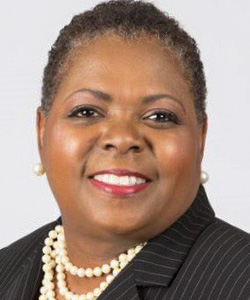
Del. Jamila Woods
Sponsored bills
Maddy summaryHB 578 requires Board of Public Works approval for Department of Transportation and Maryland Transportation Authority contracts related to roads, bridges, or highways valued at $500,000 or more. It exempts contracts below this threshold from Board review and mandates 40 days' written notice to local governments before land acquisition for transportation projects. The bill also specifies that the Board retains authority over procurement for itself and must ensure consistent procedures across agencies. This change standardizes oversight for major transportation contracts while maintaining exemptions for smaller projects.
Maddy summaryHB 1522 exempts certain religious educational institutions in Maryland from needing a certificate of approval from the Maryland Higher Education Commission to operate. It applies to schools established for religious purposes that offer only sectarian instruction aligned with a specific faith, provide programs solely for religious vocations, and state the religious nature of their awards. However, institutions established before January 1, 2013, and those accredited by a U.S. Department of Education-recognized body remain subject to the approval requirement. The bill amends Maryland’s Education Article (§11-202.1(b)) and takes effect July 1, 2025.
Maddy summaryHB 697 requires Maryland health insurance carriers to submit quarterly reports to the Maryland Insurance Commissioner about their use of artificial intelligence (AI) and automated decision-making systems. Specifically, carriers must report details on AI system deployment (including training data sources, purpose, and bias testing), as well as expanded demographic data on grievances and adverse decisions (broken down by zip code, race, ethnicity, gender, and age). The bill also updates existing reporting rules to include the monetary value of grievance decisions and timeframes for handling cases. These reports will enable the Commissioner to compile annual oversight summaries and identify potential disparities in insurance practices.
Maddy summaryHB 1000 updates Maryland's criminal law to strengthen protections for human and pet remains in cemeteries. It expands the definition of "permanent cemetery" to include family- and religious organization-owned sites (previously limited to corporations, nonprofits, or state-owned cemeteries) and prohibits tampering with human remains in cemeteries, as well as damaging, trafficking, or transporting human or pet remains without authorization. Violations carry felony penalties: up to 15 years in prison and $30,000 fines for repeat offenses, with civil lawsuits allowed for family members to seek damages. The bill specifically prohibits handling pet remains in cemeteries, except under a defined exception, and increases penalties for offenses against cemetery structures or funerary objects.
Maddy summaryThis Maryland bill (HB 1165) allows a parent to request an emergency court hearing if the other parent violates a court-ordered visitation schedule without valid reason. If approved, the court must hold a hearing within 10 days and can order the noncompliant parent to pay for missed visitation time, attend parenting classes, cover legal costs, or schedule additional time that aligns with the child’s best interests. It directly affects parents in custody disputes and courts enforcing visitation agreements under Maryland’s Family Law. The law takes effect October 1, 2025, and focuses on enforcing existing schedules rather than changing custody arrangements.
Maddy summaryHB 847 establishes a public Domestic Violence Offender Registry in Maryland, requiring individuals convicted three or more times of a domestic violence-related crime (including crimes against current or former intimate partners) to register with their local sheriff upon release, probation, or when not imprisoned. Registrants must provide personal details like their address, photo, and crime descriptions, updating this information annually or within 10 days of moving. The registry, maintained by the state, will be publicly accessible online, by phone, and in person, with registration lasting 15 years from the latest conviction or release, plus 20 additional years for each new conviction. Individuals may seek court exemption if convictions are reversed, pardoned, or under specific court orders.
Maddy summaryHB 1362 (Eminent Domain - Just Compensation - Fees and Costs) changes Maryland law to require that landowners facing government condemnation (eminent domain) proceedings receive reimbursement for their legal fees and costs, in addition to the fair market value of their property. This directly affects property owners whose land is taken by government entities for projects like roads or public facilities. The key mechanism amends Section 12-104 of the Maryland Annotated Code to explicitly include "any legal, expert, or other fees or costs of the action incurred by the defendant" as part of awarded damages. The bill takes effect October 1, 2025.
Maddy summaryHB 607 establishes the PAREA Grant Program to provide financial assistance to minorities residing in historically redlined neighborhoods and underrepresented communities for training to become real estate appraisers. The program aims to close appraisal gaps in these areas, diversify the appraisal profession, and support individuals pursuing real estate appraisal careers. Administered by the Maryland Higher Education Commission, the grants directly target residents in communities historically excluded from the appraisal field. This policy creates a concrete pathway for career development in a specific profession while addressing documented disparities in real estate services.
Maddy summaryHB 941 requires the Governor to include at least $5 million annually in the state budget for the University of Maryland Eastern Shore (UMES) starting in fiscal year 2027, continuing until a total of $321,181,312 is appropriated. This addresses a historical funding disparity identified by the state legislature, where UMES (as Maryland’s 1890 land-grant institution) received less per-student state funding than UM College Park (the 1862 land-grant institution) from 1987-2020. Funds must be supplemental to existing appropriations and can be used for infrastructure, faculty, scholarships, or other institutional needs identified by UMES. The bill aims to fully remedy the $321 million shortfall over time through mandatory annual appropriations.