

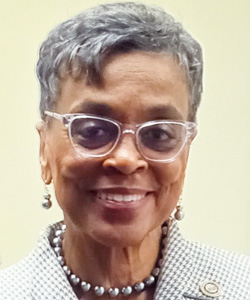
Photo of Cheryl Pasteur
D Maryland House · District 11A On the 2026 ballot

Rep. Cheryl Pasteur

Compare
Total votes
4,293
all sessions
Attendance
97%
127 missed
Near the chamber average
With party
99%
of cast votes
Near the chamber average
Bipartisan score
0%
crosses aisle rarely
Near the chamber average
Sponsored
284
bills & resolutions
Higher than 77% of chamber peers
Committees
1
assignment
284 bills and resolutions

Sponsored bills

Total
284
Primary
284
Co-sponsor
0
This page
284
matching current filters
Primary HB 197
Signed into law · Maryland House · Lead sponsor
Public Schools - Restorative Practices Schools - Comprehensive Plan

Maddy summaryHB 197 requires Maryland’s State Department of Education to develop a comprehensive plan by July 1, 2026, for establishing Restorative Practices Schools. This plan must be created after consulting with schools already using restorative approaches, which focus on repairing harm through relationship-building rather than punitive discipline. County school boards would need to adopt this plan if they choose to implement restorative practices in their schools. The bill also prohibits corporal punishment in public schools and mandates annual, disaggregated data reports on discipline practices by race, disability, socioeconomic status, and other factors.

Signed into law May 6, 2025 0 co-sponsors
Primary HB 600
Signed into law · Maryland House · Lead sponsor
Educational Equality for Service Members Act

Maddy summaryHB 600, the "Educational Equality for Service Members Act," updates Maryland's education laws to ensure eligibility for educator certification applies equally to all uniformed services (including National Guard, reserves, and other service branches), not just the traditional armed forces. It revises definitions throughout education statutes to replace "military" with "uniformed services" and clarifies that "veteran" includes those discharged within one year for certification purposes. The bill maintains the existing requirement for active service members, eligible veterans, and their spouses to hold a valid out-of-state license and meet basic qualifications to qualify for expedited certification. This change directly affects service members and veterans seeking teaching careers in Maryland by aligning certification pathways with current service definitions.

Signed into law May 6, 2025 0 co-sponsors
Primary HB 691
Signed into law · Maryland House · Lead sponsor
Tax Relief and State Personnel Equality for Service Members Act

Maddy summaryHB 691, the Tax Relief and State Personnel Equality for Service Members Act, redefines "uniformed services" to include the Public Health Service and National Oceanic and Atmospheric Administration (NOAA), extending veteran benefits to their members who meet federal veteran criteria. The bill amends Maryland's tax, pension, and personnel laws to apply the same rules to all uniformed services - not just the armed forces - ensuring equal access to state benefits like tax relief and retirement programs. It specifically updates definitions in the Maryland Code to include these service members in state programs previously limited to military veterans. This directly affects service members in non-military uniformed services and state agencies administering veteran benefits.

Signed into law May 6, 2025 0 co-sponsors
Primary HB 853
Signed into law · Maryland House · Lead sponsor
Postconviction Review - Procedure to Reduce Duration of Sentence (Maryland Second Look Act)

Maddy summaryHB 853 (Maryland Second Look Act) allows individuals serving prison sentences of 20+ years to petition courts for sentence reduction under specific conditions. To qualify, petitioners must have served at least 20 years and wait 5 years after any prior petition, with a maximum of three petitions total. Courts must hold hearings considering factors like rehabilitation, victim input, the individual’s age at the offense, and safety risks, and must publicly state their reasons for granting or denying relief. The law applies retroactively to eligible individuals already serving long sentences.

Signed into law Apr 22, 2025 0 co-sponsors
Primary HB 293
Signed into law · Maryland House · Lead sponsor
Criminal Procedure - Child Victims - Testimony in Child Abuse Cases

Maddy summaryHB 293 allows courts in Maryland to order child victims of abuse to testify via closed-circuit TV outside the courtroom when their presence with the defendant would cause serious emotional distress that prevents them from communicating. This applies to cases under Maryland’s Family Law or Criminal Law regarding child abuse, but only if the defendant has legal representation. The bill specifies that defendants cannot be in the same room as the child during testimony, and limits who may be present (attorneys, therapists, or others supporting the child). It also prohibits two-way video that would let the child see or hear the defendant during testimony. The law takes effect October 1, 2025.

Signed into law Apr 22, 2025 0 co-sponsors
Primary HB 1424
Signed into law · Maryland House · Lead sponsor
Support and Protections for Individuals Affected by Federal Actions (Protect Our Federal Workers Act)

Maddy summaryHB 1424, the "Protect Our Federal Workers Act," expands state financial assistance to Maryland residents affected by federal government disruptions beyond just shutdowns. It renames the "Federal Government Shutdown Employee Assistance Loan Fund" to the "Federal Government Employee Assistance Loan Fund" and broadens eligibility to include current federal employees not paid during shutdowns *and* Maryland residents recently terminated due to federal office closures, relocations, or mass layoffs. The bill allows funds from the state’s Catastrophic Event Account to cover costs for these individuals, administered by the Maryland Department of Labor. This changes existing law to provide loans for both ongoing shutdowns and post-layoff financial hardship from federal facility changes.

Signed into law Apr 22, 2025 0 co-sponsors
Primary HB 601
Signed into law · Maryland House · Lead sponsor
Economic Development - Small Business Guaranty Fund - Alterations

Maddy summaryHB 601 amends Maryland's Small Business Guaranty Fund program (Section 5-540 of the Economic Development Article) to expand how loan guarantees can be supported. It now allows guarantees to be backed by the State’s full faith and credit *or* by alternative financial instruments like irrevocable letters of credit, treasurer’s checks, escrow accounts, or other instruments promising reimbursement for lender losses. The bill also adds a requirement that the Authority must determine a loan will have "substantial economic impact" before approving a guarantee, considering factors like job creation and loan terms. This directly affects small businesses seeking loans (applicants) and financial institutions providing those loans by making guarantee options more flexible and adding a new review step. The changes take effect October 1, 2025.

Signed into law Apr 8, 2025 0 co-sponsors
Primary HB 579
Passed · Maryland House · Lead sponsor
Criminal Procedure - U Nonimmigrant Status Petitions and Immigration Enforcement at Sensitive Locations

Maddy summaryHB 579 modifies Maryland's certification process for U Nonimmigrant Status visas (U visas), which help victims of certain crimes access legal immigration status. The bill expands who can certify victim helpfulness to include agencies like child protective services, adult protective services, and the Commission on Civil Rights (not just police). It requires certifying officials to provide specific details about the crime and victim's cooperation when completing Form I-918, Supplement B. This directly affects crime victims seeking U visas and the state agencies that issue these certifications. The bill aligns Maryland's process with federal U visa guidelines to streamline eligibility verification.

Passed Apr 7, 2025 0 co-sponsors
Primary HB 147
Passed · Maryland House · Lead sponsor
County Boards of Education - Student Technology Use Policy - Requirements

Maddy summaryHB 147 requires Maryland county school boards to create policies banning elementary and middle school students from using cell phones or personal devices (like tablets or laptops) during school hours, unless specific exceptions apply. The policy must allow device use for students with documented special education needs (IEP/504 plans), health monitoring, or when teachers direct it for educational purposes. It does not apply to counties already having such policies in place. The law takes effect July 1, 2025, directly affecting all public elementary and middle schools in Maryland not covered by existing rules.

Passed Apr 7, 2025 0 co-sponsors
Primary HB 1057
In committee · Maryland House · Lead sponsor
Department of Human Services - Study on Private Treatment Foster Care Homes

Maddy summaryHB 1057 requires Maryland's Department of Human Services to reallocate a portion of its annual budget starting in fiscal year 2026 to provide child care stipends to private treatment foster care homes. These homes, which care for children with special physical, emotional, or behavioral needs, will receive funding similar to public treatment foster care homes to cover child care expenses. The bill mandates that the Secretary of Human Services include this funding request in annual budget proposals and adopt procedures ensuring private homes meet the same equity standards and anti-discrimination requirements (prohibiting discrimination based on race, gender, disability, etc.) as public homes. The policy change takes effect July 1, 2025, aiming to create funding parity for private providers.

In committee Apr 5, 2025 0 co-sponsors
Showing 121 to 130 of 284 bills
Previous 1 12 13 14 29 Next