

Scientific Integrity Act This bill revises provisions regarding the release of scientific research results by federal agencies. Each agency that funds, conducts, or oversees scientific research must (1) adopt and enforce a scientific integrity policy that includes requirements such as that scientific conclusions are not based on political considerations, and (2) submit such policy to the Office of Science and Technology Policy (OSTP) for approval. Each agency must make such policy available to the public and submit such policy to Congress. Agencies and the OSTP must periodically review the policies. The Government Accountability Office shall review implementation of the policies. Each agency shall (1) appoint a Scientific Integrity Officer, (2) establish a process for dispute resolution consistent with the scientific integrity policy, and (3) establish a specified training program for current and new employees.
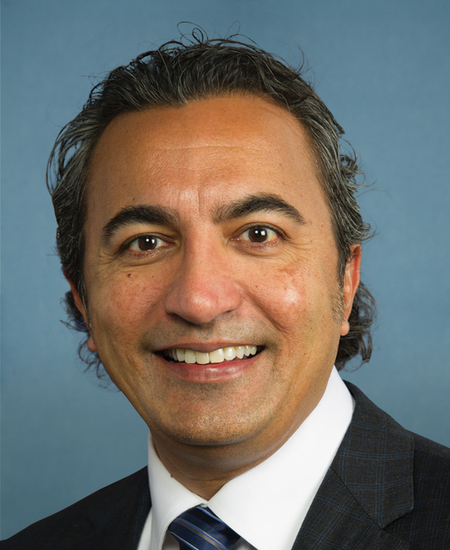
Rep. Ami Bera
Sponsored bills
FEMA Empowering Essential Deliveries Act or the FEED Act This bill authorizes the Federal Emergency Management Agency (FEMA) to approve state, local, and Indian tribal government plans to partner with small and mid-size restaurants and nonprofit organizations to provide nutritious meals to individuals in need. Specifically, during the period following the President's emergency declaration of March 13, 2020, and under any subsequent major disaster declaration that supersedes it, FEMA may approve plans from state, local, and Indian tribal governments that (1) establish contracts with small and mid-sized restaurants and nonprofits, including faith-based organizations and soup kitchens, to prepare healthy meals for people in need; and (2) provide for partnerships with nonprofit organizations to purchase directly from food producers and farmers. FEMA shall waive federal matching requirements under the Robert T. Stafford Disaster Relief and Emergency Assistance Act during such period.
USPS Fairness Act This bill repeals the requirement that the U.S. Postal Service annually prepay future retirement health benefits.
Global Health, Empowerment and Rights Act This bill establishes that a foreign nongovernmental organization shall not be disqualified from receiving certain U.S. international development assistance solely because the organization provides medical services using non-U.S. government funds if the medical services are legal in both the United States and the country in which they are being provided. Such foreign organizations shall not be subject to requirements relating to their use of non-U.S. funds for advocacy or lobbying activities, other than those that apply to U.S. nongovernmental organizations. Current U.S. policy prohibits various foreign assistance from going to a foreign nongovernmental organization unless it agrees to not perform or actively promote abortions.
Securing Access to Lower Taxes by ensuring Deductibility Act or the SALT Deductibility Act This bill repeals the temporary restrictions in taxable years 2018 through 2025 on the deductibility of state and local taxes.
Special Districts Provide Essential Services Act This bill makes special districts eligible for the Coronavirus Relief Fund and the Municipal Liquidity Facility program. Specifically, the bill makes special districts eligible for payments from amounts paid to states from any new appropriations to the fund. A special district must submit a request for payment to the state with information demonstrating that the special district has experienced or is likely to experience during the COVID-19 (i.e., coronavirus disease 2019) emergency reduced revenue or operational funding derived from provided services, taxes, fees, or other sources of revenue; reduced indirect funding from the federal government, the state, or a unit of general government below the state level; or as a result of the COVID-19 emergency, increased expenditures necessary to continue operations. The Board of Governors of the Federal Reserve System shall include special districts as eligible issuers in the Municipal Liquidity Facility program, which was created in response to the COVID-19 emergency to buy municipal securities.
Officer Brian D. Sicknick Congressional Gold Medal Act This bill requires the Speaker of the House of Representatives and the President pro tempore of the Senate to arrange for the presentation of a Congressional Gold Medal commemorating Officer Brian D. Sicknick for giving his life to protect the Capitol and Members and staff of Congress on January 6, 2021. Following its award, the medal shall be given to Officer Sicknick's parents, Charles and Gladys Sicknick.
Raise the Wage Act of 2021 This bill increases the federal minimum wage for regular employees over a 5-year period, for tipped employees, and for newly hired employees who are less than 20 years old. The bill sets forth a schedule of annual increases in the federal minimum wage for individuals with disabilities. The Department of Labor shall no longer issue special certificates for the payment of subminimum wages to such individuals after the final wage increase under this bill for such individuals takes effect. Labor shall provide, upon request, technical assistance and information to employers to (1) help them transition their practices to comply with wage increases and other requirements under this bill for individuals with disabilities, and (2) ensure continuing employment opportunities for such individuals. The bill eliminates the separate minimum wage requirements for tipped, newly hired, and disabled employees. After a specified period, these employees shall be paid the same minimum wage as regular employees. Labor must publish any increase in the minimum wage in the Federal Register and on its website 60 days before it takes effect.
This bill allows a medical expense tax deduction for face masks and hand sanitizers during the period of the COVID-19 (i.e., coronavirus disease 2019) public health emergency beginning on the enactment of this bill and ending when the COVID-19 emergency period has terminated.
This resolution expresses support for the goals and ideals of Korean American Day and honors the 118th anniversary of the arrival of the first Korean immigrants to the United States.