

American Music Fairness Act of 2025 This bill establishes that the copyright holder of a sound recording shall have the exclusive right to perform the sound recording through an audio transmission. (Currently, the public performance right only covers performances through a digital audio transmission in certain instances, which means that nonsubscription terrestrial radio stations generally do not have to get a license to publicly perform a copyright-protected sound recording.) Under the bill, a nonsubscription broadcast transmission must have a license to publicly perform such sound recordings. The Copyright Royalty Board must periodically determine the royalty rates for such a license. When determining the rates, the board must base its decision on certain information presented by the parties, including the radio stations' effect on other streams of revenue related to the sound recordings. Terrestrial broadcast stations (and the owners of such stations) that fall below certain revenue thresholds may pay certain flat fees, instead of the board-established rate, for a license to publicly perform copyright-protected sound recordings.
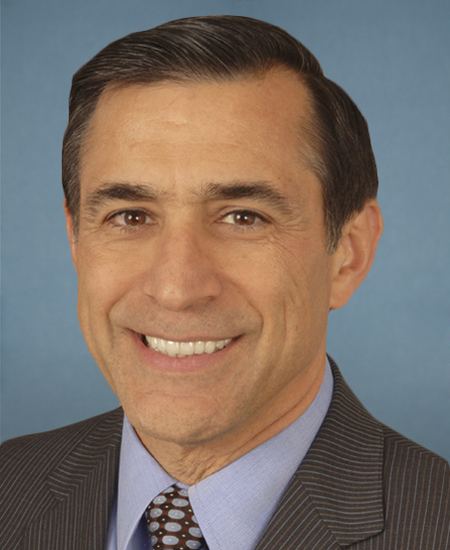
Rep. Darrell Issa
Sponsored bills
Maddy summaryThe No Track No Tax Act of 2025 prohibits federal funds from being used to study, propose, establish, implement, or enforce any mileage tax program, including those requiring vehicle mileage tracking. It directly affects state and local governments seeking to adopt mileage-based taxes, as they cannot use federal money for related activities like developing tracking systems. The bill blocks federal financial support for mileage tax initiatives but does not ban the taxes themselves. This restriction applies to all federal funding streams, preventing even indirect support for such programs.
Maddy summaryHR 780, the Alexandra’s Law Act of 2025, amends the Controlled Substances Act to require courts to advise defendants convicted of drug-related offenses involving synthetic opioids (like fentanyl analogues) that caused death about the lethal risks of illicit drugs. It creates new evidence rules: prior convictions for similar drug offenses involving death can be used to prove a defendant knew the substance contained fentanyl analogues, and court advisements from state cases may be admitted in federal courts. The law directly affects individuals convicted of drug sales or distribution linked to overdose deaths involving these substances. It excludes minors from these evidentiary provisions, focusing on holding accountable those who knowingly distribute dangerous synthetic drugs.
Maddy summaryThis bill requires states to submit annual lists of individuals convicted of sexually violent offenses and deemed "sexually dangerous" under existing law to the Attorney General. The Attorney General must then review these lists to determine if federal prosecution is warranted. It also blocks Medicaid and Medicare funding for these individuals (unless receiving involuntary treatment in a hospital or nursing facility), directly affecting their access to healthcare coverage. The law targets a specific subset of offenders already classified under current federal standards, with no broader changes to sentencing or general sex offender registration.
Maddy summaryHR 731, the Green Tape Elimination Act of 2025, exempts certain forest fire prevention activities on federal land from major environmental review and legal requirements for 10 years. It specifically removes the need for compliance with the Endangered Species Act, National Historic Preservation Act, Migratory Bird Treaty Act, and related laws when conducting "hazardous fuel reduction activities," such as prescribed burns, creating firebreaks, or mechanically removing dead vegetation. The bill also adds a provision to the Clean Air Act allowing the EPA to exclude air quality monitoring data directly caused by these activities from violation determinations. This directly affects federal land management agencies (like the Forest Service) conducting fire prevention work on public lands.
Life at Conception Act This bill declares that the right to life guaranteed by the Constitution is vested in each human being at all stages of life, including the moment of fertilization, cloning, or other moment at which an individual comes into being. Nothing in this bill shall be construed to authorize the prosecution of any woman for the death of her unborn child.
Maddy summaryHR 21, the Born-Alive Abortion Survivors Protection Act, requires medical staff at abortion facilities to provide the same immediate care and hospital admission to any infant born alive during an abortion as they would for any newborn. It mandates reporting failures to provide this care to law enforcement and imposes penalties of up to 5 years in prison for violations, with harsher penalties for intentional killing. The bill also allows women who undergo abortions to sue for civil damages, including triple the abortion cost, and provides for attorney fees. It defines "abortion" to exclude procedures performed after viability to preserve a live birth. This law directly affects healthcare providers at abortion facilities and creates new federal legal obligations for them.
Maddy summaryHRES 63 is a symbolic resolution designating the week of January 26-February 1, 2025, as "National School Choice Week." It expresses the House's support for raising public awareness about educational options - including public schools, charter schools, private schools, online academies, and homeschooling - and encourages parents to explore these choices. The resolution also urges the public to host events during this week to celebrate parental choice in education. As a non-binding resolution, it does not create new policies or alter existing laws.
Maddy summaryHJRES 28 proposes a constitutional amendment to permanently fix the number of justices on the U.S. Supreme Court at nine. This would require ratification by 38 state legislatures (three-fourths of states) within seven years to become part of the Constitution. The amendment directly affects the structure of the Supreme Court, which has had nine justices since 1869 but could otherwise be altered by future congressional action. It does not change current court operations or create new laws, but instead seeks to make the nine-justice composition a permanent constitutional requirement.
Maddy summaryThis bill amends the legal definition of "firearm silencer" and "firearm muffler" under federal law. It clarifies that these terms include any device designed to reduce firearm noise, as well as the outer tube or primary housing component that serves as the main structure for noise-reduction parts. The definition specifically covers devices intended to attach to a firearm (directly or via mounts) and excludes other firearms. This change affects how silencers are legally categorized under federal regulations, not who can own them. It does not create new restrictions but refines the scope of existing definitions.