This bill repeals the joint resolution of March 9, 1957, that provided for the use of certain funds to promote peace and stability in the Middle East.
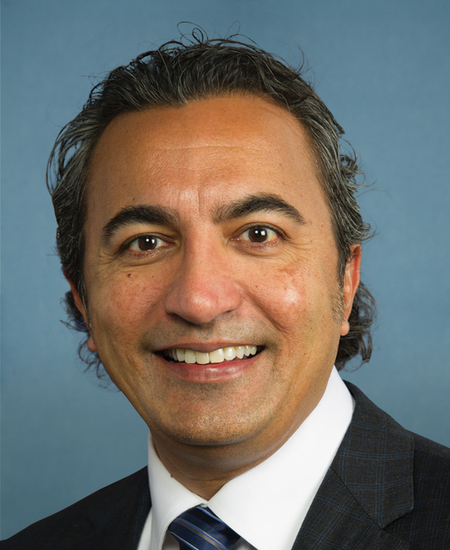
Rep. Ami Bera
Sponsored bills
This bill repeals the January 14, 1991, resolution authorizing the use of military force against Iraq.
National Science Foundation for the Future Act This bill reauthorizes the National Science Foundation (NSF) through FY2026 and authorizes programs and activities at the NSF. The bill establishes requirements for the NSF, including to enter into a contract with the National Academies of Science, Engineering, and Medicine to assess the status and opportunities for Pre-K through 12 science, technology, engineering, and mathematics, including computer science, (STEM) education research; award grants to establish no fewer than three multidisciplinary Centers for Transformative Education Research and Translation to support research and development of STEM education innovations; provide grants for research on programming that engages students in grades Pre-K through 8, including underrepresented and rural students, in STEM in order to prepare such students to pursue degrees or careers in STEM; award grants to support research and development activities to encourage greater collaboration and coordination between institutions of higher education and industry to enhance education, foster hands-on learning experiences, and improve alignment with workforce needs; award grants to establish a network of centers for science and technical education; award grants to advance research on the nature of learning and teaching at community colleges; award grants to establish traineeship programs for graduate students who pursue artificial intelligence-related research leading to a masters or doctorate degree; award grants to carry out research on the cyber workforce; establish a cybersecurity workforce data initiative; carry out a national initiative to facilitate the development of networks and partnerships to broaden participation in STEM studies and careers of groups historically underrepresented in such studies and careers; maintain a Research Security and Policy office to coordinate all research security policy issues across the NSF; award grants to support research to improve our understanding of the climate system and related human and environmental systems; support research to significantly advance our understanding of the food-energy-water system; award grants to advance knowledge of risk assessment and predictability to improve our ability to predict extreme events and natural hazards, including pandemics; and award grants to support basic research that will accelerate innovation to advance critical minerals mining strategies and technologies. The bill also establishes within the NSF a Directorate for Science and Engineering Solutions to advance research and development solutions to address societal and national challenges.

Global Health Security Act of 2021 This bill directs the United States to implement a strategy to strengthen global health security, including by requiring the President to create the Global Health Security Agenda Interagency Review Council to implement the Global Health Security Agenda. The agenda is an initiative launched by nearly 30 nations to address global infectious disease threats. The council's responsibilities include (1) providing policy recommendations on agenda-related goals, objectives, implementation, and other international efforts to strengthen pandemic preparedness and response; (2) helping federal agencies with implementation; and (3) reviewing the progress and challenges in achieving U.S. commitments, including assistance to help other countries meet agenda targets. The bill also directs the federal agencies involved with the agenda to prioritize its implementation and to take certain steps to achieve that goal. The President shall coordinate a strategy for responding to global health security emergencies and submit a report on the implementation of this strategy. Additionally, the Department of State should seek to enter into negotiations with donors, relevant United Nations agencies, and other multilateral stakeholders to establish a Fund for Global Health Security and Pandemic Preparedness that (1) closes gaps in global health security and pandemic preparedness; and (2) builds capacity in eligible partner countries related to global health security, infectious disease control, and pandemic preparedness. The fund should provide grants, technical assistance, and innovative funding mechanisms to achieve its purposes.
Safe Schools Improvement Act of 2021 This bill requires states to direct their local educational agencies (LEAs) to establish policies that prevent and prohibit bullying and harassment of elementary and secondary school students. In particular, these policies must prohibit bullying and harassment based on race, color, national origin, sex, sexual orientation, gender identity, disability, or religion. Further, LEAs must provide (1) students, parents, and educational professionals with annual notice of the conduct prohibited in their disciplinary policies; (2) students and parents with grievance procedures that target such conduct; and (3) the public with annual data on the incidence and frequency of that conduct at the school and LEA level. The Department of Education must conduct and report on an independent biennial evaluation of programs and policies to combat bullying and harassment in elementary and secondary schools. The National Center for Education Statistics must collect state data to determine the incidence and frequency of the conduct prohibited by LEA disciplinary policies.
This resolution urges the President to facilitate private medical supply donations and to deliver urgently needed medical supplies, including oxygen generator plants, to India and countries neighboring India that are facing the spread of COVID-19.
Allergy Testing Access Act of 2021 This bill requires equal coverage of two types of allergy tests under Medicaid and Medicare. Specifically, in vitro specific IgE tests (blood tests) and percutaneous tests (skin tests) must be treated equally with respect to (1) medical necessity or other coverage requirements, (2) frequency limits, and (3) allergen unit limits.
Therapeutic Fraud Prevention Act of 20 21 This bill prohibits commercial conversion therapy, which is a practice or treatment designed to change a person's sexual orientation or gender identity or otherwise change behaviors, thoughts, or expressions related to gender or sexual attraction. This prohibition does not apply to treatment that assists an individual undergoing a gender transition or facilitates identity exploration and development.
Vanessa Guillén Military Justice Improvement and Increasing Prevention Act This bill modifies the process and policy related to the disposition of charges and convening of courts-martial for certain sexual assault cases and other specified offenses under the Uniform Code of Military Justice (UCMJ). Among other elements, the bill provides that the determinations on the preferral, disposition, and referral of charges for specified offenses under the UCMJ must be made by a commissioned officer of the Armed Forces who is designated as a court-martial convening authority (in grade O-6 or higher) and who is available for detail as trial counsel, has significant trial experience, and is outside the chain of command of the member subject to the charges.