Drinking Water and Wastewater Infrastructure Act of 2021 This bill reauthorizes through FY2026 or establishes a variety of programs for water infrastructure. Specifically, it supports programs to provide safe drinking water or treat wastewater, such as sewer overflows or stormwater. For example, the bill reauthorizes and revises the clean water state revolving fund (SRF) and the drinking water SRF.
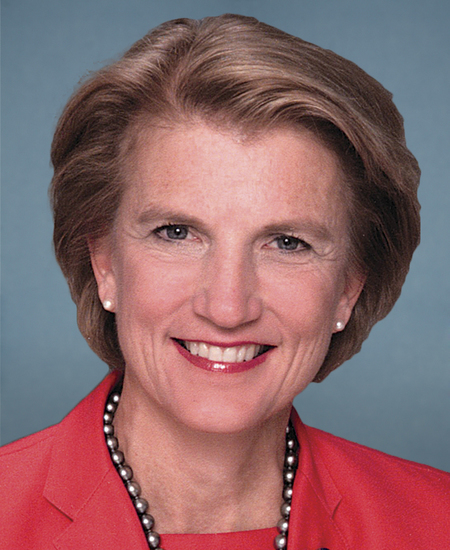
Sen. Shelley Moore Capito
Sponsored bills
This concurrent resolution declares that Congress should not impose any new performance fee, tax, royalty, or other charge relating to the public performance of sound recordings on a local radio station for broadcasting sound recordings over the air, or on any business for such public performance of sound recordings.
This resolution thanks the teachers of the United States and promotes the teaching profession by encouraging students, parents, school administrators, and public officials to recognize National Teacher Appreciation Week.
Military Justice Improvement and Increasing Prevention Act of 2021 This bill modifies the process and policy related to the disposition of charges and convening of courts-martial for certain sexual assault cases and other specified offenses under the Uniform Code of Military Justice (UCMJ). Among other elements, the bill provides that the determinations on the preferral, disposition, and referral of charges for specified offenses under the UCMJ must be made by a commissioned officer of the Armed Forces who is designated as a court-martial convening authority (in grade O-6 or higher) and who is available for detail as trial counsel, has significant trial experience, and is outside the chain of command of the member subject to the charges.
Creating Opportunities Now for Necessary and Effective Care Technologies (CONNECT) for Health Act of 2021 or the CONNECT for Health Act of 2021 This bill expands coverage of telehealth services under Medicare. Among other provisions, the bill allows the Centers for Medicare & Medicaid Services (CMS) to waive certain restrictions, such as restrictions on the types of technology that may be used; permanently removes geographic restrictions on originating sites (i.e., the location of the beneficiary) and allows the home of the beneficiary to serve as the originating site for all services; permanently allows federally qualified health centers and rural health clinics to serve as the distant site (i.e., the location of the health care practitioner); and allows the CMS to generally waive coverage restrictions during any public health emergency. Additionally, the CMS must report on the effects of expanded telehealth services during the COVID-19 public health emergency, including with respect to the utilization, quality, and outcomes of services. The Center for Medicare and Medicaid Innovation may also test alternative payment models relating to expanded telehealth services.
Reach Every Mother and Child Act of 2021 This bill authorizes the President to provide assistance to implement a comprehensive five-year strategy to contribute toward the global goal of ending preventable child and maternal deaths by 2030.
Gabriella Miller Kids First Research Act 2.0 This bill modifies funding for a pediatric disease research initiative within the National Institutes of Health (NIH). Currently, this initiative receives funding through FY2023 from the 10-Year Pediatric Research Initiative Fund. This bill directs certain penalties assessed by the Securities and Exchange Commission against pharmaceutical companies for specified violations to that fund. In making allocations from the fund, the NIH must prioritize pediatric research that does not duplicate existing research activities.
Access to Genetic Counselor Services Act of 2021 This bill provides for coverage under Medicare of genetic counseling services that are furnished by genetic counselors. Covered services include those services, as well as incidental services and supplies, that would otherwise be covered under Medicare if provided by a physician.
Constitutional Concealed Carry Reciprocity Act of 2021 This bill allows a qualified individual to carry a concealed handgun into or possess a concealed handgun in another state that allows its residents to carry concealed firearms. A qualified individual must (1) be eligible to possess, transport, or receive a firearm under federal law; (2) carry a valid photo identification document; and (3) carry a valid state-issued concealed carry permit, or be eligible to carry a concealed firearm in his or her state of residence.
Understanding the True Cost of College Act of 2021 This bill requires standardized financial aid terminology and offer forms. Specifically, the Department of Education (ED) must develop standard terminology and a format for financial aid offer forms based on recommendations from representatives of certain groups, including students, veterans, and institutions of higher education (IHEs). The consumer-friendly form must include specified details and disclosures, including the estimated cost of attendance, the net price that a student or family is estimated to pay, and the terms and conditions of financial aid. In addition, ED must (1) test the form with representatives of students, students' families, IHEs, secondary school and postsecondary counselors, and nonprofit consumer groups; and (2) use the results to develop the final form. Each IHE that participates in federal student-aid programs must (1) use the standard form when offering financial aid to students, and (2) use the standard terminology and definitions developed by ED for all communications related to financial aid offers.