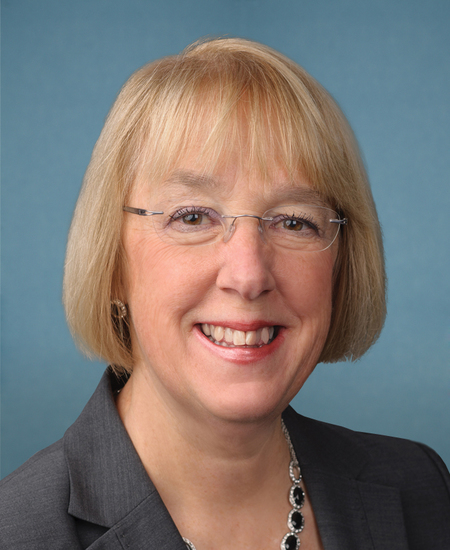
Photo of Patty Murray
D United States Senate · Washington

Sen. Patty Murray

Compare
Total votes
1,054
all sessions
Attendance
97%
34 missed
Lower than 95% of chamber peers
With party
99%
of cast votes
Higher than 84% of chamber peers
Bipartisan score
1%
crosses aisle rarely
Lower than 86% of chamber peers
Sponsored
1,138
bills & resolutions
Near the chamber average
Committees
18
assignments
1,138 bills and resolutions

Sponsored bills

Total
1,138
Primary
149
Co-sponsor
989
This page
1,138
matching current filters
Primary S 2460
In committee · Indiana Senate · Lead sponsor
Improving Training for School Food Service Workers Act of 2023

Maddy summaryThis bill requires schools to provide free, in-person training for food service workers during paid working hours, with hands-on learning components. If training must occur outside regular hours, schools must consult staff on scheduling, pay them at their regular rate (including overtime), and cannot penalize them for attendance. It directly affects school food service workers and their employers under the Child Nutrition Act. The law does not override existing labor protections but mandates specific scheduling and compensation rules for training programs.

In committee Jul 25, 2023 0 co-sponsors
Co-sponsor S 2488
In committee · Indiana Senate · Co-sponsor
Raise the Wage Act of 2023

Maddy summaryThe Raise the Wage Act of 2023 would gradually increase the federal minimum wage to $17.00 per hour by 2028, with specific annual steps: $9.50 in year one, $11.00 in year two, $12.50 in year three, $14.00 in year four, $15.50 in year five, and $17.00 starting in year six. It also phases out separate minimum wage rates for tipped workers (raising their base wage to match the standard minimum wage by year six) and for workers under 20 (phasing out their lower rate by year five). The bill requires annual minimum wage adjustments after year six based on increases in the median hourly wage of all employees, as tracked by the Bureau of Labor Statistics. Additionally, it eliminates special minimum wage certificates for workers with disabilities by 2028, requiring all such workers to receive the standard minimum wage.

In committee Jul 25, 2023 1 co-sponsor
Co-sponsor S 1
In committee · Indiana Senate · Co-sponsor
Freedom to Vote Act

Maddy summary# Summary of Proposed Election Reform Legislation This comprehensive legislative document outlines a wide-ranging election reform bill with multiple titles addressing various aspects of voting rights, election administration, and election integrity. Key provisions include: 1. **Democracy Restoration** (Title I): - Restores voting rights for citizens with criminal convictions (except those serving felony sentences in correctional institutions) - Requires states to notify individuals of restored voting rights upon completion of sentence or release from custody - Includes enforcement mechanisms for states to comply with the restoration provisions 2. **Voter Identification Requirements** (Title II): - Establishes a standardized system for voter identification requirements - Specifies acceptable forms of identification (including many government-issued documents) - Requires states to provide free identification documents to eligible voters - Includes funding ($5 million annually for 5 years) to cover costs 3. **Voter List Maintenance** (Title III): - Prohibits "voter caging" (using undeliverable mail to challenge voter eligibility) - Requires states to verify voter ineligibility using objective and reliable evidence - Limits removal of voters from registration lists to specific circumstances (death, permanent move) - Mandates notice requirements for voters removed from lists 4. **Election Integrity** (Title IV): - Prohibits interference with voter registration (Section 612) - Restricts removal of local election administrators to cases of inefficiency, neglect, or malfeasance - Prohibits harassment and intimidation of election workers - Bans deceptive practices in elections (false information about voting procedures, qualifications, or endorsements) The legislation aims to expand voting access while maintaining election integrity, with specific focus on eliminating barriers for people with criminal convictions, ensuring fair voter list maintenance, and protecting election workers from harassment and intimidation. It also includes provisions for enforcement through civil actions, criminal penalties, and reporting requirements.


In committee Jul 25, 2023 1 co-sponsor
Co-sponsor S 2427
In committee · Indiana Senate · Co-sponsor
A bill to amend title XXVII of the Public Health Service Act to require group health plans and health insurance issuers offering group or individual health insurance coverage to permit enrollees to obtain a 365-day supply of contraceptives.

Maddy summaryS 2427 requires group health plans and health insurance issuers (both group and individual plans) to cover a full year's supply (up to 365 days) of contraceptives that are already mandated to be covered under existing law. This means enrollees can obtain a one-time refill for a full year's supply without any additional cost-sharing (like copays or deductibles). The rule applies to all plans with coverage effective January 1, 2024, and requires federal agencies to inform providers and enrollees about the new requirement within 90 days of the law's enactment. The bill directly affects people with health insurance who use prescribed contraceptives, ensuring easier access without extra out-of-pocket costs for a full year's supply.

In committee Jul 20, 2023 1 co-sponsor
Co-sponsor S 2439
In committee · Indiana Senate · Co-sponsor
Reproductive Health Patient Navigator Act of 2023

Maddy summaryThe Reproductive Health Patient Navigator Act of 2023 would create a federal grant program to fund community organizations - including abortion funds and nonprofits - that help individuals access abortion services. Eligible groups would use these grants to provide practical support like connecting people to providers, coordinating travel and childcare costs, and offering accurate, culturally appropriate reproductive health information. The bill also includes legal protections preventing states from restricting these navigation services, even in states with abortion bans, and allows organizations to sue states that block such support. This directly affects people seeking abortion care and the community groups that assist them, focusing on reducing barriers to access.

In committee Jul 20, 2023 1 co-sponsor
Co-sponsor S 2372
In committee · Indiana Senate · Co-sponsor
Accelerating Kids’ Access to Care Act

Maddy summaryS 2372, the Accelerating Kids’ Access to Care Act, streamlines enrollment for out-of-state healthcare providers who treat Medicaid-eligible children under 21 with medically complex conditions. It requires states to adopt a process allowing these providers to join state Medicaid/CHIP programs without extra state-level screening, provided they already meet federal Medicare or home-state program requirements and pose low fraud risk. The bill establishes a 5-year enrollment period for eligible providers, directly affecting children needing specialized care across state lines and the providers serving them. Key provisions remove barriers to interstate care coordination while maintaining federal oversight standards.

In committee Jul 19, 2023 1 co-sponsor
Co-sponsor S 2344
In committee · Indiana Senate · Co-sponsor
Freedom to Vote Act

Maddy summary# Summary of Comprehensive Election Reform Bill This document is a comprehensive voting rights and election reform bill containing multiple titles with various provisions designed to: 1. **Restore voting rights** for citizens with criminal convictions (Democracy Restoration Act) - Restores voting rights for citizens not serving felony sentences in correctional institutions - Requires states to notify individuals of restored voting rights upon release or probation - Establishes enforcement mechanisms through civil actions 2. **Strengthen voter identification requirements** - Establishes a broad list of acceptable identification documents - Requires states to provide government-issued identification at no cost - Allows for provisional ballots with sworn statements for those without ID - Includes provisions for electronic documents and copies 3. **Prohibit voter caging and improper voter list maintenance** - Bans the use of "voter caging" documents or lists as evidence for challenging voter eligibility - Establishes strict conditions for removing voters from registration lists - Requires objective and reliable evidence for removals - Mandates notification procedures for voters removed from lists 4. **Enhance election integrity protections** - Prohibits interference with voter registration (including hindering, interfering with, or preventing registration) - Restricts removal of local election administrators to cases of inefficiency, neglect, or malfeasance - Protects election workers from intimidation and harassment - Bans deceptive practices regarding election information within 60 days of an election - Establishes criminal penalties for deceptive election practices 5. **Provides enforcement mechanisms** - Establishes private rights of action for violations - Includes civil and criminal penalties for violations - Requires reports to the Department of Justice for removals of election administrators - Sets specific timeframes for notification and corrective actions The bill aims to expand voting access while maintaining election integrity, with provisions designed to protect voting rights, prevent discrimination, and ensure fair administration of elections for Federal office.

In committee Jul 18, 2023 1 co-sponsor
Co-sponsor S 1664
In committee · Indiana Senate · Co-sponsor
Healthy Families Act

Maddy summaryThe Healthy Families Act requires most employers (with 15 or more employees) to provide workers with up to 56 hours of paid sick leave annually, earned at a rate of 1 hour for every 30 hours worked. Employees can use this leave for their own illness, medical care, caring for family members with health conditions, or addressing domestic violence, sexual assault, or stalking situations. The law prohibits employers from retaliating against workers who use this leave and mandates that employers post notices about the policy. Smaller employers (with fewer than 15 employees) may provide up to 56 hours of unpaid sick leave instead of paid leave. The Act includes enforcement mechanisms allowing employees to file complaints with the Department of Labor and seek damages for violations.

In committee Jul 18, 2023 1 co-sponsor
Primary S 728
In committee · Indiana Senate · Lead sponsor
Paycheck Fairness Act

Maddy summaryThe Paycheck Fairness Act aims to reduce gender-based pay disparities by strengthening protections against wage discrimination. It modifies the "bona fide factor" defense to require employers to prove pay differences are based on job-related factors rather than sex, prohibits reliance on salary history when making hiring decisions, and requires employers with 100+ employees to collect and report pay data disaggregated by sex, race, and ethnicity. The bill enhances penalties for violations, including compensatory and punitive damages, and strengthens non-retaliation protections for employees discussing wages. These changes directly affect employers, employees, and prospective employees, with particular focus on addressing pay gaps that disproportionately impact women and women of color. The act also creates a National Award for Pay Equity in the Workplace to recognize employers making progress in eliminating pay discrimination.

In committee Jul 18, 2023 0 co-sponsors
Co-sponsor S 567
In committee · Indiana Senate · Co-sponsor
Richard L. Trumka Protecting the Right to Organize Act of 2023

Maddy summaryThe Richard L. Trumka Protecting the Right to Organize Act of 2023 strengthens workers' rights to organize and bargain collectively by amending key labor laws. It clarifies that multiple employers can be held accountable for labor practices (joint employer definition), makes it harder for employers to misclassify workers as independent contractors, and prohibits employers from permanently replacing workers who strike. The bill requires employers to provide detailed voter lists for union elections, strengthens protections against anti-union discrimination, and increases penalties for unfair labor practices (up to $100,000 for repeat violations). It directly affects workers seeking union representation, employers who must comply with new requirements, and labor organizations conducting organizing campaigns. The bill aims to make it easier for workers to form unions and negotiate better wages and working conditions.

In committee Jul 18, 2023 1 co-sponsor
Showing 561 to 570 of 1,138 bills
Previous 1 … 56 57 58 … 114 Next