Let States Cut Taxes Act This bill removes a prohibition on states and territories using COVID-19 (i.e., coronavirus disease 2019) relief funding under the American Rescue Plan Act of 2021 to offset a reduction in revenue resulting from a reduction in taxes or a delay in the imposition of a tax or tax increase.
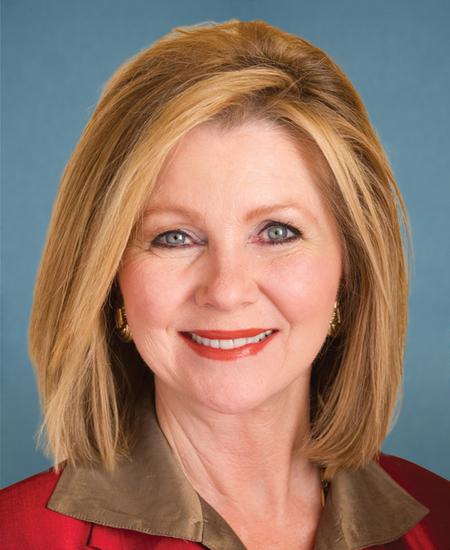
Sen. Marsha Blackburn
Sponsored bills
Sister City Transparency Act This bill requires the Government Accountability Office to study the activities of sister city partnerships involving foreign communities in countries that received a score of 45 or less on Transparency International's 2019 Corruption Perceptions Index. A sister city partnership is a formal agreement between a U.S. community and a foreign community that is recognized by Sister Cities International and that is operating within the United States. Among other elements, the required study must (1) identify oversight practices that U.S communities implement to mitigate the risks of foreign espionage and economic coercion within sister city partnerships, (2) assess the extent to which U.S. communities ensure transparency regarding sister city partnership contracts and activities, and (3) review the range of activities conducted within sister city partnerships.
Women and Lung Cancer Research and Preventive Services Act of 2021 This bill requires the Department of Health and Human Services to conduct an interagency review of the status of women and lung cancer. The review must report on the status of existing research and current knowledge gaps; identify new opportunities for collaborative research to determine the causes of lung cancer and advance prevention, screening, diagnosis, and treatment; and provide recommendations for a national cancer screening strategy and public education campaign.
Gun Owner Registration Information Protection Act This bill prohibits federal funding of, or support for, state databases that list (1) firearms lawfully owned or possessed by individuals, or (2) individuals who lawfully own or possess firearms.
Hello Girls Congressional Gold Medal Act of 2021 This bill provides for the award of a single Congressional Gold Medal in honor of the female telephone operators of the Army Signal Corps, commonly known as the Hello Girls , in recognition of their military service, devotion to duty, and 60-year struggle for veterans' benefits and recognition as soldiers.
English Language Unity Act of 2021 This bill establishes English as the official language of the United States. It establishes a framework for implementation and enforcement, including by testing English as part of the naturalization process.
Developing Responsible Individuals for a Vibrant Economy Act or the DRIVE Safe Act This bill directs the Department of Transportation to promulgate regulations to implement an apprenticeship program for licensed commercial motor vehicle drivers under the age of 21. Under the program, an apprentice must complete two probationary periods that total 400 hours of on-duty time, of which at least 240 hours must be driving time in a commercial motor vehicle. Additionally, the apprentice must be accompanied in the cab of the commercial motor vehicle by an experienced driver. Further, the bill requires all commercial motor vehicles used in the program for training to be equipped with safety technology such as active braking collision mitigation systems and video event capturing systems. An employer shall not knowingly allow, require, permit, or authorize a driver under the age of 21 to operate a commercial motor vehicle unless the driver is participating in, or has completed, an apprenticeship program that meets the requirements set forth in this bill.
Stop Higher Education Espionage and Theft Act of 2021 This bill establishes a process for designating foreign actors as foreign intelligence threats to higher education. Specifically, the Federal Bureau of Investigation (FBI) must designate a foreign actor as a foreign intelligence threat to higher education if the foreign actor has committed, attempted to commit, or conspired to commit certain actions in connection with an institution of higher education (IHE), such as espionage, misuse of visas, or theft of trade secrets. Prior to making such a designation, the FBI must submit notice to Congress and the Department of Justice. Upon the designation of a foreign actor as a threat, the Department of State must revoke the nonimmigrant visa issued to the foreign actor present in the United States, and the Department of Homeland Security must initiate removal proceedings against the foreign actor. Additionally, the bill provides for judicial review and a process for revoking a foreign actor's designation as a threat. Finally, the bill also requires an IHE to disclose to the Department of Education any gift or contract with a foreign intelligence threat, including the fair market value of the gift or contract.

Child Welfare Provider Inclusion Act of 2021 This bill generally prohibits the federal government, states, tribal nations, or localities from discriminating or taking adverse action against a child welfare provider that declines to provide services due to the provider's sincerely held religious beliefs or moral convictions. However, government entities may still take adverse action against a provider that declines to provide adoption or foster care services based on race, color, or national origin. The Department of Health and Human Services must withhold a portion of federal funding for family services and child welfare activities from a government entity that discriminates against a child welfare provider in violation of this bill. Child welfare providers may also sue the government entity for such discrimination. A prevailing provider may recover reasonable attorney's fees and costs. Furthermore, government entities that accept certain federal funding for family services and child welfare activities must waive sovereign immunity as a defense to lawsuits brought under this bill. (In many cases, sovereign immunity shields states, territories, tribal nations, and some localities against private suits.)
Strengthening and Amplifying Vaccination Efforts to Locally Immunize all Veterans and Every Spouse Act or the SAVE LIVES Act This bill authorizes the Department of Veterans Affairs (VA) to furnish a COVID-19 (i.e., coronavirus disease 2019) vaccine to covered individuals during the COVID-19 public health emergency. Under the bill, covered individuals are veterans who are not eligible to enroll in the VA health care system; specified veterans who are eligible for hospital care, medical services, and nursing home care abroad; beneficiaries who are eligible for care due to a specified disability or death of a veteran; family caregivers of veterans who are participating in the VA's Program of Comprehensive Assistance for Family Caregivers; caregivers of veterans participating in the VA's Program of General Caregiver Support Services; caregivers of veterans participating in the VA's Medical Foster Home Program, Bowel and Bladder Program, Home Based Primary Care Program, or Veteran Directed Care Program; and the spouses of veterans. The VA must prioritize the vaccination of (1) veterans who are enrolled in the VA health care system, (2) veterans who fail to enroll but receive hospital care and medical services for specified disabilities in their first 12 months of separation from service, and (3) caregivers accompanying such prioritized veterans. Under the bill, the VA is authorized to offer a vaccine to the spouse of a veteran near the same time the veteran receives the vaccine.