Fair Access to Banking Act This bill restricts certain banks, credit unions, and payment card networks from refusing to do business with a person who is in compliance with the law. Restrictions include prohibiting the use of certain lending programs, initiating the process of terminating an institution's depository insurance, and instituting specified civil penalties.
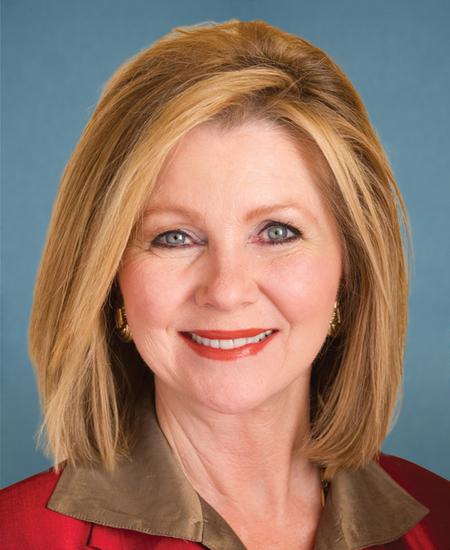
Sen. Marsha Blackburn
Sponsored bills
SFC Sean Cooley and SPC Christopher Horton Congressional Gold Star Family Fellowship Program Resolution This resolution establishes in the Senate the Congressional Gold Star Family Fellowship Program under which certain family members of a member of the Armed Forces who is a hostile casualty or died from a training-related injury may serve a 12-month fellowship in the office of a Senator.
Davis-Bacon Repeal Act This bill repeals the Davis-Bacon Act, which requires that the locally prevailing wage rate be paid to various classes of laborers and mechanics working under federally-financed or federally-assisted contracts for construction, alteration, and repair of public buildings or public works. References in any law to a requirement under the Davis-Bacon Act shall be null and void.
Haulers of Agriculture and Livestock Safety Act of 2021 or the HAULS Act of 202 1 This bill modifies exemptions with respect to commercial motor vehicle safety regulations involving the transportation of agricultural commodities and farm supplies. The bill allows the federal hours-of-service rules exemption regarding maximum driving and on-duty time for drivers transporting agricultural commodities and farm supplies to apply year-round. Current law provides an exception from the federal hours-of-service rules for the transportation of agricultural commodities within a 150 air-mile radius of the normal work reporting location only during planting and harvest periods which are determined by each state. Additionally, the Department of Transportation must revise the definition of agricultural commodity to include specific commodities that are covered by the federal hours-of-service rules exception.
Cost Openness and Spending Transparency Act of 2021 or the COST Act This bill requires recipients of federal funds to disclose financing information relating to programs, projects, or activities carried out using such funds. Specifically, such a recipient (including a state or local government or a recipient of a federal research grant) must clearly state in any press release, request for proposals, bid solicitation, or other document describing the activity the amount and percentage of federal funding and the amount and percentage of nongovernmental funding. If the Office of Management and Budget determines that a recipient is failing to comply, it may direct each agency providing federal funds to withhold up to 25% of the funds until the recipient complies.
This bill waives certain eligibility requirements for hospitals participating in the 340B drug discount program (i.e., a program that allows entities to receive covered outpatient drugs at reduced prices from manufacturers) during the COVID-19 (i.e., coronavirus disease 2019) public health emergency. Specifically, the bill waives the required minimum proportion of low-income patients served for hospitals that began participating in the program during or prior to the COVID-19 emergency.
Protecting Children From Experimentation Act of 2021 This bill establishes a new criminal offense for performing gender reassignment medical interventions on minors. It also provides that a minor who receives such an intervention may bring a civil action against each person who performed that intervention. The bill defines these interventions as certain surgeries or the use of hormones to change the body of an individual to correspond to a sex that is discordant with the individual's biological sex. It excludes, however, interventions in cases where an individual has ambiguous external biological sex characteristics or where a physician has determined that an individual does not have normal sex chromosome structure, sex steroid hormone production, or sex steroid hormone action. An individual who performs these interventions on a minor is subject to criminal penalties—a fine, a prison term of up to five years, or both. A minor who receives these medical interventions may not be arrested or prosecuted for an offense under this bill.
Help Independent Tracks Succeed Act or the HITS Act This bill permits taxpayers to treat as currently deductible expenses the cost of qualified sound recording productions not exceeding $150,000 in a taxable year. The bill defines qualified sound recording production as certain sound recordings produced and recorded in the United States.
End Taxpayer Funding of Gender Experimentation Act of 2021 This bill modifies provisions relating to federal funding for, and health insurance coverage of, gender reassignment medical interventions, which include surgical remedies and hormone therapy arising from a conflict between an individual's gender identity and the sex the individual has or was identified as having at birth. Specifically, the bill prohibits the use of federal funds for gender reassignment medical interventions or for health coverage that includes such interventions. Additionally, such interventions may not be provided in a federal health care facility or by a federal employee. Under current law, coverage of these interventions through Medicare and Medicaid is generally determined at the state level. The bill's restrictions regarding the use of federal funds do not apply to treatment of individuals with medically verifiable disorders of sex development, such as individuals born with atypical development of chromosomal, gonadal, or anatomical sex. The bill also prohibits qualified health plans from including coverage for gender reassignment medical interventions. Further, plans that include coverage for such interventions are not eligible for federal subsidies.

Protect and Serve Act of 2021 This bill establishes a new criminal offense for knowingly assaulting a law enforcement officer and causing serious bodily injury (or attempting to do so) in circumstances that affect interstate commerce. It imposes criminal penalties—a prison term, a fine, or both—on a violator.