

Maddy summaryThe Restoring Essential Healthcare Act repeals a provision that blocked Medicaid payments to certain healthcare providers. Specifically, it removes a restriction from Public Law 119-21 that prevented Medicaid from paying "prohibited entities" for services provided between the law's enactment and this bill's effective date. Payments for those services will now be made retroactively, as if the restriction had never existed. This directly affects Medicaid programs and the healthcare providers previously excluded from receiving these payments.
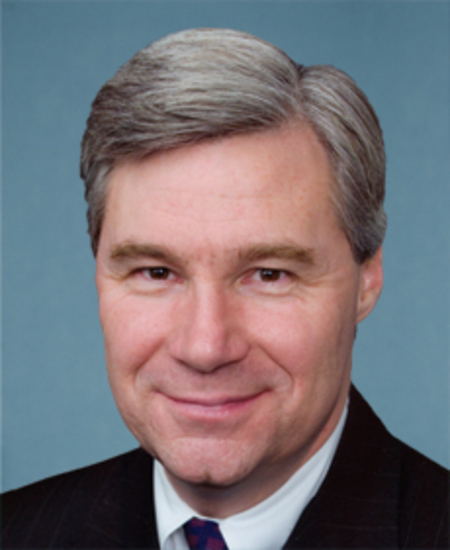
Sen. Sheldon Whitehouse
Sponsored bills
Maddy summarySRES 338 is a non-binding Senate resolution recognizing how the Americans with Disabilities Act (ADA) of 1990 enables independent living and economic self-sufficiency for people with disabilities. It highlights that over one-third of disabled individuals rely on Medicaid for health coverage and community-based care, yet many remain in segregated institutions due to Medicaid limitations and insufficient community services. The resolution calls for bipartisan action to strengthen Medicaid funding, oppose cuts or work-reporting requirements that hinder access to care, and expand home-based services to support employment and community living. It specifically urges federal agencies to improve accessibility in housing, transportation, emergency services, and competitive employment opportunities for people with disabilities, particularly those of color facing systemic barriers. This resolution does not create new law but advocates for policy changes to fulfill the ADA’s promise.
Maddy summaryThis bill expands health coverage access for military families by modifying the TRICARE Young Adult Program. It directly affects military service members' children aged 21-26 who previously faced eligibility restrictions or separate fees. Key changes include removing a prior age limit that excluded some young adults and eliminating a separate premium for this coverage. The result is simplified access to health care under TRICARE without additional costs for qualifying dependents. These updates apply to existing TRICARE benefits, not new programs.
Maddy summaryThis bill expands Medicare Part B coverage to include specific pharmacist services, directly affecting Medicare beneficiaries and pharmacists who provide these services. It defines "pharmacist services" as evaluations and treatments for illnesses like COVID-19, flu, RSV, or strep throat, or services addressing public health emergencies, requiring collaboration with physicians as state law permits. Medicare would pay 80% of the lower of the actual charge or 85% of the physician payment rate (100% for public health emergencies), and prohibits balance billing for these services. The changes take effect January 1, 2026.
Maddy summaryThe Stop the Scammers Act establishes a whistleblower reward program for individuals reporting violations of federal consumer financial law (e.g., scams, fraud). Whistleblowers who provide original information leading to successful enforcement actions by the Consumer Financial Protection Bureau (CFPB) may receive 10-30% of recovered civil penalties (minimum $50,000 if penalties are under $1 million). The bill mandates strong confidentiality protections for whistleblowers, prohibits employers from waiving these rights via contracts, and requires the CFPB to report annually on the program. It directly affects whistleblowers in consumer finance cases and the CFPB’s enforcement process, not the general public.
Maddy summaryThis bill creates a refundable tax credit of up to $15,000 (10% of purchase price) for first-time homebuyers in the U.S. To qualify, buyers must be at least 18 years old, have no recent home ownership, and purchase with a federally-backed mortgage. The credit is reduced for higher-income households relative to local median income and home prices. Homeowners who sell within 4 years must repay the credit, though exceptions exist for military service or job changes. The credit can also be transferred to the mortgage lender at the time of purchase.
Maddy summaryThe Art Market Integrity Act (S 2400) requires art dealers, auction houses, galleries, and other intermediaries who handle art transactions exceeding $10,000 in a single sale or $50,000 annually to report these transactions to the Treasury Department. It defines "work of art" to include original paintings, sculptures, and similar pieces while excluding mass-produced items or functional design. The bill mandates Treasury to update guidance on art transactions involving sanctioned entities within 360 days and issue new rules within 180 days to clarify reporting requirements and exemptions. This directly affects businesses in the art market that meet the transaction thresholds, aiming to improve transparency in high-value art sales.
Maddy summaryThis bill (SJRES 67) is a congressional resolution seeking to block an Environmental Protection Agency (EPA) rule. It specifically targets the EPA's "National Emission Standards for Hazardous Air Pollutants" rule for integrated iron and steel manufacturing facilities, which was published on July 3, 2025 (90 Fed. Reg. 29485). The resolution asks Congress to formally disapprove the rule under Chapter 8 of Title 5, U.S. Code, which would prevent the rule from taking effect. If passed, this would stop the EPA from enforcing the specific emissions standards on steel manufacturing facilities covered by this interim final rule.
Maddy summaryThis joint resolution (SJRES 66) seeks to block an Environmental Protection Agency (EPA) rule that established new emission standards for hazardous air pollutants from specific coke oven operations at steel plants. It directly affects the EPA, which would no longer enforce the rule, and steel manufacturers operating coke ovens (used in steel production) who would avoid compliance with the proposed standards. The resolution uses a congressional disapproval process under federal law to nullify the EPA’s rule, which was published in the Federal Register on July 8, 2025. If passed, the rule would have no legal effect, halting its implementation.
Maddy summaryThis bill (SJRES 64) seeks congressional disapproval of an Environmental Protection Agency (EPA) rule that approved West Virginia's air quality plan for reducing regional haze during the second implementation period. The resolution would block the EPA rule (published in the Federal Register on July 7, 2025) from taking effect, directly affecting West Virginia's compliance with federal air quality standards for haze reduction. Under Chapter 8 of Title 5, U.S. Code, this disapproval process allows Congress to halt federal agency rules without changing the underlying law. The bill does not alter air quality requirements but stops this specific EPA action from being implemented.