

Maddy summarySCONRES 2 is a symbolic congressional resolution commending Iranian protesters who risked their safety to demonstrate against the Iranian regime's human rights abuses, particularly following the death of Mahsa Amini after her arrest by morality police for alleged hijab violations. It specifically highlights protests in over 133 cities where demonstrators, including women removing headscarves, have faced violent crackdowns, with reports of over 500 deaths and 19,000 arrests. The resolution condemns the regime's brutality, supports internet freedom tools to bypass censorship, and urges the administration to impose human rights sanctions on officials responsible for repression. As a non-binding resolution, it expresses congressional support for protesters but does not enact new laws or policies.
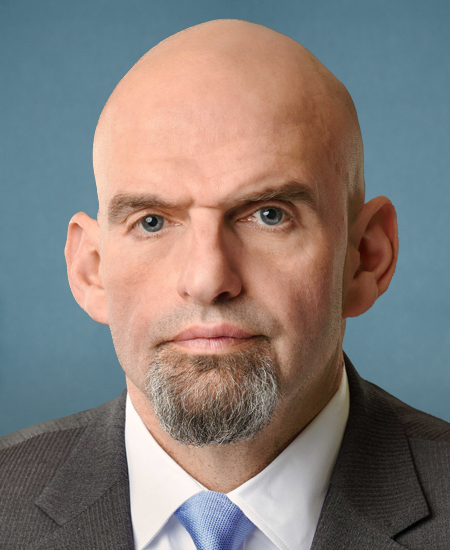
Sen. John Fetterman
Sponsored bills
Maddy summaryThe Raise the Wage Act of 2023 would gradually increase the federal minimum wage to $17.00 per hour by 2028, with specific annual steps: $9.50 in year one, $11.00 in year two, $12.50 in year three, $14.00 in year four, $15.50 in year five, and $17.00 starting in year six. It also phases out separate minimum wage rates for tipped workers (raising their base wage to match the standard minimum wage by year six) and for workers under 20 (phasing out their lower rate by year five). The bill requires annual minimum wage adjustments after year six based on increases in the median hourly wage of all employees, as tracked by the Bureau of Labor Statistics. Additionally, it eliminates special minimum wage certificates for workers with disabilities by 2028, requiring all such workers to receive the standard minimum wage.
Maddy summaryS 2494, the Communications, Video, and Technology Accessibility Act of 2023, requires closed captioning and audio description for all video programming delivered via internet protocol (streaming services), with implementation deadlines up to 6 years depending on programming type (live, near-live, or prerecorded). The bill mandates that video playback devices include accessible controls for captioning and audio description, and establishes advisory committees to develop technical standards for these requirements. It directly affects streaming platforms, content providers, and device manufacturers, aiming to improve accessibility for people with hearing, visual, and speech disabilities.
Maddy summaryThe Wall Street Tax Act of 2023 would impose a 0.1% tax on most trades of stocks, bonds, and derivatives occurring on U.S. exchanges or involving U.S. individuals or companies. This applies to transactions like buying or selling securities on U.S. platforms, but excludes initial stock sales, short-term debt (under 100 days), and specific exceptions such as real estate contracts requiring physical delivery or business-related commodity trades. The tax would be paid by the exchange for U.S. platform trades, U.S. brokers for other trades, or the U.S. party in direct transactions. It would take effect for transactions after December 31, 2023.
Maddy summary# Summary of Proposed Election Reform Legislation This comprehensive legislative document outlines a wide-ranging election reform bill with multiple titles addressing various aspects of voting rights, election administration, and election integrity. Key provisions include: 1. **Democracy Restoration** (Title I): - Restores voting rights for citizens with criminal convictions (except those serving felony sentences in correctional institutions) - Requires states to notify individuals of restored voting rights upon completion of sentence or release from custody - Includes enforcement mechanisms for states to comply with the restoration provisions 2. **Voter Identification Requirements** (Title II): - Establishes a standardized system for voter identification requirements - Specifies acceptable forms of identification (including many government-issued documents) - Requires states to provide free identification documents to eligible voters - Includes funding ($5 million annually for 5 years) to cover costs 3. **Voter List Maintenance** (Title III): - Prohibits "voter caging" (using undeliverable mail to challenge voter eligibility) - Requires states to verify voter ineligibility using objective and reliable evidence - Limits removal of voters from registration lists to specific circumstances (death, permanent move) - Mandates notice requirements for voters removed from lists 4. **Election Integrity** (Title IV): - Prohibits interference with voter registration (Section 612) - Restricts removal of local election administrators to cases of inefficiency, neglect, or malfeasance - Prohibits harassment and intimidation of election workers - Bans deceptive practices in elections (false information about voting procedures, qualifications, or endorsements) The legislation aims to expand voting access while maintaining election integrity, with specific focus on eliminating barriers for people with criminal convictions, ensuring fair voter list maintenance, and protecting election workers from harassment and intimidation. It also includes provisions for enforcement through civil actions, criminal penalties, and reporting requirements.
Maddy summaryS 2427 requires group health plans and health insurance issuers (both group and individual plans) to cover a full year's supply (up to 365 days) of contraceptives that are already mandated to be covered under existing law. This means enrollees can obtain a one-time refill for a full year's supply without any additional cost-sharing (like copays or deductibles). The rule applies to all plans with coverage effective January 1, 2024, and requires federal agencies to inform providers and enrollees about the new requirement within 90 days of the law's enactment. The bill directly affects people with health insurance who use prescribed contraceptives, ensuring easier access without extra out-of-pocket costs for a full year's supply.
Maddy summaryThe Relief for Survivors of Miners Act of 2023 simplifies benefits for survivors of miners who died from black lung disease (pneumoconiosis). It creates a rebuttable presumption that a miner's death was caused by the disease if they worked 10+ years in coal mines or were totally disabled by the disease at the time of death - this presumption can only be overturned by proving the disease didn’t contribute to the death. The bill also establishes a new program to cover up to $4,500 in attorneys’ fees and $3,000 in medical expenses for contested claims unresolved within a year, with coal operators later reimbursing the fund. Additionally, it requires a Government Accountability Office review of current benefit payments and interim payment practices to assess their financial and emotional impact on survivors.
Maddy summaryThe Food for Thought Act of 2023 creates a federal grant program to provide free on-campus meals to low-income college students. Eligible colleges and university consortia can apply for 5-year grants to offer 1-10 free meals weekly per qualifying student, prioritizing those with the greatest financial need or experiencing food insecurity. The bill requires institutions to identify eligible students, remove barriers to meal plan access, and report on student outcomes (like retention rates) disaggregated by factors like race and Pell Grant status. It also mandates that meals meet nutritional guidelines and accommodate dietary needs, while allowing limited funding for SNAP enrollment support and campus food pantries.
Maddy summaryS 2435, the Improving Access to Nutrition Act of 2023, eliminates work requirements for participants in the Supplemental Nutrition Assistance Program (SNAP). This change directly affects approximately 6.1 million individuals currently subject to SNAP work requirements, particularly vulnerable populations including families with children and people with health barriers that prevent meeting such requirements. The bill amends Section 6 of the Food and Nutrition Act of 2008 to remove these requirements and includes necessary conforming changes to related laws. By eliminating these requirements, the bill aims to increase SNAP participation and access to food assistance without adding administrative barriers. The law would take effect 180 days after enactment.
Maddy summaryThe Exploitative Workplace Surveillance and Technologies Task Force Act of 2023 establishes a White House Task Force to study workplace surveillance practices and their impact on workers. The Task Force will examine how employers collect and use workplace data, including the effects on worker compensation, safety, health, and vulnerable populations such as workers with disabilities, low-wage workers, and workers of color. The Task Force will produce three reports over time, including an initial report within one year of enactment and a final report with recommendations for addressing workplace surveillance. This bill affects employers who employ 11 or more workers (called "covered employers") and federal agencies participating in the Task Force, though it does not directly regulate workplace surveillance.