

Maddy summaryThe FABRIC Act (S 2817) would prohibit piece-rate pay in the garment industry, requiring employers to pay workers hourly wages at or above minimum wage. It would hold brand guarantors (companies contracting for garment manufacturing) jointly liable for wage violations with their contractors. The bill would require garment manufacturers and contractors to register with the Department of Labor, providing detailed information about ownership, employees, and compliance history. It would establish a new Office of the Garment Industry and create a grant program to support domestic garment manufacturing through workforce development and equipment investments.
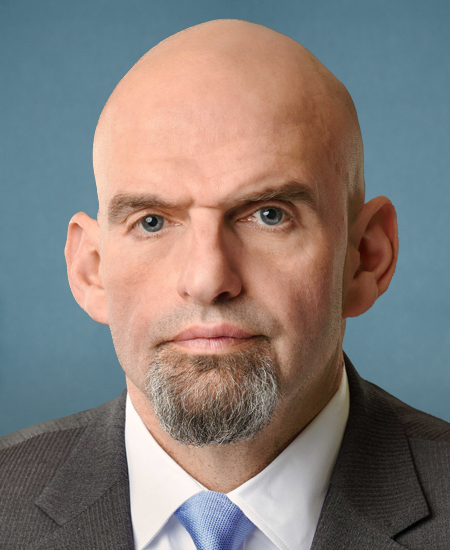
Sen. John Fetterman
Sponsored bills
Maddy summaryThe Strengthening Local Meat Economies Act of 2023 requires the U.S. Department of Agriculture to increase procurement of meat and poultry from small, locally-focused processors. It defines "eligible processors" as those with fewer than 150 employees or processing less than 1 million pounds per month, not owned by larger entities or foreign companies. The bill mandates increasing procurement from these processors to $50 million or 50% in the first year after enactment, then $100 million or 75% in the next year, and at least 20% of total procurement thereafter. It requires using a new digital livestock exchange platform for these contracts and prioritizes processors owned by beginning farmers, socially disadvantaged farmers, or veteran farmers, as well as those with local sourcing or specific labeling. The bill also includes provisions to prevent market manipulation and requires the Secretary to report on procurement practices and barriers to participation.
Maddy summaryS 2776, the Disarm Hate Act, prohibits firearm sales, possession, shipment, or transport for individuals convicted of a misdemeanor hate crime or receiving an enhanced sentence for such a crime. It directly affects people convicted under state, federal, or tribal law of a misdemeanor involving bias motivation (based on race, religion, gender, sexual orientation, gender identity, or disability) and physical threat or force. The bill amends federal gun laws (18 U.S.C. §§922(d) and 922(g)) to add this restriction, while excluding cases where convictions were expunged, pardoned, or where legal rights were waived improperly. This is a concrete policy change affecting firearm access for a specific category of offenders, not a broader hate crime prevention measure.
Maddy summaryThis bill provides $16 billion in federal funding over five years (2024-2028) to stabilize the child care sector. It directly affects child care providers by offering grants to offset operating costs, support higher wages for early childhood educators without increasing fees for families, and expand access to high-quality care. Key provisions include funding for providers in underserved areas (like rural communities, infant/toddler care, and inclusive services for children with disabilities) and a requirement that 99% of funds go directly to providers. The funds are administered through the existing framework of the American Rescue Plan Act's child care program.
Maddy summaryThe School MEALS Act of 2023 aims to increase access to free school meals by improving how schools automatically enroll eligible students. It creates $28 million in federal grants for states and tribal organizations to boost "direct certification" rates - where schools enroll children in free meals based on existing government benefit data - prioritizing areas with the lowest current rates. The bill expands eligibility criteria (increasing the timeframe for implementation from 10 to 20 years) and funds technology upgrades, technical assistance, and coordination with other benefit programs. This directly affects schools, state education agencies, tribal organizations, and children in households receiving public benefits like SNAP or TANF.
Maddy summaryThe Wage Theft Prevention and Wage Recovery Act requires employers to provide detailed paystubs showing wage calculations, timely final payments within 14 days of termination, and strengthens workers' ability to recover stolen wages. It increases civil penalties for wage theft violations from $10,000 to $22,030 per employee affected for initial violations, and extends the statute of limitations for wage theft claims from 2-3 years to 4-5 years. The bill creates a $50 million grant program to fund community partnerships that prevent wage theft and assist workers in recovering unpaid wages. These provisions target widespread wage theft that disproportionately affects low-wage workers, women, immigrants, and racial and ethnic minorities.
Maddy summaryThis bill renames a United States Postal Service facility at 101 South 8th Street in Lebanon, Pennsylvania, as the "Lieutenant William D. Lebo Post Office Building." It directly affects the postal facility and all official government references to it. The key provision updates all federal documents, maps, and records to use the new name instead of the previous designation. The bill has no policy changes beyond this naming action.
Maddy summaryThis bill (S 2757) freezes current payment rates for veterans' transportation services provided through "special modes" (like non-emergency medical transport) starting January 1, 2023, preventing the VA from lowering these rates without strict conditions. It directly affects veterans relying on these transportation services and the contractors providing them. The key provision allows rate increases but requires the VA to conduct a detailed economic impact review, consult with veterans' groups and industry experts, and ensure new rates cover actual costs before any decrease can occur. This aims to protect veterans' access to care by preventing rate cuts that could disrupt transportation services.
Maddy summaryS 2756 establishes a new "Coordinating and Expanding Organic Research Initiative" within the USDA to better coordinate organic agriculture research across four key agencies (Agricultural Research Service, National Institute of Food and Agriculture, Economic Research Service, and National Agricultural Statistics Service). The initiative must conduct a comprehensive survey of all USDA organic research every five years, develop strategic plans, and make specific recommendations focused on improving soil health, climate resilience, pest management, and economic analysis for organic producers. The bill authorizes $5 million annually for research on transitioning to organic production and $10 million annually for economic impact studies of organic farming. This law directly affects USDA research planning and reporting, aiming to streamline efforts that benefit organic farmers, researchers, and the broader organic food industry.
Maddy summaryThis bill amends a provision in the Elementary and Secondary Education Act to explicitly allow schools using federal funds to offer hunter safety education and similar activities like archery or culinary arts as part of approved educational programs. It directly affects schools and educational programs receiving funds under the Elementary and Secondary Education Act by removing a previous restriction on using those funds for such activities. The key mechanism is a new exception inserted into Section 8526(7), clarifying that these educational programs remain permissible. The bill does not change funding levels or create new programs, but specifically permits existing funds to be used for these instructional activities. This is a technical amendment to clarify funding eligibility for certain educational offerings.