

Maddy summaryThe Preventing and Treating Substance Use Disorders Among Older Adults Act (S 4358) creates two federal grant programs to improve access to substance use disorder treatment and prevention services for older adults aged 60 and older. It authorizes $25 million annually for five years to fund early intervention, integrated care coordination, and evidence-based treatment through community organizations, tribes, and health providers, with priorities including person-centered care and data collection on service gaps. Additionally, it establishes a demonstration program to expand evidence-based treatment in areas with high substance misuse rates (including opioids) or unmet need, requiring at least 15% of funds to support rural communities and communities of color.
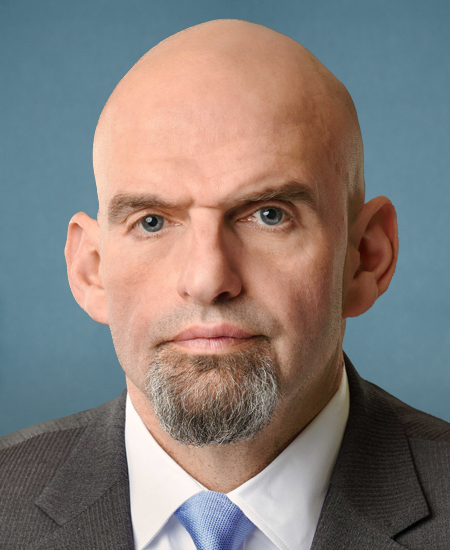
Sen. John Fetterman
Sponsored bills
Maddy summaryThis bill establishes federal minimum standards for collective bargaining rights for public employees and supervisors. It directs the Federal Labor Relations Authority (FLRA) to determine if state laws "substantially provide" for specific rights including the right to form unions, bargain collectively, and have interest impasse resolution mechanisms. If a state law doesn't meet these standards, the FLRA would administer collective bargaining for affected employees. The bill also prohibits strikes or lockouts that would disrupt emergency services and preserves existing collective bargaining agreements in place before the bill's enactment. It does not preempt state laws that already meet these minimum standards.
Maddy summarySRES 693 is a Senate resolution recognizing May as Asian American, Native Hawaiian, and Pacific Islander Heritage Month, celebrating the historical contributions of these communities to U.S. history. The resolution does not create new laws or funding but serves as a symbolic acknowledgment of their achievements, growth (including demographic data and key anniversaries like the 50th anniversary of *Lau v. Nichols*), and ongoing challenges like anti-Asian hate crimes. It directly honors these communities and aims to raise awareness of their diverse impacts on American society.
Maddy summaryThe Rights for the TSA Workforce Act of 2024 requires the Transportation Security Administration to transition its workforce from its current personnel management system to the standard federal employee system under Title 5 of the U.S. Code by December 31, 2024, while protecting employees from pay or benefit reductions during the transition. The bill preserves existing leave, retirement benefits, and collective bargaining rights for screening agents, and includes specific provisions for Federal air marshals regarding pay and benefits. It mandates consultation with labor representatives during the transition and requires several reports on workforce conditions, including recruitment efforts, workplace safety, and employee satisfaction.
Maddy summaryThis resolution (SRES 681) supports designating May 10, 2024, as "National Asian American, Native Hawaiian, and Pacific Islander Mental Health Day." It does not create new laws or funding but formally recognizes the mental health disparities faced by AANHPI communities, including lower service utilization rates and higher youth suicide rates. The resolution encourages federal, state, and local agencies to improve mental health awareness and culturally appropriate care for these communities. It is a symbolic gesture aligning with May's existing Heritage Month and Mental Health Awareness Month.
Maddy summaryS 4300 restricts U.S. call center employers from moving operations overseas or outsourcing work to foreign entities without 120 days' notice to the Labor Secretary. It creates a public list of violators, barring them from federal grants or loans for 5 years, and requires federal contracts to keep call center work in the U.S. The bill also mandates that businesses disclose their physical location at the start of customer service calls (with exceptions for U.S.-based teams or emergencies) and allows customers to request transfers to U.S.-based agents. These rules apply to businesses employing 50+ call center workers (full-time equivalent) and are enforced by the Labor Secretary and Federal Trade Commission.
Maddy summaryThis bill establishes the United States Senate Commission on Mental Health to study and make recommendations on improving mental health care access and affordability. The 8-member commission (6 senators appointed by party leaders and 2 mental health experts) will conduct annual studies on topics like insurance coverage parity, provider reimbursement rates, and workforce challenges, including barriers faced by specific populations such as rural communities and racial minorities. It requires the commission to submit annual reports to Congress starting in 2026, analyzing current barriers, workforce needs, and successful state-level efforts. The commission will terminate 10 years after enactment and is funded through fiscal years 2025-2034. As a procedural bill creating a study commission, it does not directly change laws but aims to inform future policy.
Maddy summaryThis bill increases funding for replacing insecure communication networks by raising the expenditure limit from $1.9 billion to $4.98 billion under the Secure and Trusted Communications Networks Act. It significantly reforms the Affordable Connectivity Program (ACP) by requiring all households to verify eligibility through a centralized National Verifier system, ending free device subsidies, and tightening eligibility rules (e.g., requiring school lunch program participation for household qualification). The bill allocates $6 billion for the ACP in fiscal year 2024, mandates new antifraud controls within 180 days, and requires the FCC to report on program effectiveness within one year. These changes directly affect low-income households receiving broadband subsidies and aim to reduce program fraud while expanding network security funding.
Maddy summaryThe Essential Caregivers Act of 2024 ensures nursing home residents can designate and maintain access to essential caregivers (such as family members or close friends who provide care) during emergencies when regular visitation is restricted. It requires facilities to allow at least one essential caregiver access to residents daily during such emergencies, with limited exceptions for safety concerns. Facilities must follow specific procedures if denying access, including providing written warnings and allowing appeals within 48 hours. The law applies to Medicare skilled nursing facilities, Medicaid nursing facilities, and related care facilities, creating a process for residents and caregivers to challenge access denials. This addresses issues identified during the pandemic when isolation contributed to health declines among residents.
Maddy summary# Summary of the Proposed Substance Use Disorder Treatment and Prevention Bill This document is a comprehensive legislative proposal focused on addressing substance use disorder through a public health approach rather than a criminal justice approach. The key elements include: ## Main Components (Title XXXIV of the Public Health Service Act) **Subtitle A: Local and State Grants** - Establishes a grant program for local and state entities to provide substance use disorder treatment - Requires establishment of a "planning council" for each locality - Specifies funding requirements and administrative structures **Subtitle B: State and Tribal Grants** - Creates a grant program for states and tribes to address substance use disorder - Includes requirements for planning councils and other administrative structures - Provides significant funding for these programs **Subtitle C: Other Grant Program** - Establishes a grant program for public entities, nonprofits, Indian entities, and Medicaid providers - Prioritizes organizations serving underserved populations - Includes specific requirements for applications and service delivery **Subtitle D: Innovation, Training, and Health Systems Strengthening** - Creates "Special projects of national significance" for innovative treatment models - Establishes education and training centers for health professionals - Provides funding to increase substance use disorder treatment provider capacity - Includes programs to support workers with substance use disorder ## Key Funding Authorizations The bill authorizes substantial annual funding across all subtitles: - **Subtitle A:** $4.6 billion annually (2024-2033) - **Subtitle B:** $4.6 billion annually (2024-2033) - **Subtitle C:** $1 billion annually (2024-2033) - **Subtitle D:** - Special projects: $500 million annually - Education/training: $500 million annually - Provider capacity: $50 million annually - Employee support: $40 million annually - Research: $10 million annually ## Additional Key Provisions 1. **Amendments to Controlled Substances Act:** - Requires "covered persons" (dispensers, distributors, manufacturers of schedule II controlled substances) to submit annual certifications regarding diversion controls and misbranding - Establishes civil and criminal penalties for failure to submit or submitting false certifications - Creates a "Comprehensive Addiction Resources Fund" to collect penalties and supplement substance use disorder treatment funding 2. **General Limitations on Fund Use:** - Funds can only be used for public health purposes - Prohibits use of funds for incarceration, institutionalization, or involuntary treatment of individuals with substance use disorder - Prohibits use of funds for activities inconsistent with public health purposes 3. **Federal Drug Demand Reduction Activities:** - Requires the Director of National Drug Control Policy to publish an online list of all drug control program grant programs - Mandates annual review of federally funded demand reduction activities for effectiveness and efficiency ## Overall Approach The bill represents a significant shift toward a public health model for addressing substance use disorder, emphasizing: - Treatment rather than punishment - Prevention and early intervention - Training for health professionals - Support for underserved populations - Evidence-based treatment models - Comprehensive data collection and research This legislation is designed to provide substantial, sustained funding for a comprehensive approach to the opioid crisis and broader substance use disorder treatment, with specific requirements to ensure accountability, effectiveness, and public health focus.