

Maddy summaryS 951, the "Stop Comstock Act," amends federal obscenity laws to remove outdated and restrictive language. It deletes terms like "indecent" and "immoral" from Title 18 (e.g., Sections 552, 1461, 1462) and the Tariff Act, which were historically used to block access to reproductive health materials. The bill directly affects how federal law defines "obscene" materials, eliminating references to abortion, contraception, or "immoral use" that could be misapplied to restrict lawful medical information. This is a technical legal update to clarify that federal obscenity laws do not cover protected reproductive health content.
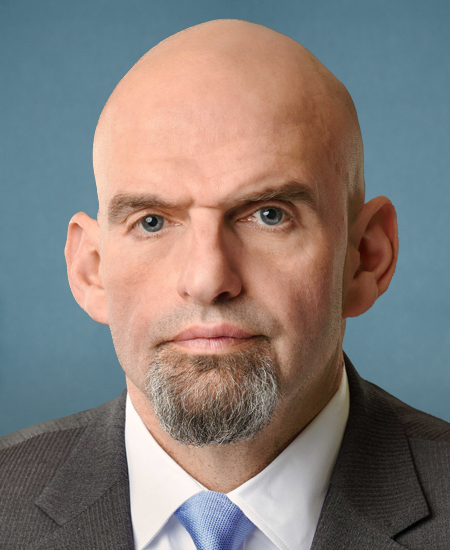
Sen. John Fetterman
Sponsored bills
Maddy summaryThe Chesapeake Bay Conservation Acceleration Act of 2025 establishes a new initiative to help agricultural producers in the Chesapeake Bay watershed (encompassing parts of six states and the District of Columbia) implement conservation practices that improve water quality and soil health. The bill provides funding for erosion control, nutrient reduction, and habitat restoration, including a new pilot program that allows landowners to install riparian buffers with no cost to them and with technical assistance provided by third-party providers. A new task force will develop better methods for measuring the environmental benefits of conservation activities in the watershed. The legislation also modifies existing conservation programs to prioritize Chesapeake Bay watershed conservation efforts and includes workforce development provisions for agricultural education.
Maddy summarySCONRES 9 is a symbolic congressional resolution expressing support for recognizing March 10, 2025, as "Abortion Provider Appreciation Day." It honors abortion providers and staff for their work amid increased challenges following the Dobbs decision, which overturned Roe v. Wade. The resolution specifically acknowledges the risks providers face, including harassment and clinic closures, and affirms Congress’s commitment to their safety and patients’ access to abortion care. As a non-binding statement, it does not create new policy but publicly recognizes the contributions of providers in a landscape of restrictive abortion laws.
Maddy summaryS 916 prohibits the detention of pregnant, lactating, or postpartum noncitizens in immigration custody, requiring their immediate release except in rare cases involving credible safety threats. It bans all physical restraints during pregnancy, labor, delivery, and postpartum recovery, with strict limits on exceptions. The bill mandates access to comprehensive reproductive healthcare, including prenatal care, labor services, and postpartum support, while requiring facilities to provide medical consent and maintain detailed reporting on detention practices. These provisions apply directly to noncitizens held by U.S. Immigration and Customs Enforcement (ICE) or U.S. Customs and Border Protection (CBP) facilities.
Maddy summaryThe FARMLAND Act of 2025 strengthens oversight of foreign ownership of U.S. agricultural land by requiring foreign persons to report land acquisitions and mandating due diligence for entities involved in agricultural land transactions. It creates civil penalties for noncompliance, establishes a database to track foreign ownership, and prohibits foreign persons from participating in Farm Service Agency programs. The bill requires annual reports to Congress on national security risks related to foreign ownership by countries like China, Russia, and state sponsors of terrorism, focusing particularly on strategic competitors. Key provisions include enhanced reporting requirements, public disclosure of noncompliant entities, and new requirements for the Committee on Foreign Investment in the United States.
Maddy summaryThis bill amends the Religious Freedom Restoration Act (RFRA) to clarify that RFRA does not block enforcement of key federal laws protecting civil rights and safety. Specifically, it adds an exception preventing RFRA claims from overriding laws that prohibit discrimination (like the Civil Rights Act of 1964), ensure workplace protections (such as the Family and Medical Leave Act), prevent child exploitation, or guarantee healthcare access. The amendment ensures religious freedom arguments cannot be used to challenge these existing legal requirements. It also clarifies that RFRA does not apply to lawsuits against government entities seeking relief for violations of these protections.
Maddy summaryThis bill, the Richard L. Trumka Protecting the Right to Organize Act of 2025, aims to strengthen workers' rights to organize and bargain collectively. It would make it harder for employers to classify workers as independent contractors by changing the definition of "employee," restricts employers from threatening to permanently replace workers who strike, and prohibits them from requiring employees to give up their right to pursue class or collective claims. The bill also changes election procedures to make it easier for workers to form unions, requires employers to post notices about workers' rights in conspicuous locations, and increases penalties for unfair labor practices. It directly affects employers and workers across various industries by altering the landscape of labor organizing and collective bargaining.
Maddy summaryThis bill designates the U.S. Postal Service facility at 28 East Airy Street in Norristown, Pennsylvania, as the "Charles L. Blockson Post Office Building." It updates all official U.S. government references to the building to reflect this new name, with no changes to postal services or funding.
Maddy summaryThis resolution (SRES 101) is a symbolic Senate statement affirming that Iran's nuclear activities - specifically its enrichment of uranium to 83.7% (close to weapons-grade 90%) and stockpiling of 274.8 kilograms of 60% enriched uranium - pose a credible threat to U.S. security and an existential threat to Israel and Middle Eastern allies. It demands Iran cease uranium enrichment, nuclear weapons development, and delivery systems, while emphasizing the Senate supports all options to address the threat. The resolution explicitly states it does not authorize military force, as noted in its rule of construction. This is a declarative statement with no binding policy changes or new legislation.
Maddy summaryThis bill prohibits the slaughter of horses, ponies, and other equines for human consumption by amending existing federal law. It directly affects businesses or individuals currently involved in slaughtering equines for food, making such activity illegal under the Agriculture Improvement Act of 2018. The key change updates a provision that previously banned slaughtering dogs and cats to now include equines, expanding the existing prohibition. This is a concrete policy change that bans a specific practice under federal law.