

Living Donor Protection Act of 2021 This bill prohibits certain insurance carriers from discriminating against, and provides other protections for, living organ donors. Specifically, carriers may not deny, cancel, or otherwise impose conditions on policies for life insurance, disability insurance, or long-term care insurance based on an individual's status as a living organ donor. The bill also expressly specifies that recovery from organ-donation surgery constitutes a serious health condition that entitles eligible employees to job-protected medical leave. In addition, the Department of Health and Human Services must update educational materials on live organ donation to include information about the benefits of live organ donation and about access to insurance for living organ donors.
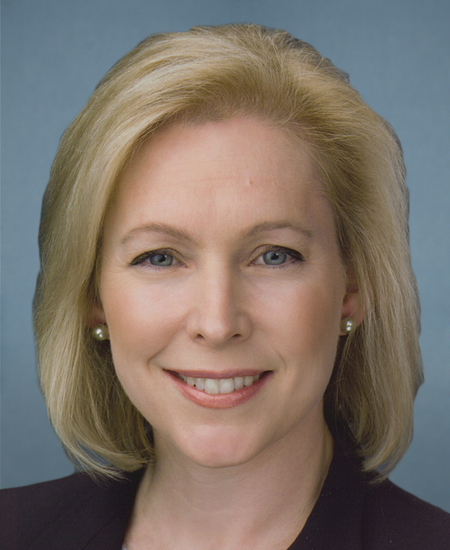
Sen. Kirsten E. Gillibrand
Sponsored bills
Duty To Report Act This bill requires political committees, candidates for federal office, and other individuals to report to the Federal Election Commission (FEC) and the Federal Bureau of Investigation (FBI) any offers of prohibited contributions, including offers of nonpublic information regarding other candidates, by foreign nationals. Specifically, political committees and candidates must report to the FEC within 24 hours any (1) offers of prohibited contributions from foreign nationals, and (2) meetings with foreign governments or their agents. In addition, the bill requires political committees, candidates, immediate family members of candidates, and individuals affiliated with a campaign (e.g., employees and independent contractors) to report to the FBI within 24 hours any offers of prohibited contributions from foreign nationals. Further, the bill establishes a new criminal offense for knowingly and willfully failing to comply with this reporting requirement. A violator is subject to criminal penalties—a fine, a prison term of up to two years, or both. Such reported information may not be used to enforce certain immigration provisions related to the removal of undocumented aliens.
Protection of Kids in Immigrant Detention Act or PROKID Act This bill establishes the Office of the Ombudsperson for Immigrant Children in Government Custody within the Department of Health and Human Services (HHS). The office shall ensure that if government detention of an immigrant child is necessary, that child is held in the least restrictive setting. The office shall also advocate for (1) the quick and safe release of such a detained child, and (2) a child who was detained with family to be released concurrently with a parent or legal guardian. The office's duties shall include (1) monitoring facilities with immigrant children held in government custody to ensure compliance with applicable laws and standards, (2) investigating claims of mistreatment and complaints against foster care providers, (3) reviewing contested decisions about the placement of an immigrant child, and (4) reviewing data from HHS and the Department of Homeland Security (DHS) relating to such children. The office may also offer individual case assistance to such a detained child who requires expedited processing or elevated attention. The office may also issue subpoenas with HHS approval. DHS and HHS must ensure that the office has the ability to conduct investigative and monitoring activities, including by providing unobstructed access to any detention facility with immigrant children. The office and DHS shall enter into a memorandum of understanding to coordinate oversight between DHS and HHS. The bill also establishes an expert advisory committee to assist the office and an interagency working group to identify and discuss concerns related to detained immigrant children.
Equality Act This bill prohibits discrimination based on sex, sexual orientation, and gender identity in areas including public accommodations and facilities, education, federal funding, employment, housing, credit, and the jury system. Specifically, the bill defines and includes sex, sexual orientation, and gender identity among the prohibited categories of discrimination or segregation. The bill expands the definition of public accommodations to include places or establishments that provide (1) exhibitions, recreation, exercise, amusement, gatherings, or displays; (2) goods, services, or programs; and (3) transportation services. The bill allows the Department of Justice to intervene in equal protection actions in federal court on account of sexual orientation or gender identity. The bill prohibits an individual from being denied access to a shared facility, including a restroom, a locker room, and a dressing room, that is in accordance with the individual's gender identity.
Full-Service Community School Expansion Act of 2021 This bill reauthorizes through FY2025 and expands the Full-Service Community Schools program. The program provides support for full-service community schools that serve children and their families, particularly for children who attend high-poverty elementary and secondary schools. Specifically, the bill directs the Department of Education (ED) to award grants to eligible entities to plan, implement, expand, and support full-service community schools. An eligible entity is a consortium of (1) one or more local educational agencies or the Bureau of Indian Education; and (2) one or more community-based organizations, nonprofit organizations, Indian tribes, tribal organizations, or other entities. A community school refers to a public elementary or secondary school that incorporates the four pillars of community schools. These four pillars are defined by the bill as (1) integrated student supports that address out-of-school barriers to learning (e.g., medical care and assistance with housing, transportation, or nutrition); (2) expanded and enriched learning time and opportunities (e.g., before- and after-school programs); (3) family and community engagement (e.g., adult education); and (4) collaborative leadership and practices, which must include a school-based leadership team, a community school coordinator, and a community-wide leadership team. Further, the bill directs ED to award grants to states to plan, implement, and expand community schools. A state educational agency that receives a grant must meet certain requirements, such as providing subgrants to local educational agencies, establishing a state-level steering committee, and establishing goals for the implementation and expansion of community schools throughout the state.
COVID-19 Nursing Home Protection Act of 2021 This bill provides funds and establishes requirements for Medicare skilled nursing facilities (SNFs) and Medicaid nursing facilities (NFs) to address COVID-19 (i.e., coronavirus disease 2019). Specifically, the bill provides FY2021 funding for COVID-19 strike teams that can be deployed to these facilities to help with vaccinations, clinical care, infection control, or staffing. The amounts provided by the bill are designated as an emergency requirement pursuant to the Statutory Pay-As-You-Go Act of 2010 (PAYGO) and the Senate PAYGO rule. (This excludes the budget effects from being counted for the purposes of enforcing the PAYGO rules.) In addition, the bill requires the Centers for Medicare & Medicaid Services (CMS) to ensure that, during the public health emergency relating to COVID-19, at least one of its contracts with Medicare quality improvement organizations requires that the organization assist SNFs with COVID-19 infection control (e.g., training materials). Finally, the bill provides statutory authority for the requirement that SNFs and NFs report data regarding COVID-19 preparedness, testing, infections, and deaths. Additionally, the CMS must publish on the Nursing Home Compare website certain demographic information, aggregated by state, with respect to COVID-19 infections and deaths in such facilities.
End Police Use of Chokeholds Act of 2021 This bill creates a new condition of eligibility for funds under the Edward Byrne Memorial Justice Assistance Grant (JAG) program and the Community Oriented Policing Services (COPS) program. Specifically, to be eligible for grant funds under the COPS program and JAG program, a state or locality must have in effect a law that prohibits law enforcement officers from using a chokehold or carotid hold.
Black Maternal Health Momnibus Act of 2021 This bill directs multi-agency efforts to improve maternal health, particularly among racial and ethnic minority groups, veterans, and other vulnerable populations. It also addresses maternal health issues related to COVID-19 (i.e., coronavirus disease 2019). The Department of Health and Human Services (HHS) and other specified departments must address the social determinants of maternal health, which include child care, housing, food security, transportation, and environmental conditions. The bill also extends to 24 months postpartum eligibility for the Special Supplemental Nutrition Program for Woman, Infants, and Children. Additionally, HHS and other agencies must take actions to grow and diversify the maternal health workforce. To increase access to maternity care, HHS and other agencies must (1) award specified grants; (2) test an alternative payment model for perinatal care under Medicaid and the Children's Health Insurance Program (CHIP); and (3) support training, technology, and telehealth initiatives. The bill also increases research and data collection on maternal morbidity and mortality, particularly among tribal populations and minority groups. The Bureau of Prisons and the Department of Justice must establish programs to improve maternity care for incarcerated populations. The Medicaid and CHIP Payment and Access Commission must also report on the impact of Medicaid ineligibility for pregnant and postpartum prisoners. Additionally, as a condition for certain grants, states and territories must have laws limiting the use of restraints on pregnant individuals in prisons. The bill also directs activities to mitigate adverse maternal health outcomes associated with climate change and to improve maternal vaccination rates.
U.S. Citizenship Act This bill establishes a path to citizenship for certain undocumented individuals. The bill also replaces the term alien with noncitizen in the immigration statutes and addresses other related issues. Specifically, the bill establishes a new status of lawful prospective immigrant . This status shall be available to an applying noncitizen who meets certain requirements, including being continually present in the United States from January 1, 2021, and passing background checks. After at least five years with this status, an eligible noncitizen may apply for and receive permanent resident status. The bill also provides permanent resident status to certain applying noncitizens, specifically for eligible noncitizens who (1) entered the United States as a minor, (2) were eligible for temporary protected status or deferred enforced departure on January 1, 2017, or (3) worked a certain amount of agricultural labor in the five years prior to applying. Among other things, the bill also redefines for immigration purposes the term conviction to exclude convictions that have been expunged or vacated, requires the Department of State to implement a strategy to advance reforms in Central America and address key factors contributing to migration from the region to the United States, requires the State Department to establish refugee processing centers in Central America, requires Customs and Border Patrol sectors and stations to have a certain number of employees with certain qualifications such as paramedic training, generally prohibits religious discrimination in granting or denying immigration benefits, and establishes grant programs for providing training and services to immigrants.
Officer Eugene Goodman Congressional Gold Medal Act This bill directs the Speaker of the House of Representatives and the President pro tempore of the Senate to arrange for the presentation of a Congressional Gold Medal to U.S. Capitol Police Officer Eugene Goodman for his actions to protect the Senate chamber during the security breach at the U.S. Capitol on January 6, 2021.