

Secure Research Data Network Act This bill establishes a Secure Research Data Network (SRDN) pilot program in the National Science Foundation (NSF). The NSF shall direct the SRDN to carry out specified responsibilities, including supporting governmentwide evidence-building activities to support policymaking including implementation of agency multiyear evidence-building plans, deploying and operating a SRDN platform for authorized analysts to calculate statistics on data for evidence-building activity purposes using data assets made available by reporting entities for approved projects, and consulting with the National Artificial Intelligence Research Resource Task Force and considering how to integrate the Task Force's recommendations and road map for expanding access to critical artificial intelligence resources and educational tools into the SRDN. The NSF shall direct the SRDN to develop a plan for and operate a data quality service team who will help reporting entities evaluate their data and prepare it for use with the SRDN platform to achieve approved project goals. The NSF shall establish a SRDN Advisory Board. The Government Accountability Office shall conduct an evaluation of the SRDN pilot program.
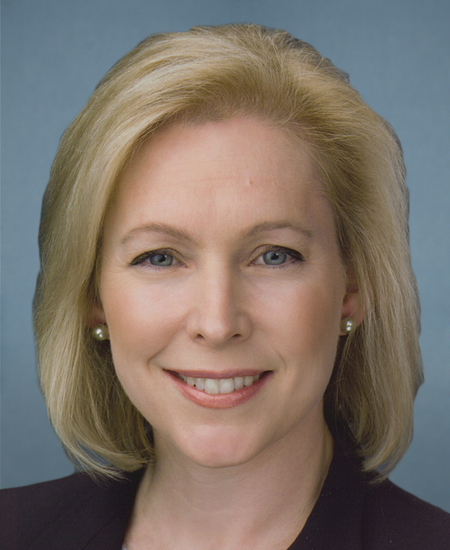
Sen. Kirsten E. Gillibrand
Sponsored bills
Fashioning Accountability and Building Real Institutional Change Act or the FABRIC Act This bill requires garment industry employers to pay at least the hourly minimum wage and prohibits piece rate pay. Garment manufacturers and contractors also must register with the Department of Labor.
NAPA Reauthorization Act This bill extends through 2035 and makes other changes to the National Alzheimer's Project. This project supports coordination of federal planning, programs, and other efforts to address Alzheimer's disease and related dementias. In particular, the bill incorporates a focus on promoting healthy aging and reducing risk factors associated with cognitive decline. The bill also expands the membership of the Advisory Council on Alzheimer's Research, Care, and Services to include (1) a researcher with experience recruiting and retaining diverse clinical trial participants, (2) an individual diagnosed with Alzheimer's disease, and (3) representatives from additional federal agencies (e.g., the Department of Justice and the Office of Management and Budget).
COVID-19 Commuter Benefits Distribution Act This bill permits a one-time payment of unused transportation fringe benefits to a succeeding month. Under current law, such unused benefits are forfeited.
Supreme Court Ethics, Recusal, and Transparency Act of 2022 This bill provides for the establishment of a code of conduct for Supreme Court Justices, judges of the courts of appeals, judges of the district courts, and judges of the Court of International Trade.
Workplace Violence Prevention for Health Care and Social Service Workers Act This bill requires the Department of Labor to address workplace violence in health care, social service, and other sectors. Specifically, Labor must issue an interim occupational safety and health standard that requires certain employers to take actions to protect workers and other personnel from workplace violence. The standard applies to employers in the health care sector, in the social service sector, and in sectors that conduct activities similar to those in the health care and social service sectors. In addition, Labor must promulgate a final standard within a specified time line.
Wage Theft Prevention and Wage Recovery Act This bill requires employers to make initial and modified disclosures to employees of the terms of their employment, provide such employees with regular paystubs, and make a final payment to an employee for uncompensated work hours within 14 days of the employee's termination. Employers must also allow employees access to wage records. An employer must compensate an employee at the rate specified in an employment contract, including a collective bargaining agreement, that specifies a rate of pay higher than the minimum wage rate. The bill makes all of such unpaid wages recoverable through civil enforcement. The bill establishes new and increased civil and criminal penalties for violations of overtime or minimum wage requirements, including referral to the Department of Justice for criminal prosecution of employers who engage in wage theft, falsification of wage records, or retaliation against employees. The Wage and Hour Division of the Department of Labor must provide grants to specified organizations, including nonprofits and educational institutions, to enhance the enforcement of wage and hour laws. The Government Accountability Office must study and report on successful grant programs.
This resolution expresses that the Senate has heard of the death of the Honorable Orrin G. Hatch, former U.S. Senator for the state of Utah. The resolution also expresses that the Senate honors the life and legacy of the late Senator Hatch for his unwavering dedication to Utah as a Senator and a public servant and accomplishments in legislating with principle and dedication for the good of the people of the United States. The resolution states when the Senate adjourns today, it stands adjourned as a further mark of respect to the memory of Senator Hatch.
Clean Water Standards for PFAS 2.0 Act of 2022 This bill directs the Environmental Protection Agency to develop requirements to (1) limit the discharge of perfluoroalkyl and polyfluoroalkyl substances (PFAS) into certain waters of the United States, and (2) publish human health water quality criteria for PFAS. PFAS are man-made and may have adverse human health effects. A variety of products contain the compounds, such as nonstick cookware or weatherproof clothing.
CDFI Crisis Fund Act This bill establishes the CDFI National Crisis Fund. The fund is authorized to make grants to community development financial institutions (CDFIs) providing financial products as emergency assistance to small businesses and low-income populations in certain circumstances. Furthermore, the fund is triggered by certain emergency declarations, including the COVID-19 emergency period; certain disaster declarations; a specified increase in a statewide unemployment rate; or a specified increase in the nationwide unemployment rate. Specified amounts in the fund are set aside for grants to Native and minority CDFIs. The Government Accountability Office must report on the impact of the fund and provide recommendations.