

This bill establishes that a minimum of 50% of a covered packer's weekly volume of livestock slaughter must be purchased through spot market sales from nonaffiliated producers. (The term covered packer applies to a packer that is required to report to the Department of Agriculture each reporting day information on the price and quantity of livestock purchased by such packer and does not include a packer that owns only one livestock processing plant.) A spot market sale is a purchase and sale of livestock by a packer from a producer under (1) an agreement that specifies a firm base price that may be equated with a fixed dollar amount on the date the agreement is entered into, (2) which the livestock are slaughtered not more than 14 days after the date on which the agreement is entered into, and (3) circumstances in which a reasonable competitive bidding opportunity exists on the date on which the agreement is entered into.
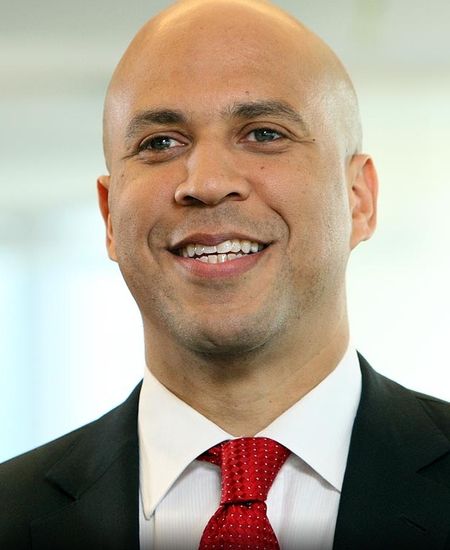
Sen. Cory A. Booker
Sponsored bills
This resolution celebrates the successes of American Indian, Alaska Native, and Native Hawaiian women and the contributions they have made in the United States. The resolution also recognizes the importance of supporting equity, providing safety, and upholding the interests of these women.
This resolution designates March 2021 as National Women's History Month. The resolution also recognizes the celebration of such month as a time to reflect on the contributions that women have made to the United States.
Save Oak Flat Act This bill repeals the requirement for the Department of Agriculture to convey the 2,422 acres of Forest Service land located in Tonto National Forest in Pinal County, Arizona, known as Oak Flat, to Resolution Copper Mining, LLC, in exchange for various parcels of land owned by Resolution Copper. Oak Flat is withdrawn from (1) entry, appropriation, or disposal under the public land laws; (2) location, entry, and patent under the mining laws; and (3) disposition under all laws pertaining to mineral and geothermal leasing or mineral materials.
National Climate Emergency Act of 2021 or the Climate Emergency Act of 2021 This bill directs the President to declare a national emergency relating to climate change. Further, the President must ensure that the federal government invests in projects to mitigate the emergency and reduce greenhouse gas emissions. At least 40% of such investments must be for historically disadvantaged communities. In addition, the President must ensure that the federal government reinvests in existing public sector institutions and creates new public sector institutions to strategically mobilize and channel investments at the scale and pace required by the emergency.
Data Care Act of 20 21 This bill imposes various duties on online service providers with respect to their handling of individual-identifying data that can be reasonably linked to a specific user. Specifically, online service providers have a duty to (1) reasonably secure such data from unauthorized access, (2) refrain from using such data in a way that will result in reasonably foreseeable harm to the end user, and (3) not disclose such data to another party unless that party is also bound by the duties established in this bill. The bill authorizes the Federal Trade Commission and specified state officials to take enforcement actions with respect to breaches of such duties.
Prescription Drug Price Relief Act of 2021 This bill establishes a series of oversight and disclosure requirements relating to the prices of brand-name drugs. Specifically, the bill requires the Department of Health and Human Services (HHS) to review at least annually all brand-name drugs for excessive pricing; HHS must also review prices upon petition. If any such drugs are found to be excessively priced, HHS must (1) void any government-granted exclusivity; (2) issue open, nonexclusive licenses for the drugs; and (3) expedite the review of corresponding applications for generic drugs and biosimilar biological products. HHS must also create a public database with its determinations for each drug. Under the bill, a price is considered excessive if the domestic average manufacturing price exceeds the median price for the drug in Canada, the United Kingdom, Germany, France, and Japan. If a price does not meet this criteria, or if pricing information is unavailable in at least three of the aforementioned countries, the price is still considered excessive if it is higher than reasonable in light of specified factors, including development cost, revenue, and the size of the affected patient population. The bill also requires drug manufacturers to report specified financial information for brand-name drugs, including research and advertising expenditures.
Funding Attorneys for Indigent Removal Proceedings Act or the FAIR Proceedings Act This bill expands access to counsel for aliens in immigration proceedings and provides for protections related to such proceedings. An alien shall have the privilege of being represented by counsel in any immigration proceeding, whereas currently this privilege is statutorily provided for only in removal proceedings. Similarly, the Department of Justice (DOJ) may provide counsel at government expense to aliens in any immigration proceeding, whereas currently DOJ is statutorily authorized to provide counsel to aliens only in removal proceedings and at no expense to the government. Under this bill, DOJ shall provide counsel to children and vulnerable individuals in such proceedings, at government expense if necessary. If DOJ fails to do so, certain limits on filing a motion to reopen removal proceedings (such as the time limit for filing) shall not apply, and the alien's removal shall be stayed upon the motion's filing. The Department of Homeland Security (DHS) shall provide each alien, generally at the beginning of proceedings, a complete copy of the alien's case file in DHS possession, unless the alien waives this right in writing. Failure to provide such documents shall delay the alien's removal proceeding. DHS shall facilitate for all detained aliens access to counsel and programs that inform such aliens of their immigration-related rights and obligations.
COVID-19 Disinformation Research and Reporting Act of 2021 This bill requires the National Science Foundation to contract with the National Academies of Sciences, Engineering, and Medicine to study disinformation and misinformation about COVID-19 (i.e., coronavirus disease 2019) on the internet and social media platforms.
Survivors' Access to Supportive Care Act or SASCA This bill sets out programs and requirements to address access and quality issues related to sexual-assault examinations. Specifically, the bill establishes training and technical assistance programs for health care providers on conducting sexual-assault examinations and treating survivors of sexual assault, including in rural and tribal settings; grants for states to assess the availability of trained providers to perform sexual-assault examinations; and a task force to assist state-level efforts to improve medical forensic evidence collection related to sexual assault. The bill also requires institutions of higher education to provide information about the availability of sexual-assault examinations to survivors of sexual assault. Additionally, hospitals and specified components of the Department of Health and Human Services (HHS) must report on access and quality issues concerning sexual-assault examinations and related services. Furthermore, HHS must address access to, and the quality of, trained health care providers who conduct sexual-assault examinations in the National Quality Strategy. This is a national effort to align public-sector and private-sector stakeholders to achieve better health and health care.