

Maddy summarySRES 19 is a Senate resolution honoring former President Jimmy Carter's life and legacy, commending his decades of public service, humanitarian work, and diplomatic achievements including the Camp David Accords and founding The Carter Center. The resolution specifically recognizes his Nobel Peace Prize, efforts to combat diseases like Guinea worm, and 30+ years of Habitat for Humanity homebuilding. It formally mourns his passing and extends condolences to his family, while highlighting his role in establishing U.S.-China diplomatic relations and creating the Departments of Education and Energy. As a symbolic resolution with no policy impact, it directly affects no individuals or entities but serves as a formal Senate tribute to Carter's historical contributions.
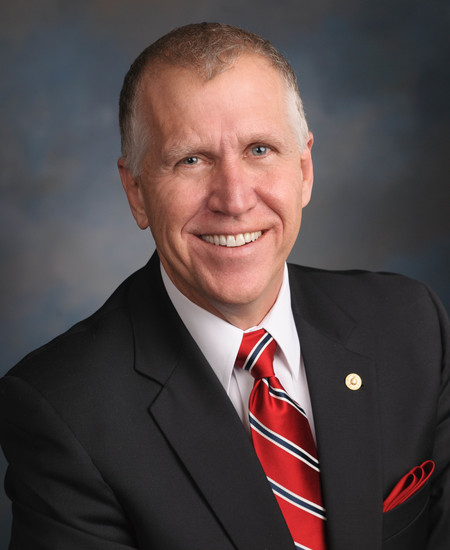
Sen. Thom Tillis
Sponsored bills
End Child Trafficking Now Act This bill imposes restrictions related to adult non-U.S. nationals ( aliens under federal law) being admitted into the United States with a minor. Such an adult may not be admitted with a minor unless the adult (1) presents documents and witness testimony proving that the adult is a relative or guardian of the minor, or (2) submits to a DNA test that proves such a relationship. The Department of Homeland Security may request a DNA test only if the required relationship cannot be established by the presented documents and witness testimony. An adult who does not consent to a requested DNA test shall be inadmissible. If the required relationship cannot be established and the immigration officer believes the adult is guilty of a felony offense, the officer may arrest the adult. The bill makes it a crime for an adult to knowingly use a minor to whom the adult is not a relative or guardian to enter the United States.
Maddy summaryThis bill would allow individuals with a valid concealed carry permit from their home state to carry concealed handguns in other states that either permit concealed carry for residents or don’t ban it entirely. It applies to permit holders who are federally eligible to possess firearms, require government-issued ID, and must follow the host state’s specific restrictions (like where carry is prohibited). The bill does not override state laws on issuing permits but ensures reciprocity for those who legally carry in their home state, excluding machineguns and destructive devices.
Maddy summaryThis bill adds new federal district court judgeships to address growing case backlogs. It authorizes 66 permanent judgeships to be appointed starting in 2025 (with an additional 34 in 2029) across specific districts in Arizona, California, Texas, Florida, Georgia, New York, and others, based on current caseload data. It also creates temporary judgeships for Oklahoma districts (Eastern and Northern) that expire after five years if vacancies occur. The bill aims to reduce the average of 491 cases per judgeship by increasing staffing in overburdened courts, as identified by the Judicial Conference.
Maddy summaryThe Federal Judiciary Stabilization Act of 2024 makes permanent 10 temporary federal district court judgeships in specific judicial districts, including Hawaii, Kansas, and multiple districts across Alabama, Arizona, California, Florida, Missouri, New Mexico, North Carolina, and Texas. It achieves this by amending federal law to treat these positions as permanent, so current judges in those roles will now hold their positions under permanent authority rather than temporary appointments. The bill also updates the official U.S. Code table listing authorized judgeships to reflect these new permanent numbers for each district. This directly affects the federal courts in the specified districts by ending the temporary status of these judgeships and providing long-term stability to their staffing.
Maddy summaryThe Stop Institutional Child Abuse Act (S. 1351) directs the Department of Health and Human Services to contract with the National Academies of Sciences, Engineering, and Medicine to study child abuse in youth residential programs. The study, to be completed within three years and updated every two years for a decade, will examine the prevalence of abuse, funding sources, regulations, and barriers to community-based alternatives for youth. It will identify risk assessment tools, recommend improved oversight and training for staff, and provide best practices for care including reducing the use of seclusion and restraints. The bill directly affects youth in residential programs, child welfare systems, and the agencies that oversee them, with recommendations aimed at improving safety and care. The study will involve consultation with child advocates, health professionals, individuals with lived experience, and government agencies to ensure comprehensive recommendations.
Maddy summaryThis bill expands a tax credit for manufacturers by redefining "advanced manufacturing facility" to specifically include facilities producing semiconductors, semiconductor manufacturing equipment, or essential materials for those products. It directly affects semiconductor manufacturers and related suppliers by making them eligible for the expanded investment tax credit under the Internal Revenue Code. The key provision amends existing tax code language to clarify this scope, aligning with the CHIPS Act of 2022. The changes take effect as if they were part of the CHIPS Act.
Maddy summaryThe Disaster Survivors Fairness Act of 2024 amends the Robert T. Stafford Disaster Relief Act to improve assistance for individuals and households affected by major disasters. It introduces new hazard mitigation assistance to help reduce future damage, expands direct repair assistance for those unable to access financial aid, and creates a state-managed housing pilot program with transparency requirements. The bill requires FEMA to publish an interactive dashboard showing application status and approval rates, and mandates reports on assistance disparities between homeowners and renters. It also includes provisions to improve rental assistance by considering local post-disaster rent increases and requires studies on damage assessment practices and challenges faced by rural and impoverished communities. These changes aim to make disaster assistance more accessible, transparent, and equitable for all survivors, particularly those with lower incomes and renters.
Maddy summaryThis bill extends existing federal tax credits for biodiesel and renewable diesel producers and users through 2025, replacing the previous 2024 expiration date. It directly affects biodiesel producers, refiners, and businesses using these fuels by maintaining their eligibility for tax credits on qualifying fuel sales or use. Key provisions include extending the biodiesel credit (Section 40A) and the biodiesel mixture credit (Section 6426), while adding a rule preventing double claims for fuel covered under another credit (Section 45Z(a)). The changes apply to fuel sold or used after December 31, 2024.
Maddy summaryThe Countering Violence in the Western Hemisphere Act requires U.S. agencies to address gender-based violence (GBV) across the Western Hemisphere through concrete policy changes. It directs USAID to fund women-led organizations working to prevent and respond to GBV, expand economic empowerment programs for women, and train local law enforcement on GBV investigations and reporting. The bill also mandates that the U.S. include detailed GBV descriptions in annual human rights reports, contribute $2 million yearly to a UN fund ending violence against women, and produce a report on GBV’s role in migration. These provisions apply to U.S. agencies (like USAID and the State Department) and their partners in the Western Hemisphere, focusing on actionable programs rather than speculative outcomes.