Maddy summaryThis bill amends federal law to clarify that certain less-than-lethal projectile devices are exempt from firearm restrictions under Title 18. It defines these devices as those not firing standard ammunition, operating below 500 ft/s velocity, unlikely to cause serious injury, and incompatible with common firearm magazines. The law directly affects manufacturers and users of such devices by establishing a clear legal standard for their classification. It also requires the Attorney General to review device requests within 90 days to confirm compliance with the new definition.
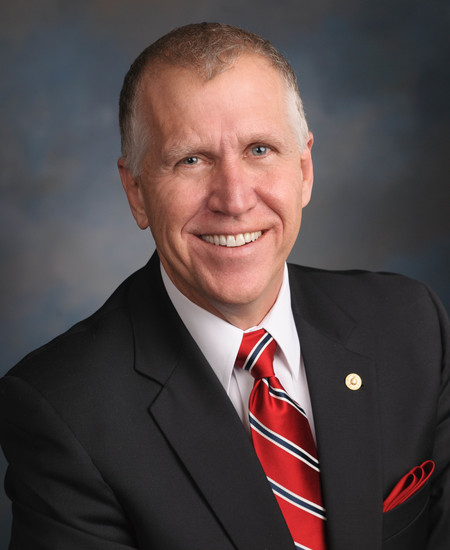
Sen. Thom Tillis
Sponsored bills
Maddy summaryS 1289 authorizes the U.S. Mint to produce and sell commemorative $5 gold and $1 silver coins to mark the 25th anniversary of the September 11, 2001, terrorist attacks. The bill specifies coin specifications (e.g., 90% gold/silver content, design requirements including "Never Forget"), sets a one-year issuance window (January 1, 2027-2028), and requires surcharges of $35 per gold coin and $10 per silver coin. These surcharges will be paid directly to the National September 11 Memorial and Museum to support its operations and maintenance, with coins sold at a price covering face value, surcharge, and production costs. The legislation does not impose new regulations or affect public policy but focuses on commemoration and funding for the museum.
Maddy summaryS 1292, the Save Our Seafood Act, exempts foreign workers employed as fish processors (including roe processors and supervisors) from the annual H-2B visa numerical cap. This directly affects nonimmigrant aliens working in specific seafood processing roles, such as handling, preparing, or packaging fish, mollusks, or crustaceans (excluding harvesting or retail). The bill amends immigration law to clarify that the visa cap does not apply to these workers, using defined terms to exclude roles like vessel-based processing or retail. It does not change visa requirements for other industries or create new visa categories. The key mechanism is removing a barrier for seafood processing employers seeking foreign labor in these defined roles.
Defending Education Transparency and Ending Rogue Regimes Engaging in Nefarious Transactions Act or the DETERRENT Act This bill expands oversight and disclosure requirements related to foreign sources and institutions of higher education (IHEs). Specifically, the bill requires an IHE to annually disclose to the Department of Education (ED) any year in which the IHE receives a gift from a foreign country of concern (e.g., China or Russia) or foreign entity of concern of any dollar amount; receives a gift or contract from a foreign source (other than a foreign country of concern or foreign entity of concern) that is valued at $50,000 or more, considered alone or in combination with all other gifts or contracts within a calendar year (current disclosure threshold is $250,000 or more), or which has an undetermined monetary value; enters into a contract with a foreign country of concern or foreign entity of concern after receiving a waiver for such contract; or is substantially controlled by a foreign source. Additionally, the bill prohibits IHEs from entering into contracts with a foreign country of concern or with a foreign entity of concern without obtaining a waiver, and requires certain IHEs to disclose gifts or contracts between covered individuals (e.g., researchers) and foreign sources. The bill requires ED to investigate possible violations of this bill and outlines the various penalties for each violation. Penalties may include losing eligibility for federal student financial aid.

Maddy summaryThis bill requires the Department of Housing and Urban Development (HUD) to develop guidelines for states and local governments to reform zoning laws that limit housing supply. The guidelines would recommend specific changes like eliminating parking minimums, allowing more housing types (such as duplexes and accessory units), and streamlining approval processes for new projects. It directly affects state and local governments, housing developers, and communities facing housing shortages - addressing a 3.85 million home shortfall cited in the bill. HUD must report to Congress on which states and localities adopt these reforms and their impact on building permits.
Maddy summaryThe Project Safe Neighborhoods Reauthorization Act of 2025 extends funding for the nationwide Project Safe Neighborhoods program through fiscal year 2030, supporting collaboration between federal, state, local, and tribal law enforcement agencies across all 50 states and territories. It expands allowable uses of grant funds to include hiring crime analysts, covering overtime for officers and support staff, and purchasing technology for violent crime reduction. The bill adds specific funding for multi-jurisdictional task forces and requires the Attorney General to annually report to Congress on fund allocation, community outreach efforts, and violent crime statistics (including murder, robbery, and aggravated assault). These changes update the program’s funding structure and transparency requirements without altering its core focus on reducing violent crime through community-based strategies.
Maddy summaryThis bill requires businesses that sell whole human bodies or body parts for non-transplant purposes (like medical education or research) to register with the federal government. It mandates detailed record-keeping about donor consent, chain of custody, and medical history, along with strict labeling standards showing donor identity and safety information. The law specifically excludes medical schools, funeral homes, and organ networks from these requirements. It aims to ensure transparency, safety, and respect for donors by regulating for-profit entities handling donated remains. Violations can result in fines or loss of registration.
Maddy summaryThe EASE Act (S 1248) creates a new Medicare and Medicaid model to improve access to specialty health care for beneficiaries in rural or underserved areas. It requires the Centers for Medicare & Medicaid Services to partner with nonprofit provider networks (comprising at least 50 rural clinics or health centers) to deliver specialty care via telehealth and remote technologies, coordinated with primary care providers. Eligible individuals include Medicare Part B beneficiaries or Medicaid/CHIP enrollees living in designated rural or underserved areas. The model mandates that selected provider networks must have proven experience serving rural communities and the capacity to track health data for evaluation.
Maddy summaryThis bill creates a new $1.00 per gallon tax credit for renewable natural gas (RNG) used as fuel in vehicles, boats, or aircraft. It directly affects RNG producers (who must register and certify their product) and businesses that buy or use RNG for transportation fuel. Key provisions require producers to register with the IRS, provide specific certification about the fuel's origin and volume, and limit blended RNG treatment to amounts specified in contracts. The credit expires after December 31, 2035, and applies only to RNG produced and used within the United States.
Maddy summaryThe CONNECT for Health Act of 2025 expands Medicare coverage for telehealth services by removing geographic restrictions that previously limited where patients could receive telehealth care. It allows more healthcare providers to offer telehealth services, including expanding eligibility for practitioners and removing the six-month in-person visit requirement for telemental health. The bill also includes specific provisions for Federally Qualified Health Centers, rural health clinics, and Native American health facilities to better integrate telehealth into their services. Additionally, it establishes program integrity measures to address billing patterns and requires the posting of telehealth service data to improve transparency and quality measurement. These changes aim to make telehealth more accessible for Medicare beneficiaries, particularly in rural areas and for underserved populations.