

Maddy summaryThis bill establishes 7 regional "Ocean Innovation Clusters" across U.S. coastal areas to grow the sustainable ocean-based economy (Blue Economy), directly benefiting coastal communities, Tribal nations, small businesses, and diverse populations. It requires the Commerce Secretary to designate these clusters - led by nonprofits and including partners like universities, tribes, and governments - prioritizing underserved regions and economic diversity. The bill authorizes $10 million annually (2026-2030) for grants to support cluster operations, with each cluster managing a local "Ocean Innovation Center" providing shared workspaces, training, and collaboration hubs. These centers will focus on expanding job opportunities in sustainable sectors like seafood processing, ocean energy, and coastal resilience while improving cross-sector partnerships.
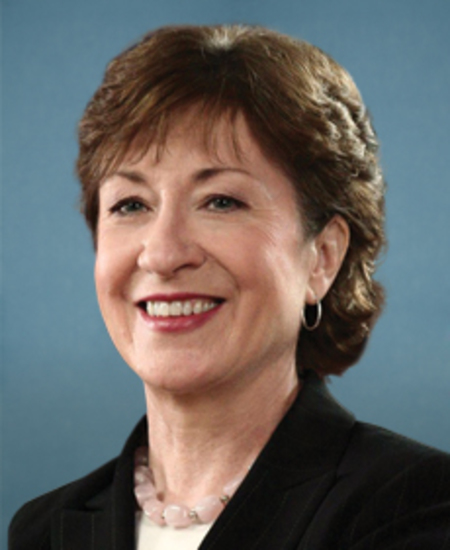
Sen. Susan M. Collins
Sponsored bills
Maddy summaryThis bill (S 1324) makes technical corrections to the Safe Drinking Water Act's eligibility rules for states seeking assistance under the State Response to Contaminants program. It clarifies who qualifies for federal grants, specifically allowing states to apply on behalf of: (1) disadvantaged communities meeting state affordability criteria, (2) small communities (under 10,000 people) lacking debt capacity, or (3) private drinking water well owners not connected to public systems. The changes streamline how states identify eligible communities and well owners for funding to address water contaminants. This is a procedural adjustment to existing program rules, not a new policy.
Maddy summaryS 1336, the "Jobs in the Woods Act," creates a federal grant program to support forestry workforce training in underserved rural communities. It provides funding for eligible entities (like nonprofits, tribes, local governments, and colleges) to develop training programs in areas meeting specific criteria: nonmetropolitan, low-income, small-population communities with reliable broadband access. Grants range from $500,000 to $2 million per award for up to 4 years, with priority given to programs addressing aging forestry workforces and youth migration, and partnerships with schools. The program is authorized to receive $10 million annually from 2025 through 2029.
Maddy summaryThe Cybersecurity Information Sharing Extension Act (S 1337) extends the expiration date of a key provision in the Cybersecurity Act of 2015 from 2025 to 2035. This provision enables private companies and government agencies to share cybersecurity threat information without legal liability. The extension ensures the current information-sharing framework remains active until 2035, providing ongoing legal certainty for participants. It directly affects organizations that rely on this program to enhance their cyber defense capabilities.
Maddy summaryThis bill creates a new $30 million annual Weatherization Readiness Fund (2026-2030) to help states fix structural defects in low-income homes before weatherization can be installed. It directly affects low-income households in states receiving Weatherization Assistance Program funds, by requiring states to use these funds to repair hazards that block weatherization work. The bill also raises the maximum per-unit cost limit for fully weatherized homes from $6,500 to $15,000 and adds flexibility for the Secretary to adjust costs based on market conditions. These changes aim to streamline the weatherization process and increase funding efficiency for eligible homes.
Maddy summaryThis bill increases tax incentives for residential and commercial biomass heating systems. It raises the energy efficient home improvement credit cap to $2,000 for certain biomass stoves/boilers and $10,000 for others, effective after 2025. It also creates a new 30% investment tax credit for qualifying "open-loop biomass heating property" (systems using biomass for space heating, hot water, or industrial heat) that meet specific efficiency (75% minimum), size (under 50 MMBtu), and emissions control requirements. These changes directly affect homeowners and businesses installing eligible biomass heating equipment by reducing their tax burden for qualifying purchases.
Maddy summaryThis resolution (SRES 159) is a ceremonial Senate measure honoring the late Senator John Bennett Johnston, Jr. (1932-2024), who represented Louisiana in the U.S. Senate from 1972 to 1997. It commemorates his career, including his work on energy policy, flood control, and Louisiana conservation efforts, and requests the Senate adjourn in his memory while sending condolences to his family. As a non-binding resolution, it has no policy impact or direct effect on any individuals or laws.
Maddy summaryThis bill expands eligibility for Small Business Administration disaster loans by adding "snow drought" to the list of qualifying disasters. It directly affects winter recreation small businesses (like ski resorts and snowmobile rentals) that suffer economic harm due to insufficient snowpack caused by low precipitation or warm temperatures. Key provisions require the SBA to issue implementing rules within 90 days and mandate a report assessing federal resources and adaptation strategies for businesses impacted by snow drought. The bill does not create new funding but adjusts existing programs under the Small Business Act to cover this specific climate-related disruption.
Maddy summaryThis bill requires the President to notify Congress within 48 hours when imposing or increasing most import duties on goods entering the U.S., including an explanation of the reason and an assessment of impacts on U.S. businesses and consumers. Any new duty would automatically expire after 60 days unless Congress passes a joint resolution approving it. Congress can also disapprove a duty by passing a resolution, which would immediately end the duty. The bill does not apply to anti-dumping or countervailing duties under existing law.
Maddy summaryThis bill renames Acadia National Park's Hulls Cove Visitor Center in Bar Harbor, Maine, to the George J. Mitchell Visitor Center. It directly affects the physical visitor center and all official references to it in U.S. government documents, maps, and records. The renaming applies to the existing center and any future replacement built after the bill's enactment, ensuring all federal materials consistently use the new name.