

Promotion and Expansion of Private Employee Ownership Act of 2021 This bill expands tax incentives and federal assistance for employee stock ownership plans (ESOPs) that are sponsored by S corporations. The bill extends to all domestic corporations, including S corporations, provisions allowing deferral of tax on gain from the sale of employer securities to an ESOP. The Department of the Treasury must establish the S Corporation Employee Ownership Assistance Office to foster increased employee ownership of S corporations. The bill defines an ESOP business concern and allows such a concern to continue to qualify as a small business for the purposes of programs under the Small Business Act. An ESOP business concern is a business concern that was a small business concern eligible for a loan, preference, or other program under the Small Business Act before more than 49% of the business concern was acquired by an ESOP.
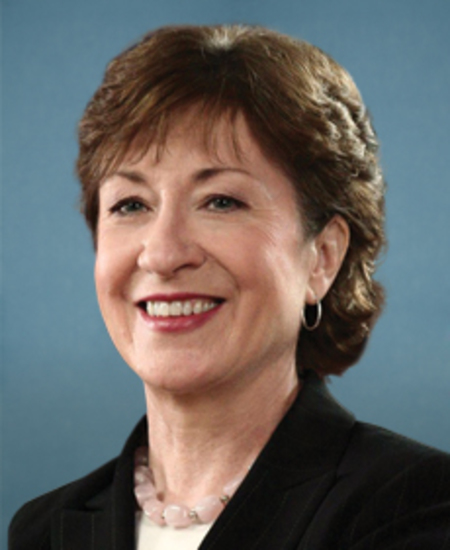
Sen. Susan M. Collins
Sponsored bills
Home Health Emergency Access to Telehealth Act or the HEAT Act This bill provides for Medicare coverage of home health services that are furnished via telehealth during a public health emergency, in accordance with specified requirements. Specifically, the bill allows telehealth services to substitute for in-person home health services and to be considered as home health visits for purposes of payment under Medicare during a public health emergency. Such services (1) may not constitute more than 50% of the number of billable visits in a 30-day period, (2) must be furnished under a plan of care established by a practitioner with whom the beneficiary has an existing care relationship, and (3) must be furnished in accordance with the beneficiary's consent.
Social Security Fairness Act This bill repeals provisions that reduce Social Security benefits for individuals who receive other benefits, such as a pension from a state or local government. The bill eliminates the government pension offset , which in various instances reduces Social Security survivors' benefits for spouses, widows, and widowers who also receive government pensions of their own. The bill also eliminates the windfall elimination provision , which in some instances reduces Social Security benefits for individuals who also receive a pension or disability benefit from an employer that did not withhold Social Security taxes. These changes are effective for benefits payable after December 2021.
Metastatic Breast Cancer Access to Care Act This bill expedites payment of Social Security Disability Insurance (SSDI) benefits and eligibility for Medicare coverage for those with metastatic breast cancer (i.e., breast cancer that has spread to other sites in the body). Specifically, the bill eliminates the 5-month waiting period for SSDI benefits and the subsequent 24-month waiting period for Medicare coverage for individuals with metastatic breast cancer. Under current law, individuals generally must wait five months after the onset of disability to begin receiving SSDI benefits and an additional 24 months to become eligible for Medicare.
Farm to School Act of 20 21 This bill modifies and expands the Department of Agriculture's (USDA's) Farm to School Program. The program currently provides grants and technical assistance to schools, state and local agencies, Indian tribal organizations, agricultural producers, and nonprofit entities to improve access to local foods in schools. Among other things, the bill reauthorizes the program through FY2027; permits USDA to provide land-grant colleges and universities with grants, research, evaluation, and technical assistance under the program; expands the purposes for grants awarded under the program to include implementing educational activities relating to agriculture, nutrition, or food; requires USDA to provide technical assistance, research, and information to increase awareness of and participation in farm to school programs among agricultural producers, including beginning, veteran, and socially disadvantaged farmers; directs USDA to seek to improve local food procurement and distribution options for agricultural producers and eligible institutions; authorizes USDA to fund projects that include innovative approaches to aggregation, processing, transportation, and distribution; establishes new limitations on the amount and duration of grants; and limits funds that may be used for administrative costs.
This resolution extends condolences to the family and friends of former Vice President Walter Mondale. The resolution acknowledges Mondale's lifetime service to the United States, including as a U.S. Senator and as the first presidential candidate from a major party to select a woman, Geraldine Ferraro, as his running mate.
SIMPLE Plan Modernization Act This bill modifies the requirements for SIMPLE (Savings Incentive Match Plan for Employees) Individual Retirement Accounts (IRAs), which are tax-favored retirement accounts that small businesses may provide to employees. The bill increases the contribution limits for certain SIMPLE IRAs and modifies the requirements for replacing SIMPLE IRAs with 401(k) plans.
Military Spouses Retirement Security Act This bill allows a tax credit for certain small businesses that include military spouses in their retirement plans.
Future Logging Careers Act This bill allows individuals who are 16 or 17 years old to work at certain logging operations that are owned or operated by at least one parent or a person standing in place of a parent. Thus, the bill exempts such employees from child labor laws.
PPP Flexibility for Farmers, Ranchers, and the Self-Employed Act This bill makes various changes to the Paycheck Protection Program (PPP) with respect to certain loans, loan applicants, and loan recipients. First, the bill permits farming partnerships with gross farming income from self-employment to request a recalculation of the amount of their PPP loans based on the partners' distributive shares of gross income from the partnership. The recalculation is available retroactively for loans made on or before the date of enactment of this bill. Additionally, applicants for PPP loans may calculate their maximum loan amount based on the applicant's Internal Revenue Service Form 1040, Schedule C (i.e., profit or loss from a business). This applies retroactively to PPP loans made or approved on or before December 27, 2020. The bill also increases the maximum amount of a second draw PPP loan for individuals who received PPP loan forgiveness. The maximum second draw PPP loan amount for an eligible individual includes the increased PPP loan amount the individual would have received under the Economic Aid to Hard-Hit Small Businesses, Nonprofits, and Venues Act had the individual not already received loan forgiveness. This applies retroactively to second draw loans made on for before the date of enactment of this bill. The bill changes from a quarterly period to any contiguous 90-day period the calculation of revenue loss in determining eligibility for a second draw PPP loan. The bill also extends certain dates with respect to the administration of the PPP.