

Maddy summaryThis bill suspends the federal government's authority to garnish wages for student loan borrowers starting upon enactment, directly affecting individuals with federal student loans facing wage deductions. It requires the Secretary of Education to submit a certification within one year detailing either a process to fix improper garnishments (including refunds within a week, employer verification, and borrower data tracking) or a decision to end garnishment entirely. The bill mandates that borrowers receive double the amount of improperly garnished wages within 10 days and holds employers liable for withholding wages after a suspension notice. It also prohibits wage garnishment for loans outstanding over 10 years.
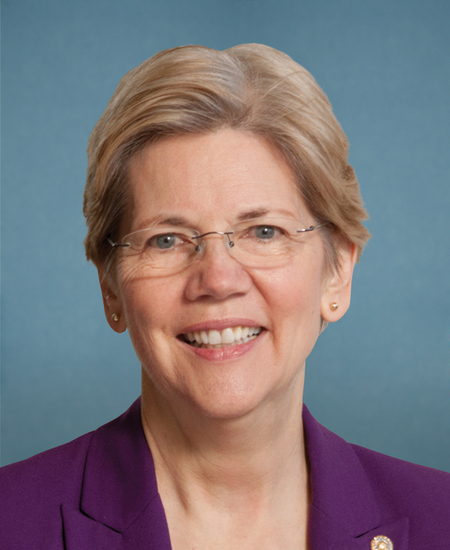
Sen. Elizabeth Warren
Sponsored bills
Maddy summarySRES 219 is a Senate resolution directing the Senate Legal Counsel to file a civil lawsuit on behalf of the Senate to enforce the Constitution's Foreign Emoluments Clause. This clause prohibits U.S. officials from accepting gifts, payments, or titles from foreign governments without Congress's consent. The resolution specifically targets alleged violations by President Trump involving a Qatar-provided plane for Air Force One and a $2 billion foreign-backed investment deal (MGX Fund-Binance) that could provide him financial benefits from foreign states. The lawsuit aims to stop Trump from accepting such foreign emoluments without congressional approval.
Maddy summaryThis resolution (SRES 224) calls for urgent U.S. diplomatic action to address the severe humanitarian crisis in Gaza, where approximately 2.2 million civilians face acute hunger and malnutrition, including 10,000 children identified with acute malnutrition since January 2025. It highlights that Gaza’s borders have been blocked since March 2, 2025, preventing entry of food, medicine, and other lifesaving aid, leading to closed bakeries and exhausted food rations. The Senate resolution specifically urges the White House and State Department to use all available diplomatic tools to end the blockade, secure hostage releases, and achieve a durable conflict resolution. As a non-binding resolution, it does not enact law but formally expresses the Senate’s concern and directs executive branch action.
Maddy summaryThis bill establishes significant federal funding for water infrastructure projects to improve affordability, transparency, equity, and reliability in water services. It allocates over $33 billion annually for clean water, drinking water, rural water, and Indian Health Service water infrastructure projects. The bill requires a comprehensive study on water affordability, discrimination in water services, and data collection about service disconnections, with a report to Congress within one year. It includes specific provisions about funding priorities, public ownership requirements for water systems, and protections for vulnerable populations facing service disconnections, affecting communities across the U.S., particularly low-income neighborhoods, rural areas, tribal communities, and colonias.
Maddy summarySRES 217 is a non-binding Senate resolution expressing that Secretary of Health and Human Services Robert F. Kennedy Jr. lacks the confidence of the Senate and American people to fulfill his duties. It cites specific alleged failures, including unlawful termination of public health funding, elimination of staff focused on health equity and disability programs, and actions undermining scientific research. The resolution does not create new policy but formally states the Senate’s position based on these reported actions. It follows multiple state lawsuits and concerns about impacts on vaccine programs, chronic disease research, and public health initiatives. This resolution serves as a symbolic statement of disapproval, not a legislative change.
Maddy summaryThis bill, S 1716 (Vision Lab Choice Act of 2025), modifies vision care coverage under health plans by limiting agreements between optometrists and vision plans to two-year terms (with possible two-year extensions) and prohibiting plans from restricting optometrists' choices of labs or suppliers for patient vision care. It directly affects optometrists and health insurance issuers offering limited-scope vision benefits, ensuring they cannot force optometrists to use specific labs or materials. The bill requires annual state enforcement notifications by the Secretary and clarifies that state laws governing vision plans take precedence if they conflict with this law. It does not change overall coverage requirements but focuses on provider choice and contract terms within vision benefit plans.
Maddy summaryThe Nurse Staffing Standards for Hospital Patient Safety and Quality Care Act of 2025 establishes specific minimum nurse-to-patient ratios for different hospital units, such as 1:1 in trauma emergency units and 2:1 in critical care units. Hospitals must develop and annually update staffing plans with nurse input, document actual staffing levels for each shift, and prohibit practices like averaging ratios or mandating overtime. The bill provides protections for nurses who refuse unsafe assignments and prohibits retaliation for reporting staffing violations, with enforcement through Medicare, Medicaid, and other federal health programs. This applies to all hospitals, including those operated by the Department of Veterans Affairs, Department of Defense, and Indian Health Service.
Maddy summarySRES 208 is a symbolic Senate resolution designating May 10, 2025, as "National Asian American, Native Hawaiian, and Pacific Islander Mental Health Day." It supports raising awareness about mental health disparities affecting AANHPI communities, where 65.3% of those needing treatment don’t receive it, and AANHPI youth face high suicide rates. The resolution encourages federal, state, and local health agencies to improve mental health literacy and culturally appropriate care access for AANHPI populations. As a non-binding resolution, it does not create new laws or funding but aims to highlight existing challenges and promote community-focused solutions.
Maddy summaryS 1705, the Chip Security Act, requires U.S. companies exporting specific advanced integrated circuits (used in AI systems and high-performance computing) to install location verification technology before shipping them abroad. It directly affects manufacturers and exporters of chips classified under U.S. export control numbers like 3A090 or 4A090. The bill mandates that these chips include security mechanisms to verify their location and prevent diversion or tampering, with companies needing to report suspicious activity like unauthorized location changes. The Commerce Secretary must implement these requirements within 180 days and conduct annual assessments to update security standards. This aims to strengthen compliance with export laws and protect national security by securing chip supply chains.
Maddy summaryS 1668 prohibits senior U.S. government officials - including the President, Vice President, Members of Congress, and Senate-confirmed appointees - from issuing, sponsoring, or endorsing cryptocurrencies, tokens, or stablecoins for profit. It also bans acquiring similar financial interests through derivatives or investment funds, while allowing normal public market trading. Violations face civil penalties of up to 10% of the financial interest's value or profits gained, and criminal charges if losses exceed $1 million or personal financial gain occurs. The law applies during official service and for one year after leaving office.