

Maddy summaryS 2006, the Fit to Serve Act, prohibits the U.S. military from discriminating against service members or applicants based on gender identity. It directly affects all current and prospective members of the Armed Forces by banning specific discriminatory actions, including denying medically necessary health care, requiring service in a sex assigned at birth, or separating members due to gender identity (including gender dysphoria diagnosis). The bill amends Title 10 of the U.S. Code to add new protections, explicitly stating that the military cannot deny service, reenlistment, or health coverage based on gender identity. These changes apply uniformly across all branches and service statuses, ensuring equal treatment under military policy.
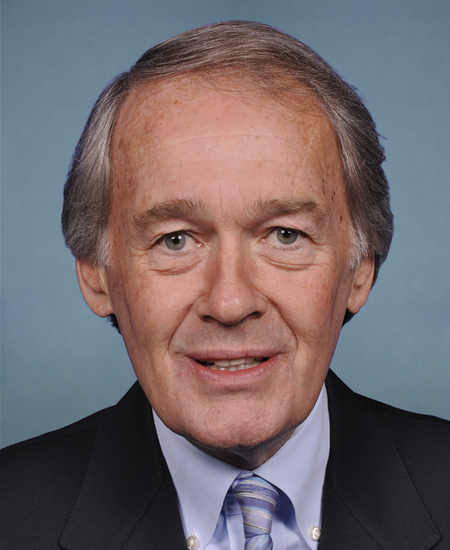
Sen. Edward J. Markey
Sponsored bills
Maddy summaryThis bill requires the Financial Crimes Enforcement Network (FinCEN) and the Small Business Administration (SBA) to coordinate outreach to small businesses about existing beneficial ownership reporting requirements under the Corporate Transparency Act. It mandates joint efforts to disseminate information through SBA resource partners (like small business development centers), provide multilingual materials, host educational events, and combat fraudulent schemes related to reporting. The coordination focuses on helping small businesses that must report beneficial ownership information to comply with current law, which aims to prevent money laundering and other illicit activities. The bill does not create new reporting requirements but ensures clearer communication and support for affected small businesses.
Maddy summaryThis bill amends the Communications Act to clarify that "franchise fee" means only monetary assessments paid to local authorities for cable or community television services. It removes the word "includes" and adds "other monetary" before "assessment" in the definition. This technical change ensures franchise fees are strictly defined as cash payments, not other types of fees or non-monetary obligations. It directly affects cable operators and local governments that collect these fees under existing law. The bill makes no new policy changes but refines the legal definition for clarity.
Maddy summaryThis bill establishes an independent expert panel to review and make recommendations for improving the FAA's Safety Management System (SMS) to ensure comprehensive safety practices across all FAA operations. It requires air carriers to install ADS-B In equipment within 4 years to enhance situational awareness, and mandates safety reviews of airspace operations at major airports, particularly examining military and civilian aircraft near airports. The bill also protects the FAA workforce from hiring freezes and staffing reductions, extends air traffic controller hiring requirements through 2033, and requires risk assessments following transport airplane accidents. These provisions aim to enhance safety coordination between the FAA and Department of Defense while addressing specific safety management and equipment requirements.
Maddy summaryThis bill prevents employers from dropping health insurance coverage for workers during strikes or lockouts. It amends the National Labor Relations Act to prohibit employers from terminating group health plan coverage for employees who are either locked out (during bargaining disputes) or participating in a lawful strike. Employers who violate this rule face civil penalties of up to $75,000 per violation for lockout-related actions (doubling to $150,000 for repeat offenses) or $50,000 for strike-related actions (doubling to $100,000 for repeat offenses). The law directly affects workers engaged in strikes or locked out by employers, ensuring their healthcare coverage continues during these labor disputes.
Maddy summaryThis bill repeals key protections in the Protection of Lawful Commerce in Arms Act that shielded gun manufacturers from civil lawsuits. It allows victims of gun violence to use federal gun trace data (from the Firearms Trace System database) as evidence in civil court cases against gun sellers or manufacturers. The law makes this trace information discoverable, admissible, and usable in any civil action in state or federal courts, including the District of Columbia. This change directly affects victims seeking legal recourse and gun industry entities previously protected by the repealed law.
Maddy summaryThe Complete Streets Act of 2025 requires states to establish programs that provide technical assistance and grants for local governments, transit agencies, and other eligible entities to develop and implement street projects accommodating all transportation modes. The bill mandates that these projects prioritize safety for pedestrians and cyclists, especially in underserved communities, and must follow new design standards including protected bike lanes, accessible sidewalks, and proper lighting. States must dedicate 5% of certain federal transportation funds to support these initiatives and report on progress to the federal government. The law establishes specific deadlines for implementing these standards on new road projects, with phased requirements for different types of projects and locations. This legislation aims to create streets that safely serve people of all ages, abilities, and backgrounds, including those who walk, bike, take transit, or drive.
Maddy summaryS 1957, the "No Place for LGBTQ+ Hate Act," repeals five specific executive orders that the bill identifies as harming LGBTQI+ rights. It prohibits federal funding for implementing or enforcing those orders, which include policies restricting transgender healthcare, military service, school sports participation, and requiring schools to deny transgender identities. The bill directly affects LGBTQI+ individuals by reversing discriminatory executive actions in key areas like employment, education, healthcare, and military service. It does not create new policies but formally nullifies existing executive actions through legislative repeal and funding restrictions.
Maddy summarySRES 260 is a symbolic Senate resolution expressing support for designating June 6, 2025, as "National Gun Violence Awareness Day" and June 2025 as "National Gun Violence Awareness Month." It calls on U.S. citizens to wear orange on June 6, 2025, promote gun safety awareness, and focus on community safety efforts during summer months when gun violence typically rises. The resolution does not create new laws or policies but aims to raise public awareness about gun violence, referencing statistics on annual gun-related deaths and honoring victims like Hadiya Pendleton. It is a non-binding expression of support, not a legislative action.
Maddy summaryThis resolution (SRES 255) is a ceremonial Senate measure honoring former U.S. Senator Christopher "Kit" Bond of Missouri, who died on May 13, 2025. It recognizes his 40+ years of public service, including his roles as Missouri Governor (1973-1977, 1981-1985) and U.S. Senator (1987-2011). The resolution directs the Senate to adjourn briefly as a mark of respect and transmit a copy to his family. It has no policy impact or direct effect on constituents, as it is purely commemorative.