

Maddy summaryS 1957, the "No Place for LGBTQ+ Hate Act," repeals five specific executive orders that the bill identifies as harming LGBTQI+ rights. It prohibits federal funding for implementing or enforcing those orders, which include policies restricting transgender healthcare, military service, school sports participation, and requiring schools to deny transgender identities. The bill directly affects LGBTQI+ individuals by reversing discriminatory executive actions in key areas like employment, education, healthcare, and military service. It does not create new policies but formally nullifies existing executive actions through legislative repeal and funding restrictions.
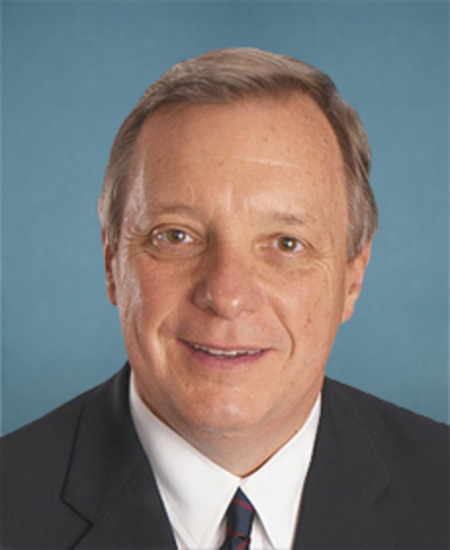
Sen. Richard J. Durbin
Sponsored bills
Maddy summarySRES 260 is a symbolic Senate resolution expressing support for designating June 6, 2025, as "National Gun Violence Awareness Day" and June 2025 as "National Gun Violence Awareness Month." It calls on U.S. citizens to wear orange on June 6, 2025, promote gun safety awareness, and focus on community safety efforts during summer months when gun violence typically rises. The resolution does not create new laws or policies but aims to raise public awareness about gun violence, referencing statistics on annual gun-related deaths and honoring victims like Hadiya Pendleton. It is a non-binding expression of support, not a legislative action.
Maddy summaryThis Senate resolution (SRES 257) urges the Turkish government to release Istanbul Mayor Ekrem İmamoğlu, who was arrested in March 2025 on corruption and terrorism charges. The resolution calls on Turkey to present credible evidence supporting these charges or free him immediately, while also urging the government to uphold democratic values like free elections. It directs the U.S. Secretary of State to engage diplomatically with Turkey over these concerns. The resolution is non-binding and focuses on expressing the Senate’s position regarding İmamoğlu’s detention, which has drawn international criticism.
Maddy summaryThis resolution (SRES 255) is a ceremonial Senate measure honoring former U.S. Senator Christopher "Kit" Bond of Missouri, who died on May 13, 2025. It recognizes his 40+ years of public service, including his roles as Missouri Governor (1973-1977, 1981-1985) and U.S. Senator (1987-2011). The resolution directs the Senate to adjourn briefly as a mark of respect and transmit a copy to his family. It has no policy impact or direct effect on constituents, as it is purely commemorative.
Maddy summarySRES 253 is a ceremonial Senate resolution congratulating Pope Leo XIV on his election as Pope, recognizing him as the first U.S. citizen elected to the papacy. The resolution highlights his global role in promoting peace, justice, and interfaith dialogue, and expresses hope for continued strong U.S.-Holy See relations based on shared values. It does not create policy changes or affect any specific group, as it is a symbolic gesture of goodwill. The resolution was introduced by multiple senators and unanimously adopted by the Senate on May 22, 2025.
Maddy summarySRES 214 is a non-binding Senate resolution recognizing May as Asian American, Native Hawaiian, and Pacific Islander Heritage Month. It celebrates the historical contributions of these communities to U.S. history and acknowledges their diverse populations, which together represent over 10% of the U.S. population. The resolution references key milestones like the 1965 Immigration Act and the 60th anniversary of the Space Shuttle Discovery mission, while noting ongoing challenges such as hate crimes. As a ceremonial resolution, it does not create new laws or policies but formally honors these communities' achievements and cultural significance.
Maddy summaryThis bill expands workplace safety protections under the Occupational Safety and Health Act to cover public employees, including those working for federal, state, or local government agencies. It amends the law to explicitly include "the United States, a State, or a political subdivision of a State" in the definition of covered workers, removing previous exclusions. The key provision requires all public workplaces to follow OSHA safety standards, with a 36-month transition period for states or localities without their own OSHA-approved plans. This directly affects government workers like teachers, police, and sanitation staff who were previously excluded from federal OSHA coverage.
Maddy summaryThe Crime Victims Fund Stabilization Act of 2025 amends the law governing deposits into the Crime Victims Fund, adding two new sources: funds from declined criminal prosecutions (without conviction) and certain False Claims Act recoveries (from 2025 through 2030). It specifically excludes two types of False Claims Act funds from these deposits: payments to whistleblowers (qui tam plaintiffs) and reimbursements for government fraud damages. This bill directly affects the Crime Victims Fund, which provides support to victims of crime, and adjusts how federal agencies handle False Claims Act cases. The changes aim to modify the fund's funding sources without altering the False Claims Act itself.
Maddy summaryThis resolution (SRES 240) affirms that diversity, equity, inclusion, and accessibility are core U.S. values and emphasizes the need to address ongoing discrimination across multiple sectors. It directly affects workplaces, K-12 and higher education systems, healthcare, housing, government programs, and the military by citing data on persistent inequities - such as racial disparities in housing discrimination, wage gaps, and underrepresentation in leadership. The resolution does not create new laws but encourages federal, state, and local entities to adopt inclusive policies and remove barriers to opportunity. It references evidence from agencies like the Department of Housing and Urban Development and the Equal Employment Opportunity Commission to support its focus on systemic discrimination. The Senate calls for promoting environments where all individuals can achieve their full potential.
Maddy summaryS 1843, the Second Chance Reauthorization Act of 2025, extends funding for existing federal reentry programs through 2030 instead of 2023. It updates timeframes across multiple programs, including state reentry demonstration projects (adding substance use disorder treatment and housing services), family-based substance abuse grants, prison education evaluations, career training for incarcerated individuals, and community mentoring programs. These programs directly support people returning from incarceration by providing critical services like recovery support, job training, and transitional housing. The bill makes no new policy changes but continues current federal funding mechanisms for reentry assistance.