Maddy summarySRES 372 is a symbolic Senate resolution designating the week beginning September 13, 2021, as "National Hispanic-Serving Institutions Week." It recognizes Hispanic-Serving Institutions (HSIs) - colleges and universities with at least 25% Hispanic undergraduate enrollment - as vital providers of higher education to underserved students, particularly Hispanic learners. The resolution calls on the public and organizations to observe the week with events supporting these institutions, which serve 2.3 million Hispanic students nationwide. This is a non-binding commemorative measure with no policy changes or funding impacts.
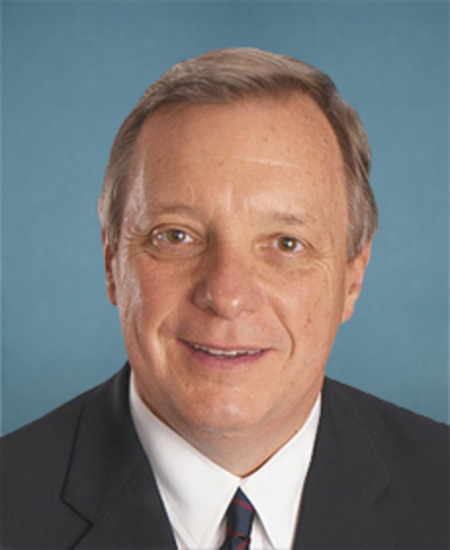
Sen. Richard J. Durbin
Sponsored bills
Bronzeville-Black Metropolis National Heritage Area Act This bill establishes the Bronzeville-Black Metropolis National Heritage Area in Chicago, Illinois. The Black Metropolis National Heritage Area Commission shall be the local coordinating entity for the heritage area and shall submit a management plan for the heritage area. The authority of the Department of the Interior to provide financial assistance to the heritage area expires 15 years after the enactment of this bill.
Burma Unified through Rigorous Military Accountability Act of 2021 or the BURMA Act of 2021 This bill imposes sanctions pertaining to Burma (Myanmar) and addresses related issues. The President must impose property- and visa-blocking sanctions on certain foreign persons (i.e., an individual or entity), including those that (1) knowingly operate in Burma's defense sector, (2) are responsible for or complicit in undermining Burma's democratic processes, or (3) are senior leaders in Burma's military or government. The Department of the Treasury must prohibit or impose strict conditions on certain accounts used to facilitate transactions for such sanctioned persons. The President may impose sanctions on Myanma Oil and Gas Enterprise if such sanctions would support certain objectives, including reducing the Burmese military's ability to undermine democracy in Burma. The President may also prohibit imports of precious and semiprecious gemstones from Burma. Before removing certain foreign persons from a list of specially designated nationals and blocked persons (commonly known as the SDN list), the President must certify to Congress that the person in question has not knowingly engaged in certain activities, such as supporting terrorism. The bill authorizes Department of State and U.S. Agency for International Development activities in Burma and the surrounding region to support democracy activists, humanitarian assistance, and reconciliation efforts. The State Department may (1) continue to assist organizations supporting political prisoners in Burma, and (2) provide assistance to entities investigating crimes against humanity. The President must direct U.S. representatives to the United Nations to vote and advocate for certain actions related to Burma, such as cutting off assistance to Burma's government.

Parental Bereavement Act of 2021 or the Sarah Grace-Farley-Kluger Act This bill entitles an eligible employee to up to 12 workweeks of leave during any 12-month period because of the death of a son or daughter. Such an employee may substitute any available paid leave for any leave without pay. The bill applies the same leave entitlement to federal employees.
This resolution designates September 2021 as National Voting Rights Month, encourages people to uphold the right to vote, encourages Congress to pass certain voting rights legislation, recommends the development of a curriculum in public schools and universities regarding voting, encourages the U.S. Postal Service to issue a special John R. Lewis stamp during the month of September, and invites Congress to allocate funds for public service announcements regarding elections.
This resolution designates September 2021 as National Democracy Month.
Afghanistan War Commission Act of 2021 This bill establishes the Afghanistan War Commission. The commission must conduct a study of various matters related to the war in Afghanistan, including (1) U.S. actions immediately prior to the attacks on September 11, 2001; (2) U.S. actions during the invasion of Afghanistan; (3) peace negotiations involving the United States, the government of Afghanistan, and the Taliban; and (4) the U.S. military withdrawal from Afghanistan. The commission must annually report to Congress on the progress of its study. Within four years of the commission's first meeting, it must submit to Congress and the President a final report with its findings, conclusions, and recommendations to address any mistakes in the conduct of the war.
Terry Technical Correction Act This bill broadens the scope of crack cocaine offenders who are eligible for a retroactive sentencing reduction under the First Step Act of 2018. The First Step Act made the Fair Sentencing Act of 2010 retroactive and authorized sentencing reductions for certain crack cocaine offenders convicted and sentenced before the Fair Sentencing Act became effective. Under current law, crack cocaine offenders whose conduct triggered a mandatory minimum sentence are eligible for a retroactive sentencing reduction under the First Step Act. However, in 2021, the Supreme Court held in Terry v. United States that low-level crack cocaine offenders whose conduct did not trigger a mandatory minimum sentence are not eligible for a retroactive sentencing reduction under the First Step Act. This bill extends eligibility for a retroactive sentencing reduction under the First Step Act to all crack cocaine offenders convicted and sentenced before the Fair Sentencing Act became effective, including low-level offenders whose conduct did not trigger a mandatory minimum sentence.
Safety Enhancements for Communities Using Reasonable and Effective Firearm Storage Act or the SECURE Firearm Storage Act This bill establishes security requirements for the business premises of a licensed firearms importer, manufacturer, or dealer. Specifically, when the premises are closed for business, an importer, manufacturer, or dealer must secure the firearms inventory and securely store paper business records. A violator is subject to penalties—a civil fine, suspension or revocation of a license, or both a civil fine and suspension or revocation of a license.
Pregnant Workers Fairness Act This bill prohibits employment practices that discriminate against making reasonable accommodations for qualified employees affected by pregnancy, childbirth, or related medical conditions. A qualified employee is an employee or applicant who, with or without reasonable accommodation, can perform the essential functions of the position, with specified exceptions. Specifically, the bill declares that it is an unlawful employment practice to fail to make reasonable accommodations to known limitations of such employees unless the accommodation would impose an undue hardship on an entity's business operation; require a qualified employee affected by such condition to accept an accommodation other than any reasonable accommodation arrived at through an interactive process; deny employment opportunities based on the need of the entity to make such reasonable accommodations to a qualified employee; require such employees to take paid or unpaid leave if another reasonable accommodation can be provided; or take adverse action in terms, conditions, or privileges of employment against a qualified employee requesting or using such reasonable accommodations. The bill sets forth enforcement procedures and remedies that cover different types of employees in relation to such unlawful employment practices. The Equal Employment Opportunity Commission must provide examples of reasonable accommodations that shall be provided to affected employees unless the employer can demonstrate that doing so would impose an undue hardship. The bill prohibits state immunity under the Eleventh Amendment to the Constitution from an action for a violation of this bill.