This resolution celebrates the 50th anniversary of the Federal Pell Grant program and expresses support for the designation of June 23 as National Pell Grant Day.
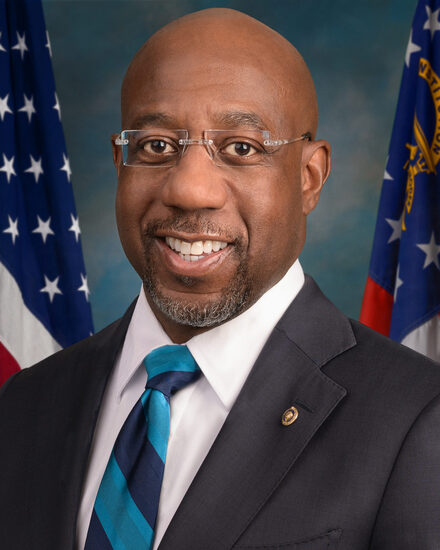
Sen. Raphael G. Warnock
Sponsored bills
Defense Infrastructure Support Act This bill extends to September 30, 2025, the authority of the Department of Defense to use a working capital fund for unspecified minor military construction projects to revitalize and recapitalize defense industrial base facilities.
Health Equity and Accountability Act of 2022 This bill directs the Department of Health and Human Services (HHS) and others to undertake efforts to reduce health disparities. For example, the bill (1) requires more detailed reporting of demographic and health disparities data, including related to public health emergencies; (2) directs certain components of HHS to support health workforce diversity; and (3) increases access to culturally and linguistically appropriate health care. The bill also modifies eligibility and other requirements for Medicare, Medicaid, private health insurance, nutrition assistance, and other programs to reduce health disparities among vulnerable populations. The bill includes specific provisions with respect to noncitizens; maternal, infant, and child health; mental and behavioral health; specified conditions that disproportionately affect racial and ethnic minority groups, such as certain cancers, HIV/AIDS, kidney disease, and diabetes; investments in communities facing health and other inequities; and nondiscrimination in the provision of services in federally supported health programs. Additionally, the bill (1) revises health information technology programs to address health disparities, and (2) supports health impact assessments and other efforts pertaining to environmental justice and social determinants of health (i.e., nonmedical factors that influence health outcomes, such as income and educational attainment). The bill also requires various studies and reports on issues related to health care and health disparities, including a report by the Government Accountability Office on health workforce diversity.

Supply Chain Resiliency Act This bill establishes the Office of Supply Chain Resiliency within the Department of Commerce. The office must identify vulnerabilities in the supply chains for critical products and emerging technologies. It also must provide financial support to manufacturers to expand production of products that are part of supply chains experiencing shortages.
Downpayment Toward Equity Act of 2021 This bill establishes a grant program through the Department of Housing and Urban Development for states and other entities to provide qualifying assistance to certain first-time, first-generation home buyers in purchasing their first homes. Qualifying assistance includes assistance for mortgage down payments, mortgage closing costs, reduction of mortgage interest rates, subsidies for shared equity homes, or for certain preoccupancy modifications to a home to accommodate persons with disabilities. The bill also establishes grant requirements regarding home buyer income, types of housing, homeowner occupancy, types of mortgages, and home buyer counseling.
Protecting the Right to Organize Act of 20 21 This bill expands various labor protections related to employees' rights to organize and collectively bargain in the workplace. Among other things, it revises the definitions of employee , supervisor , and employer to broaden the scope of individuals covered by the fair labor standards; permits labor organizations to encourage participation of union members in strikes initiated by employees represented by a different labor organization (i.e., secondary strikes); and prohibits employers from bringing claims against unions that conduct such secondary strikes. The bill also allows collective bargaining agreements to require all employees represented by the bargaining unit to contribute fees to the labor organization for the cost of such representation, notwithstanding a state law to the contrary; and expands unfair labor practices to include prohibitions against replacement of, or discrimination against, workers who participate in strikes. The bill makes it an unfair labor practice to require or coerce employees to attend employer meetings designed to discourage union membership and prohibits employers from entering into agreements with employees under which employees waive the right to pursue or a join collective or class-action litigation. Finally, the bill addresses the procedures for union representation elections, modifies the protections against unfair labor practices that result in serious economic harm, and establishes penalties and permits injunctive relief against entities that fail to comply with National Labor Relations Board orders.
This resolution reaffirms the goals of World Refugee Day and the commitment of the United States to promote the safety and well-being of refugees and asylum seekers.
Veterans Expedited TSA Screening Safe Travel Act or the VETS Safe Travel Act This bill makes certain veterans eligible for the Transportation Security Administration (TSA) PreCheck Program at no cost if they meet the program's background check and security requirements. Veterans who are eligible for this fee waiver are those who are in the annual patient enrollment system of the Department of Veterans Affairs (VA) and require the use of a wheelchair, prosthetic limb, or other assistive device to aid with mobility due to (1) loss, or loss of use, of a limb; (2) full or partial paralyzation; or (3) permanent blindness. The VA and the TSA must develop and implement a process to provide disabled veterans effective outreach about TSA programs that are designed to improve the screening process for passengers with disabilities.
Good Jobs for Good Airports Act This bill addresses pay, benefits, and labor standards for certain airport service workers. Airport service workers include security officers, food service workers, cleaning staff, ticketing agents, and retail service workers. Specifically, the bill establishes a minimum wage and benefit standard for such airport service workers at large, medium, and small hub airports. It also prohibits small, medium, and large hub airports from accessing federal funds for airport development projects unless the airports certify that such airport service workers are paid no less than the higher of $15 per hour, the applicable state or local minimum wage and fringe benefits, or the prevailing wage and fringe benefits required under the Service Contract Act as established by the Department of Labor.
Ocean Shipping Reform Act of 2022 This act revises requirements governing ocean shipping to increase the authority of the Federal Maritime Commission (FMC) to promote the growth and development of U.S. exports through an ocean transportation system that is competitive, efficient, and economical. For example, the bill requires the FMC to (1) investigate complaints about detention and demurrage charges (i.e., late fees) charged by common ocean carriers, (2) determine whether those charges are reasonable, and (3) order refunds for unreasonable charges. It also prohibits common ocean carriers, marine terminal operators, or ocean transportation intermediaries from unreasonably refusing cargo space when available or resorting to other unfair or unjustly discriminatory methods.