

Maddy summaryThis bill requires colleges and universities receiving federal financial aid to include hazing incidents in their annual security reports and publish detailed public transparency reports. It defines hazing as intentional acts causing physical or mental harm during group initiation or membership, and mandates institutions to create annual Campus Hazing Transparency Reports. These reports must list verified hazing incidents, organizational involvement, investigation timelines, and sanctions - while protecting student privacy - starting 12 months after enactment. Reports must be updated twice yearly and remain publicly available for seven years. The law applies to all U.S. institutions participating in federal higher education programs.
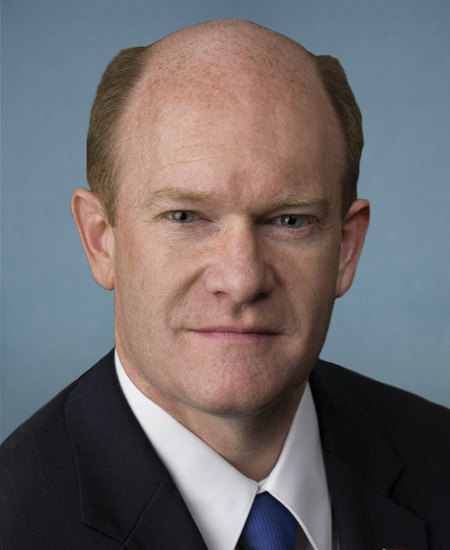
Sen. Christopher A. Coons
Sponsored bills
Maddy summaryThe Updated Drug Labeling for Patient Safety Act (S 2886) allows generic drug manufacturers to update their product labels - including safety information - using the same process as brand-name drug companies, without requiring a full new application. The bill requires the FDA to order consistent label changes across all equivalent generic drugs when one manufacturer updates its labeling for safety reasons. This ensures patients and healthcare providers receive uniform safety information across similar medications. The bill directly affects generic drug manufacturers and the FDA, streamlining safety updates to improve patient safety without delaying necessary label changes.
Maddy summaryThis bill expands Medicare's coverage for telehealth services by adding new categories of healthcare providers who can deliver these services and receive payment. It directly affects Medicare beneficiaries seeking therapy services (like physical, occupational, speech, or audiologic therapy) via telehealth, as well as the therapists and assistants providing them. Key provisions include authorizing Medicare to pay for telehealth services provided by qualified audiologists, occupational therapists and their assistants (under supervision), physical therapists and their assistants (under supervision), and speech-language pathologists. The bill also allows the Secretary of Health and Human Services to specify additional eligible providers for telehealth services under Medicare.
Maddy summarySRES 353 is a symbolic Senate resolution designating the week of September 16-23, 2023, as "National Estuaries Week." It expresses the Senate’s support for raising public awareness about the ecological and economic importance of estuaries. The resolution highlights estuaries’ role in supporting jobs, economic output, and critical habitats, while acknowledging threats like pollution and habitat loss. This procedural resolution has no direct regulatory or funding impact - it serves solely as a formal acknowledgment of estuaries’ value.
Maddy summaryThis Senate resolution symbolically designates September 2023 as "National Voting Rights Month" to raise awareness about voting rights history and current challenges. It recommends Congress pass specific voting rights legislation (like the Freedom to Vote Act and Democracy Restoration Act) and encourages public education on voting accessibility, registration, and historical voter suppression. The resolution has no binding effect on policy or funding - it serves as a symbolic recognition and call to action for voting rights advocacy.
Maddy summaryThis resolution designates September 11, 2023, as a "National Day of Service and Remembrance" to honor victims and first responders of the 2001 terrorist attacks. It encourages all Americans to observe the day through volunteerism, reflection, and community service - aligning with the existing tradition established by the 2009 Serve America Act. The resolution does not create new laws or policies but formally recognizes an annual observance already practiced nationwide.
Maddy summaryThis bill amends the tax code to exclude certain veterinary student loan repayment or forgiveness assistance from taxable income. It specifically applies to veterinarians participating in programs under the National Agricultural Research, Extension, and Teaching Policy Act of 1977 or similar state programs designed to increase rural veterinary access. The key change clarifies that financial assistance provided through these targeted programs is not considered taxable income for participants. This directly benefits veterinarians in rural areas who use these loan repayment options to practice in underserved communities.
Maddy summaryThis proposed constitutional amendment would give Congress and states the authority to regulate campaign contributions and spending, including setting limits and prohibiting corporations from spending money to influence elections. It explicitly protects freedom of the press by stating the amendment cannot be used to abridge it. If ratified by three-fourths of state legislatures, it would establish a new constitutional standard for campaign finance regulation.
Maddy summaryThe Carbon Dioxide Removal Research and Development Act of 2023 establishes a federal program to research and develop carbon dioxide removal technologies across multiple departments. It creates an Office of Fossil Energy and Carbon Management within the Department of Energy to coordinate research and authorizes over $10 billion in funding through 2033 for projects including direct air capture, forest restoration, soil carbon management, and ocean-based removal techniques. The bill requires lifecycle analyses and environmental justice assessments for all technologies and establishes competitive demonstration projects with specific cost requirements. Federal agencies must prioritize carbon removal research in their programs, directing billions of dollars toward advancing these technologies to reduce atmospheric carbon dioxide levels.
Maddy summaryThe Veteran Families Health Services Act of 2023 provides fertility treatment and counseling services to active duty military members and veterans with infertility conditions, along with adoption assistance for veterans. It requires the Department of Defense to establish fertility preservation procedures before deployment or hazardous assignments, including cryopreservation and storage of reproductive genetic material at no cost to service members. The bill ensures these services are provided without regard to sex, gender identity, sexual orientation, or marital status, with specific limits on in vitro fertilization (three completed oocyte retrievals, unlimited embryo transfers per medical guidelines). It creates coordination between the Department of Defense and Department of Veterans Affairs to ensure seamless transitions of care and adds adoption assistance with a limit of three covered adoptions. The legislation specifically covers veterans with service-connected disabilities affecting reproductive health, such as spinal cord injuries, military sexual trauma, or certain mental health conditions.