

Maddy summaryS. 3427, the Overtime Pay for Protective Services Act of 2023, extends the authority for U.S. Secret Service protective services staff to receive overtime pay beyond standard federal limits through 2028. It directly affects Secret Service personnel providing protective services (excluding routine administrative work), allowing them to earn overtime pay without hitting typical pay caps. Key provisions include updating the law’s expiration date to 2028, clarifying that "protective services" excludes administrative tasks, and requiring the Secret Service Director to submit annual reports on overtime usage and strategies to reduce reliance on overtime. These reports must detail staffing levels, operational demands, and quarterly projections for 2024-2027, plus annual effect assessments through 2029. The bill focuses on maintaining operational capacity for high-demand protective duties while adding oversight mechanisms.
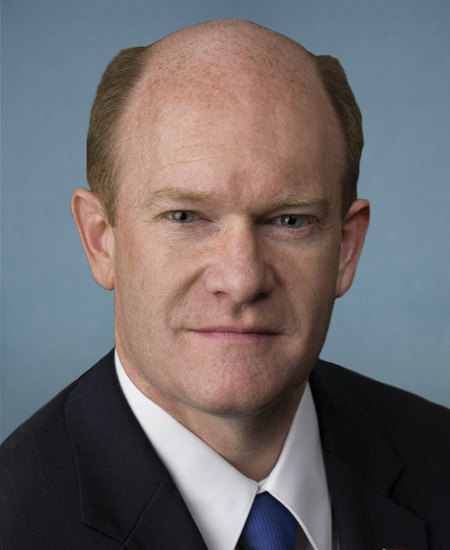
Sen. Christopher A. Coons
Sponsored bills
Maddy summarySRES 529 is a symbolic Senate resolution recognizing January 2024 as "National Mentoring Month." It does not create new laws or allocate funds, but formally acknowledges the value of mentoring relationships for youth development. The resolution highlights mentoring's benefits - including improved academic outcomes, mental health, and career readiness - while noting that one-third of U.S. youth lack a mentor. It urges support for mentoring programs but has no direct effect on individuals or policy implementation.
Maddy summarySRES 537 is a non-binding Senate resolution urging the U.S. government to formally adopt the term "genocide against the Tutsi" when referring to the 1994 Rwanda atrocities. It specifically asks the Secretary of State to use this terminology in official communications, aligning U.S. language with the UN, European nations, and the U.S. Holocaust Memorial Museum. The resolution also notes that other violence occurred during the 1994 period, including against Hutus and the Twa community. This resolution does not change U.S. law but seeks to standardize terminology to combat genocide denial.
Maddy summaryThe GRACE Act establishes a minimum annual refugee admission level of 125,000, requiring the U.S. to admit at least that many refugees each fiscal year unless the President sets a higher number (with 125,000 automatically applying if no determination is made). It mandates that the President consider the United Nations High Commissioner for Refugees' global resettlement needs when setting annual numbers and allocate refugees regionally, including an unallocated reserve for unexpected regional needs after notifying Congress. The bill also requires quarterly reports to Congress on refugee admissions, including regional breakdowns, security clearance rates, processing times, and plans to meet annual goals, enhancing transparency in the refugee admissions process.
Maddy summaryS 3702, the Credit for Caring Act of 2024, creates a tax credit for working family caregivers who provide care for a certified family member needing long-term assistance. Eligible caregivers (with over $7,500 in earned income) can claim a credit equal to 30% of qualified care expenses exceeding $2,000 annually, capped at $5,000 per year. Qualified expenses include human assistance, home modifications, respite care, counseling, lost wages for unpaid care time, and transportation - provided the care recipient (e.g., a parent or spouse) is certified by a healthcare provider as requiring long-term care for at least 180 days. The credit phases out for taxpayers with modified adjusted gross income above $75,000 (single) or $150,000 (joint returns).
Maddy summaryThis bill requires the U.S. Secretary of Energy to study and publicly report on greenhouse gas emissions intensity (emissions per unit of product) for 22 specific product categories, including aluminum, cement, lithium-ion batteries, and solar panels. It mandates comparing U.S. production emissions with those of "covered countries" (like G7 nations, U.S. trade partners, and major exporters). The study must create a public database of findings every five years, detailing methodology, data sources, and gaps in emissions data for both U.S. and foreign production. This is a data-gathering measure only - it does not impose new emissions regulations or affect current policies.
Maddy summaryThe Hire Veterans Act (S 3636) creates a 5-year pilot program to help veterans secure jobs at five federal land management agencies (Forest Service, National Park Service, Fish and Wildlife Service, Bureau of Land Management, and Bureau of Reclamation). Veterans apply through the Office of Personnel Management, take tests assessing skills for 20 specific career fields (like firefighting, ecology, and land surveying), and may receive noncompetitive hiring for positions if they pass. If veterans don’t initially qualify, agencies must refer them to training programs and retest them until they meet requirements. The program aims to streamline hiring for veterans with relevant skills while requiring annual reports to Congress.
Maddy summaryThis bill clarifies patent eligibility by removing judicial exceptions that previously blocked many inventions from patent protection. It states that any useful process, machine, manufacture, or composition of matter (or improvement) is eligible for a patent, except for unmodified human genes, natural materials, mathematical formulas used alone, mental processes, or business methods not requiring a machine. Patent applicants will no longer face uncertainty about whether their invention qualifies under patent law's eligibility rules. The law aims to provide clear, consistent standards for determining patent eligibility across all courts.
Maddy summarySRES 523 is a Senate resolution honoring the late Senator Herb Kohl of Wisconsin. The resolution expresses the Senate's sorrow at his death, directs the Secretary of the Senate to communicate it to the House of Representatives and send a copy to his family, and instructs the Senate to adjourn as a mark of respect. This procedural resolution does not create new laws or affect policy, but formally commemorates Kohl's service and legacy. It was introduced by a bipartisan group of Senators and passed unanimously on January 11, 2024.
Maddy summaryThis bill requires the U.S. Department of Energy to remove specific quantities of carbon dioxide from the atmosphere annually, starting at 50,000 metric tons in 2024 and scaling up to 10 million tons yearly by 2035. It establishes price caps for removal (ranging from $750 per ton in 2024 down to $150 per ton after 2035) and mandates that eligible technologies must remove CO2 directly from air or seawater without using natural photosynthesis or enhanced oil recovery. The bill requires rigorous monitoring, reporting, and verification of removals, prioritizes projects supporting job creation in fossil fuel communities and environmental justice, and mandates a study on scaling removal to gigaton levels by 2050. Federal agencies must report annual progress, including removal quantities, costs, and impacts on communities.