

Maddy summaryThe SOAR Act of 2024 changes how Medicare pays for supplemental oxygen therapy and related equipment/supplies by removing them from competitive bidding and establishing new payment rates starting January 1, 2025. It creates different payment structures for urban, rural, and other areas, with special provisions for liquid oxygen and additional reimbursement for respiratory therapist services. The bill requires oxygen suppliers to provide specific services including patient evaluations, equipment maintenance, 24-hour support, and clear beneficiary communications. It also establishes new electronic templates for documenting medical necessity and detailed rights for beneficiaries, including the right to choose suppliers and receive appropriate equipment for mobility.
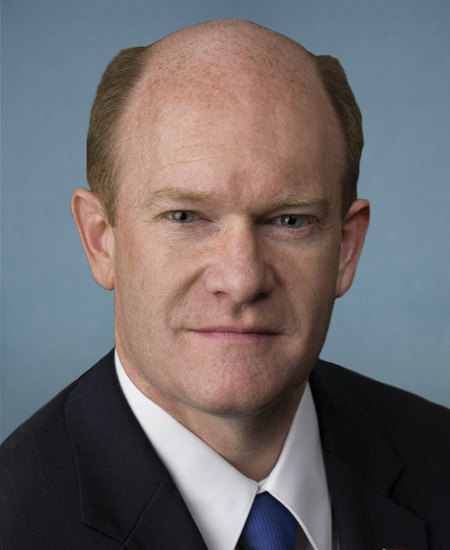
Sen. Christopher A. Coons
Sponsored bills
Maddy summaryThis bill (S 3813) is a technical amendment to existing law governing Inspector General (IG) investigations of Department of Justice (DOJ) personnel. It removes a specific exception in the law that previously restricted IG access to certain allegations about DOJ staff, streamlining the investigation process. The change affects only internal DOJ oversight procedures and does not create new policies or impact the public. It is a procedural update to clarify and simplify existing IG authority under Title 5, U.S. Code.
Maddy summaryThis bill (S 3804) designates a specific street segment in Washington, D.C. (Sumner Row between 16th and L Streets NW) as "Alexei Navalny Way" to honor the late Russian anti-corruption activist and dissident. It includes findings recognizing Navalny's work exposing Russian corruption, his imprisonment and death under the Putin regime, and his international awards for promoting democratic freedoms. The bill requires the District of Columbia to install two street signs bearing the new name at designated locations. As a commemorative resolution, it does not create new laws or affect policies - it serves as a symbolic gesture of solidarity with Russian opposition figures.
Maddy summarySRES 553 is a ceremonial Senate resolution honoring Jean A. Carnahan, who served as Missouri’s first female U.S. Senator from 2001 to 2002 after her husband’s passing. The resolution expresses the Senate’s sorrow over her death, recognizes her service as First Lady of Missouri and U.S. Senator, and her advocacy for families and veterans. It directs the Senate Secretary to share the resolution with the House and Carnahan’s family, with no substantive policy changes or affected parties. This is a standard commemorative measure with no legislative impact.
Maddy summarySRES 547 is a symbolic Senate resolution commemorating the two-year anniversary of Russia's full-scale invasion of Ukraine (launched February 24, 2022). It expresses U.S. support for Ukraine's territorial integrity and sovereignty, condemns Russian actions including war crimes (like the Bucha massacre), and reaffirms congressional backing for Ukraine's defense against aggression. The resolution has no binding effect or policy changes - it serves as a formal statement of solidarity with Ukraine, acknowledging the humanitarian crisis and international aid efforts. It was introduced by 31 Senators and does not alter laws, funding, or military commitments.
This resolution supports the designation of February 17-February 24, 2024, as National FFA Week. It also (1) recognizes the important role of the National FFA Organization (Future Farmers of America) in developing the next generation of globally conscious leaders who will change the world; and (2) celebrates the 10th anniversary of the Give the Gift of Blue program, which has donated more than 17,000 FFA blue jackets to FFA members in need.
Maddy summarySRES 550 is a symbolic Senate resolution designating February 2024 as "Career and Technical Education (CTE) Month" to recognize the value of CTE programs. It does not create new laws or funding but formally supports CTE's role in preparing students for high-demand careers through secondary and postsecondary training. The resolution encourages educators and parents to promote CTE as a respected educational pathway, aligning with the Senate's recognition of CTE's importance for workforce development and economic competitiveness. As a procedural resolution, it has no binding effect but expresses bipartisan support for CTE initiatives.
Maddy summarySRES 551 is a symbolic Senate resolution (not a law) introduced by multiple senators on February 8, 2024, to formally celebrate Black History Month. It acknowledges the historical contributions of African Americans to U.S. society and encourages the public to reflect on their legacy during February. The resolution contains no new policies or requirements - it simply expresses the Senate's recognition of Black History Month as an opportunity to honor these contributions and learn from history. It does not affect any individuals, groups, or government programs. This is a standard annual commemorative resolution, consistent with similar resolutions passed each February.
Maddy summaryThis bill amends the Social Security Act to clarify who qualifies for reemployment services under unemployment programs. It updates the language to refer specifically to "claimants for regular compensation" (unemployed workers receiving regular unemployment benefits) instead of vague terms like "individuals referred to reemployment services." The change ensures that workers actively collecting unemployment benefits are clearly identified as the direct beneficiaries of these job support services. The bill makes a technical adjustment to existing law without creating new programs or changing eligibility criteria.
Maddy summaryS 3753 (Improving State and Local Government Access to Performance Contracting Act of 2024) provides federal funding to help states develop or expand programs that enable state/local governments, public schools, and other public entities to use energy and water efficiency projects paid for by future savings. The bill allocates $35 million annually to states to create model contracts, prequalify contractors, and offer technical assistance, while requiring states to primarily use private financing and supplement - not replace - existing funds. It also establishes a national certification program for project facilitators to oversee these efficiency projects and ensure they meet savings targets. This directly affects state energy agencies and local governments seeking to implement cost-saving energy/water upgrades without upfront costs.