

Maddy summaryThis bill directs $1.4 billion annually (2025-2029) to upgrade U.S. Postal Service mailboxes with high-security models and replace physical "arrow keys" with electronic locks, directly affecting postal carriers and mail collection points. It requires the Attorney General to appoint dedicated prosecutors in each judicial district to coordinate investigations and prosecutions of crimes against postal employees, including assaults or robberies. The bill also mandates the U.S. Sentencing Commission to amend guidelines so that assaults or robberies against postal employees are treated with the same severity as assaults against law enforcement officers. These changes aim to enhance physical security, improve legal responses to violence, and increase penalties for attacks on postal workers.
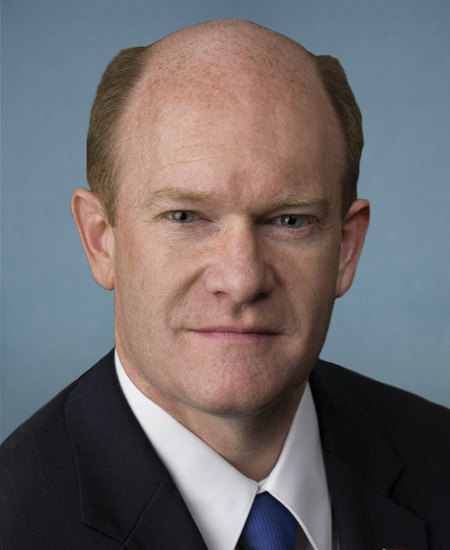
Sen. Christopher A. Coons
Sponsored bills
Maddy summaryS 475, the Alternatives to PAIN Act, changes Medicare Part D coverage to make non-opioid pain management drugs more accessible and affordable for beneficiaries. It requires Medicare plans to cover qualifying non-opioid pain drugs without deductibles and place them on the lowest cost-sharing tier (meaning patients pay the least out-of-pocket) starting in 2026. The bill also prohibits plans from requiring step therapy (forcing patients to try opioids first) or prior authorization for these specific drugs. Qualifying drugs must treat acute pain (like post-surgery), not work on opioid receptors, have no equivalent alternatives, and meet cost thresholds. This directly affects Medicare Part D beneficiaries needing pain management and the plans that cover them.
Maddy summaryThis bill (S 482) adds Czechia to the list of countries whose business traders can enter the U.S. as E-1 nonimmigrants, provided Czechia offers similar status to U.S. nationals. It directly affects Czech businesspeople seeking to operate trade in the U.S. and U.S. citizens needing reciprocal treatment in Czechia. The key provision modifies the Immigration and Nationality Act to include Czechia as a qualifying country if the Czech government grants comparable business visitor status to U.S. citizens. This change would allow Czech nationals to access E-1 visa benefits for conducting trade, contingent on Czechia’s reciprocal policy. The bill focuses solely on updating eligibility criteria without altering broader immigration rules.
Maddy summaryThis bill creates a new "Director of Foreign Assistance" position within the U.S. Department of State, requiring Senate confirmation and mandating that the Director report directly to the Deputy Secretary of State. The Director's duties include coordinating all U.S. foreign aid programs across agencies (like USAID and the Treasury), aligning aid with national security goals, tracking results through data analysis, and improving transparency in spending. The bill also requires all foreign aid funds to be obligated (committed for spending) within 90 days of congressional appropriations. This position directly affects how the State Department and other federal agencies manage and report on foreign assistance programs.
This resolution condemns Russia's nuclear escalatory rhetoric and implied threats on the potential use of nuclear weapons in the context of its invasion of Ukraine. The resolution also (1) condemns Russia's purported suspension of participation in the New START Treaty, (2) emphasizes the value of arms control agreements between the United States and Russia, and (3) calls on the administration to continue pursuing nuclear arms control and risk reduction with Russia and China.
Maddy summaryS 422, the Right to Contraception Act, establishes a federal statutory right for individuals to access contraceptives and for healthcare providers to offer contraceptive services, free from state restrictions. It directly affects all Americans seeking or providing contraception, particularly protecting historically marginalized groups like people of color, immigrants, LGBTQ+ individuals, and low-income or rural residents who face barriers to care. The bill overrides state laws that restrict access - such as bans on specific contraceptives, provider refusal policies based on personal beliefs, or Medicaid restrictions - and prohibits government actions that impede this right. Enforcement allows the Attorney General or affected individuals to challenge violations in court, with courts required to strike down restrictive laws.
Maddy summaryThis bill amends federal securities laws to expand regulatory exemptions for retirement plans used by charities and educational institutions. It specifically updates definitions to include 403(b) plans (common for nonprofit employees) under exemptions from certain registration and oversight rules, provided they meet three conditions: (1) they follow federal retirement law (ERISA), (2) the employer acts as a fiduciary for investment choices, or (3) they are governmental plans. This change directly affects employees of qualifying charities and educational institutions who participate in these 403(b) plans, reducing compliance burdens for their retirement plans. The policy change streamlines regulatory requirements without altering retirement benefits or funding.
Securing Trade and Resources for Advanced Technology, Economic Growth, and International Commerce in Minerals Act or STRATEGIC Minerals Act This bill authorizes actions to facilitate trade and increase U.S. access to critical minerals and rare earth elements (REEs). Under the bill, critical minerals are any mineral, element, substance, or material designated as critical by the U.S. Geological Survey (e.g., aluminum and cobalt). Additionally, the bill includes a group of 17 elements within the definition of REEs , including elements used in permanent magnets (e.g., dysprosium and neodymium). Specifically, the bill authorizes the President, acting through the Office of the U.S. Trade Representative, to (1) negotiate, enter into, and enforce a free trade agreement with a country or countries with respect to critical minerals and REEs when the President determines it is in the national interest; and (2) proclaim a modification or continuance of any existing duty, or continuance of existing duty-free or excise treatment, as the President determines necessary to carry out the agreement. The bill prohibits agreements with nonmarket economy countries that are designated as foreign countries of concern (e.g., China and Russia). The bill outlines procedures for congressional notification, consultation, and review of these trade agreements. The bill also expands the definition of domestic source under the Defense Production Act, thereby making certain businesses from countries that are party to free trade agreements under this bill eligible for financial incentives to increase production of critical components, critical technology items, materials, and industrial resources needed for U.S. national security.
Maddy summarySRES 55 is a Senate resolution designating January 2025 as "National Mentoring Month." It formally recognizes the value of mentoring relationships in supporting youth development, highlighting benefits like improved academic outcomes, mental health, career exploration, and reduced juvenile delinquency. The resolution encourages expanding mentoring programs in communities, schools, and workplaces to address the "mentoring gap" where one-third of U.S. youth lack consistent mentorship. As a symbolic measure, it aims to raise public awareness and promote cross-sector collaboration without creating new laws or funding.
Maddy summaryS 383 (the JOBS Act of 2025) expands Federal Pell Grant eligibility to students enrolled in certain short-term job training programs at eligible institutions of higher education. The bill creates a "job training Federal Pell Grant" for programs meeting specific criteria: 150-600 clock hours over 8-15 weeks, aligned with high-demand industry sectors, and leading to recognized postsecondary credentials that meet employer hiring requirements or licensure prerequisites. It also lowers the minimum Pell Grant award from 10% to 5% of the full annual amount. This directly affects students seeking career-focused training and institutions offering qualifying programs that validate industry partnerships.