

Maddy summarySRES 80 is a Senate resolution introduced on February 13, 2025, expressing gratitude to the Joint Congressional Committee on Inaugural Ceremonies, the Architect of the Capitol, the Sergeant at Arms, the Secretary of the Senate, law enforcement officers, emergency personnel, and volunteers. It specifically acknowledges their work during the January 20, 2025 inauguration of President Donald J. Trump, noting their efforts to adapt to cold weather challenges that required relocating events indoors. The resolution has no policy impact and serves solely as a ceremonial acknowledgment of their contributions to the inauguration's security and success.
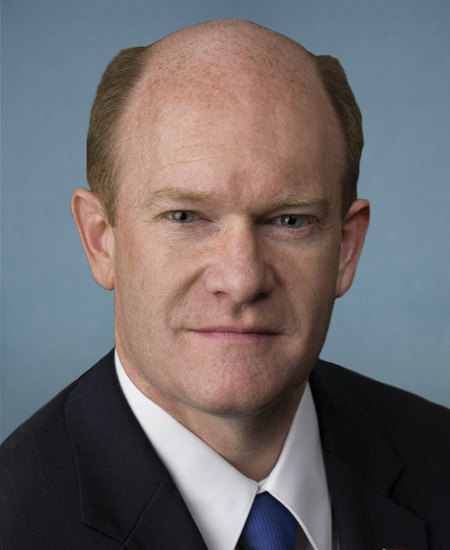
Sen. Christopher A. Coons
Sponsored bills
Maddy summaryThe Healthy Poultry Assistance and Indemnification Act of 2025 requires the U.S. Department of Agriculture to compensate poultry growers and egg-laying facility owners when their operations are in a USDA-designated "control area" (a zone established due to animal health threats like disease outbreaks). Compensation equals the average income from the owner's five most recent flocks multiplied by the number of flocks they were prohibited from raising during the control period, but cannot exceed the difference between this amount and any other compensation received. Payments must be made within 60 days of the owner's request. This bill directly assists poultry producers facing income loss due to USDA-mandated restrictions during disease control efforts.
Maddy summaryThe I CAN Act aims to expand healthcare access by removing barriers for nurse practitioners, certified registered nurse anesthetists, and certified nurse-midwives in Medicare and Medicaid programs. Key provisions include allowing nurse practitioners to certify patients for cardiac and pulmonary rehabilitation programs without physician supervision, expanding coverage for services provided by certified nurse-midwives in home health care, and removing unnecessary supervision requirements for nurse anesthetists. The bill changes Medicare rules to permit these advanced practice nurses to provide more services directly to patients in settings like hospitals, skilled nursing facilities, and home health care. This would directly affect millions of Medicare and Medicaid beneficiaries who receive care from these healthcare providers. The changes would take effect 90 days after enactment, with some provisions applying to services furnished on or after that date.
Maddy summaryThe Age 21 Act (S 597) would prohibit individuals under 21 years old from purchasing certain firearms and related items. The bill specifically targets semiautomatic assault weapons, certain pistols, shotguns, and large-capacity ammunition feeding devices by amending Section 922 of Title 18. It defines detailed categories of firearms that would be covered, including specific models like AR-15s and AK-47s, as well as features like detachable magazines that hold more than 10 rounds. The bill would require sellers to verify that buyers are at least 21 years old for these specific firearms and ammunition types. This would directly affect young adults aged 18-20 who would no longer be able to purchase these defined firearms.
Maddy summaryThe Financing Our Energy Future Act (S 510) expands tax-qualified activities for green energy publicly traded partnerships under the Internal Revenue Code. It directly affects businesses investing in renewable energy projects by adding specific eligible activities, such as generating power from qualified renewable sources (e.g., solar, wind, or advanced nuclear), storing energy using new technology, capturing carbon dioxide, and producing low-emission fuels. Key provisions require new fuels to achieve at least a 60% reduction in lifecycle greenhouse gas emissions compared to baseline standards, and mandate that carbon capture facilities capture at least 50% of their carbon oxide output. The changes take effect for taxable years beginning after December 31, 2025.
Credit Union Board Modernization Act This bill revises the required frequency of meetings held by a credit union's board of directors. Specifically, new credit unions and credit unions with a low soundness rating must meet monthly. All other credit unions must hold at least six meetings annually, with at least one meeting held during each fiscal quarter. Currently, all credit union boards must meet at least once a month.
Maddy summaryThis bill increases the Work Opportunity Tax Credit (WOTC) for employers hiring from targeted groups. It raises the credit rate to 50% for the first $6,000 in wages for most workers, and adds a 50% credit for wages between $6,000 and $12,000 for workers with at least 400 hours of service. For veterans, the wage limits for the credit are doubled (to $12,000 and $24,000), and the bill removes the previous age limit for Supplemental Nutrition Assistance Program (SNAP) recipients. These changes apply to workers hired after December 31, 2024.
Maddy summarySRES 64 is a Senate resolution honoring the 67 victims of a mid-air collision between American Airlines Flight 5342 and a U.S. Army aircraft near Washington, D.C., on January 29, 2025. It directly affects the families, friends, and communities of the victims, who were from multiple U.S. states and several countries. The resolution formally commemorates the lives lost, offers condolences to grieving families, and expresses gratitude to the 42 emergency response agencies that assisted in rescue and recovery efforts. As a commemorative resolution, it has no policy or legal effect beyond expressing collective mourning and recognition.
This resolution supports the designation of Career and Technical Education Month to celebrate career and technical education across the United States.
Protecting Sensitive Locations Act This bill prohibits immigration enforcement actions within 1,000 feet of a sensitive location except in exigent circumstances, such as the imminent risk of death, violence, or physical harm to any person. Sensitive locations include health care facilities; schools and school bus stops; places that provide assistance for people such as children, pregnant women, and abuse victims; child care facilities; places that provide disaster or emergency services; places of worship; courthouses and lawyers’ offices; facilities used as polling places; certain labor union facilities; and public assistance offices. The prohibition shall apply to Department of Homeland Security officers and agents, as well as state employees pursuing immigration enforcement actions. If an enforcement action is carried out in violation of this prohibition (1) no information resulting from the action may be entered into the record in a resulting removal proceeding, and (2) the affected individual may move to immediately terminate such a proceeding. U.S. Immigration and Customs Enforcement and U.S. Customs and Border Protection shall annually report to Congress about enforcement actions taken at sensitive locations in the preceding year.