

Maddy summaryThis resolution expresses the Senate's disapproval of the U.S. delegation's February 24, 2025, vote at the United Nations General Assembly against a Ukraine peace resolution (A/ES-11/L.10). It condemns the vote as the first U.S. alignment with Russia on Ukraine since 2014, criticizing the refusal to identify Russia as an aggressor or demand its withdrawal from Ukraine. The resolution has no binding effect but formally urges future UN cooperation with Ukraine and allies while reaffirming support for Ukraine's sovereignty.
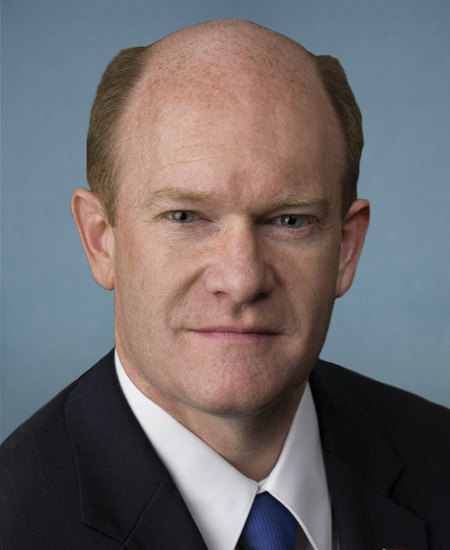
Sen. Christopher A. Coons
Sponsored bills
Maddy summaryThis bill creates a streamlined process for out-of-state healthcare providers to enroll in Medicaid or CHIP (Children's Health Insurance Program) in a state. It directly affects children under 21 enrolled in these programs and healthcare providers located in other states who already meet low fraud risk standards. The key provision requires states to adopt a simplified enrollment process using only basic provider information (like name and National Provider Identifier), granting eligible providers a 5-year enrollment period without repeated screening. This reduces administrative barriers for providers serving out-of-state children under 21 who qualify for Medicaid or CHIP coverage.
Maddy summaryThis resolution (SRES 93) expresses the Senate's view that the National Institutes of Health (NIH) should not face funding disruptions or operational delays that violate existing law. It specifically highlights the importance of uninterrupted NIH work on research for diseases like cancer, Alzheimer’s, diabetes, and heart disease. The resolution emphasizes that NIH scientists and researchers are essential to medical progress and public health efforts. As a symbolic resolution, it does not change funding laws or create new policies - it solely states the Senate’s position on protecting NIH operations.
Maddy summaryThis bill, S 708 (RESTORE Patent Rights Act of 2025), aims to restore a legal presumption that courts should grant permanent injunctions to stop ongoing or willful patent infringement. It directly affects patent owners, particularly individual inventors, universities, startups, and small businesses, who often struggle to obtain court orders against large companies. The key provision amends patent law to create a "rebuttable presumption" that an injunction is warranted after a final finding of infringement, shifting the burden to defendants to prove why an injunction shouldn’t be issued. This change seeks to address reduced access to injunctions in recent court decisions, which critics argue incentivizes predatory infringement against smaller patent holders.
Maddy summaryThis bill creates a new Medicaid health home program specifically for people with sickle cell disease (SCD), beginning January 1, 2026. It requires states to provide dental and vision services to SCD patients enrolled in these health homes, regardless of whether they offer such services generally to other Medicaid beneficiaries. States must also report on care quality, access, and costs for SCD patients using these specialized health homes, and the federal government must publish best practices for implementing the program by June 2026. The bill directly affects Medicaid patients diagnosed with SCD and state Medicaid programs managing these specialized care services.
Maddy summaryS 726, titled "Ethan's Law," requires gun owners to store firearms securely in homes where minors (under 18) or individuals ineligible to own guns (per federal/state law) reside. It makes unsecured storage unlawful if a person "knows or reasonably should know" access is possible, with exceptions for gun safes, secure locations, or carrying firearms on one's person. Violations incur $500 fines per offense, and enhanced penalties apply if injury or death occurs. The bill also creates a federal grant program to support states with similar secure-storage laws and states that non-compliance constitutes negligence. This law directly affects households with minors or prohibited individuals, aiming to reduce accidental shootings, youth access, and firearm thefts.
Maddy summaryThis Senate resolution (SRES 91) commemorates the third anniversary of Russia's full-scale invasion of Ukraine (launched February 24, 2022) and expresses U.S. Senate support for Ukraine. It symbolically affirms U.S. solidarity with Ukraine, rejects Russia's territorial seizures, reaffirms U.S. support for Ukraine's sovereignty and territorial integrity within its 1991 borders, and encourages continued international efforts to counter Russian aggression. As a non-binding resolution, it does not create new laws or directly affect any individuals or groups but serves as a formal statement of congressional support for Ukraine.
Federal Prisons Accountability Act of 2025 This bill modifies the appointment procedures and term of service for the Director of the Bureau of Prisons. Currently, the director is appointed by the Attorney General. This bill requires the director to be appointed by the President and confirmed by the Senate. The bill also limits the director to a single term of 10 years.
Maddy summaryThis Senate resolution (SRES 88) designates March 7, 2025, as "National Speech and Debate Education Day" to recognize the value of speech and debate programs in schools. It directly affects educational institutions, teachers, and students by encouraging schools and communities to celebrate this day. The resolution does not create new laws or funding but formally acknowledges speech and debate education as vital for developing communication, critical thinking, and civic skills. It urges educational institutions, businesses, and the public to promote awareness of these programs. (Note: As a commemorative resolution, it has no binding policy impact.)
Maddy summarySRES 89 is a symbolic Senate resolution designating February 15-22, 2025, as "National FFA Week." It recognizes the National FFA Organization’s role in developing student leadership through agricultural education and celebrates two milestones: the 90th anniversary of New Farmers of America (a historically Black agricultural youth group) and the 75th anniversary of the Federal charter for Future Farmers of America (signed by President Truman in 1950). The resolution does not create new laws or obligations but formally expresses congressional support for these observances. It affects no specific group or policy, serving solely as a ceremonial acknowledgment.