

Maddy summaryThe Tariff Transparency Act of 2025 requires the U.S. International Trade Commission to investigate and report on the economic impacts of tariffs imposed on imports from Mexico and Canada, including the 25% duties on general goods and 10% duties on Canadian energy imports. The report must assess how these tariffs affected consumer prices for everyday items like food, energy, medical goods, and vehicles, as well as the consequences of retaliatory tariffs from Mexico and Canada on U.S. consumers, farmers, and small businesses. It also evaluates how ongoing tariff uncertainty impacts business investment, job creation, and operations across key sectors like manufacturing and agriculture. The Commission must submit this detailed report to Congress within one year of the bill’s enactment, excluding confidential business information.
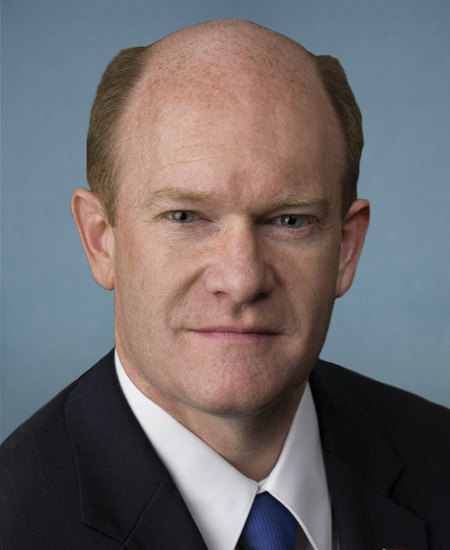
Sen. Christopher A. Coons
Sponsored bills
Maddy summarySRES 121 establishes the Senate Human Rights Commission, a bipartisan forum for discussing international human rights issues. The 10-member commission (5 from each party, led by two co-chairs) will hold hearings, monitor global human rights violations, and collaborate with other groups - but it has no legislative power or authority to draft bills. Funded with a $200,000 annual cap from the Senate’s Contingent Fund, the commission will sunset on January 1, 2029. It directly affects Senate members appointed to serve and builds on the existing Senate Human Rights Caucus.
Maddy summaryThis Senate resolution (SRES 122) recognizes the contributions of AmeriCorps members, alumni, and AmeriCorps Seniors volunteers to communities across the United States. It formally acknowledges their service - over 200,000 volunteers annually at 40,000 locations - through educational support, disaster response, environmental protection, and community strengthening. The resolution, passed during AmeriCorps Week (March 9-15, 2025), encourages public appreciation and volunteerism but does not create new policies, funding, or legal obligations. It is a symbolic gesture of Senate recognition, not a legislative change.
Maddy summaryS 916 prohibits the detention of pregnant, lactating, or postpartum noncitizens in immigration custody, requiring their immediate release except in rare cases involving credible safety threats. It bans all physical restraints during pregnancy, labor, delivery, and postpartum recovery, with strict limits on exceptions. The bill mandates access to comprehensive reproductive healthcare, including prenatal care, labor services, and postpartum support, while requiring facilities to provide medical consent and maintain detailed reporting on detention practices. These provisions apply directly to noncitizens held by U.S. Immigration and Customs Enforcement (ICE) or U.S. Customs and Border Protection (CBP) facilities.
Maddy summaryThis bill protects certain federal employees who were involuntarily separated between January 20, 2025, and January 20, 2029, and later rehired by their former agency. It requires that if a rehired employee is placed in a position similar to their previous role, their new probationary period is shortened by the amount of probation they already completed in their prior position. For example, if their original probation was 1 year and they served 6 months before separation, their new probation would be 6 months. The law expires on January 20, 2029, and applies only to Executive agencies.
Maddy summaryThe Choice in Affordable Housing Act of 2025 aims to improve the Housing Choice Voucher program by increasing landlord participation, particularly in high-opportunity neighborhoods (census tracts with poverty rates below 20%). It authorizes one-time payments to landlords (up to 200% of monthly housing assistance), security deposit payments to reduce tenant barriers, and bonuses for public housing agencies that employ dedicated landlord liaisons. The bill establishes a $100 million annual fund (2025-2029) to support these initiatives through the Herschel Lashkowitz Housing Partnership Fund. This legislation directly affects low-income families using vouchers, landlords who participate in the program, and public housing agencies administering the program.
Maddy summaryS 906 establishes a federal pilot program to fund peer-led mental health support in secondary schools (grades 6-12). States and tribes can apply for competitive grants to implement evidence-based programs where trained student peers help classmates navigate mental health challenges, with oversight by school counselors. The program requires measuring participation rates, mental health outcomes, and connections to professional care, and mandates an evaluation report to Congress. The pilot will run until September 30, 2029, with funds limited to existing mental health programs.
Maddy summaryThis bill amends the 2022 Camp Lejeune Justice Act to clarify and improve legal procedures for individuals exposed to contaminated water at Camp Lejeune. It updates the required proof of harm to include "latent or potential harm" and lowers the minimum required presence at Camp Lejeune from 30 consecutive days to any 30 days. The bill also specifies that cases must be filed in the Eastern District of North Carolina (with optional transfer to the 4th Circuit), mandates jury trials upon request, and sets attorney fee caps at 20% for pre-litigation settlements and 25% for cases filed after litigation begins. It directly affects individuals filing claims under the Camp Lejeune Justice Act for health issues linked to water contamination.
Maddy summaryThis resolution (SRES 108) is a non-binding Senate statement affirming constitutional principles regarding judicial review. It specifically affirms that Article III establishes federal courts, cites *Marbury v. Madison* as establishing judicial review (where courts interpret the law), and states that the executive branch must comply with federal court rulings. The resolution responds to recent public remarks suggesting the executive branch could disregard court decisions. It does not change laws or affect any specific group; it is a symbolic declaration of support for the judiciary's role in the constitutional system.
Maddy summaryThis bill, the Richard L. Trumka Protecting the Right to Organize Act of 2025, aims to strengthen workers' rights to organize and bargain collectively. It would make it harder for employers to classify workers as independent contractors by changing the definition of "employee," restricts employers from threatening to permanently replace workers who strike, and prohibits them from requiring employees to give up their right to pursue class or collective claims. The bill also changes election procedures to make it easier for workers to form unions, requires employers to post notices about workers' rights in conspicuous locations, and increases penalties for unfair labor practices. It directly affects employers and workers across various industries by altering the landscape of labor organizing and collective bargaining.