

Protect Our Citizens from Reckless Extortion of our Debt and Irresponsible Tactics Act of 2023 or the Protect Our CREDIT Act of 2023 This bill allows the President to increase the statutory debt limit unless a joint resolution of disapproval is passed by Congress and becomes law. Prior to the beginning of each fiscal year, the President must submit to Congress a certification that specifies the existing debt, the debt limit, and the debt that will be necessary to issue during the next year to meet existing commitments. The debt limit is increased by the proposed amount, unless a joint resolution of disapproval is passed by Congress within 15 days and becomes law. Congress must consider the joint resolution using specified expedited legislative procedures. The President must submit an additional certification to Congress during the year if the debt is within $250 billion of the limit, and further borrowing is necessary to meet existing commitments. The certification must propose a new debt limit for the remainder of the year and explain any discrepancy with the earlier certification. The new debt limit also goes into effect, unless a joint resolution of disapproval is passed by Congress within 15 days and becomes law. The bill suspends the debt limit during the period in which Congress is considering a joint resolution of disapproval after the President has submitted a mid-year certification.
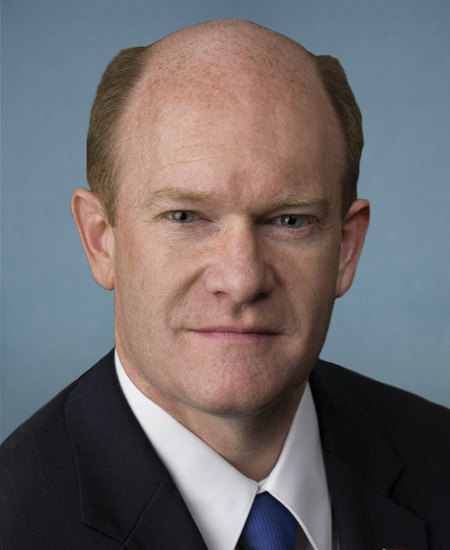
Sen. Christopher A. Coons
Sponsored bills
Maddy summaryThe COMPOST Act (S 179) establishes composting as an official conservation practice under federal farm programs, making it eligible for support in initiatives like the Conservation Stewardship Program. It creates a new $200 million annual grant and loan guarantee program (2023-2032) to fund projects expanding food waste composting infrastructure, including facility construction, equipment, and community collection systems. Eligible entities include farms, local governments, schools, nonprofits, and community projects, with priority given to initiatives serving underserved areas, creating jobs with living wages, and using source-separated organic waste. The program requires projects to demonstrate food waste processing capacity, high-quality compost production, and alignment with environmental justice principles.
Maddy summaryThe JOBS Act of 2023 expands Federal Pell Grant eligibility to short-term job training programs that provide 150-600 clock hours (8-15 weeks) of instruction aligned with in-demand local industries. It directly affects students enrolled in eligible career-focused programs at institutions of higher education, requiring programs to offer industry-recognized credentials and meet validation standards from employers or sector partnerships. Key provisions include mandatory industry validation of program quality, institutional credit articulation for noncredit programs, and lowering the minimum Pell Grant percentage from 10% to 5% for qualifying students. The bill ensures these programs count toward students’ total Pell Grant eligibility period while maintaining standard Pell Grant terms and conditions.
Maddy summaryS 173, "Ethan's Law," requires firearm owners to store guns securely in homes where minors (under 18) or individuals ineligible to own firearms might access them. It amends federal law to make non-compliant storage an offense punishable by a $500 fine per violation, with enhanced penalties (up to 5 years in prison) if injury or death results. The bill creates a federal grant program to support states with laws matching its secure storage requirements, offering funding incentives for states that enact similar measures. It directly affects homeowners with firearms in households containing minors or prohibited persons, aiming to reduce accidental child access and firearm-related injuries.
Maddy summaryThis bill increases funding for two key U.S. agricultural export promotion programs. It raises the annual budget for the Market Access Program from $200 million to $400 million and for the Foreign Market Development Cooperator Program from $34.5 million to $69 million, extending these funding levels through 2029 (previously capped at 2023). The bill directly affects U.S. agricultural producers and exporters, including those growing commodities like soybeans, beef, dairy, and wheat, by providing more resources to access international markets. These changes aim to counter competitive disadvantages from foreign competitors and address years of stagnant funding adjusted for inflation.
Maddy summaryThis bill requires the President to create a strategy aimed at doubling U.S. exports to Africa and Latin America and the Caribbean within 10 years, with the goal of supporting American jobs. The strategy must be developed with input from Congress, federal agencies, development banks, and the private sector, and submitted to Congress within 180 days, followed by a progress report after 3 years. It also establishes two special coordinators (one for Africa, one for Latin America/Caribbean) to oversee implementation and mandates standardized training for U.S. officials on export financing programs. Additionally, the bill encourages the administration to lead joint trade missions to these regions within one year.
Maddy summaryThe ISA Student Protection Act of 2023 establishes consumer protections for educational income share agreements (ISAs), which are contracts where students pay a percentage of future income in exchange for education funding. The bill limits total payments to no more than 20% of a student's future income, requires clear disclosures about payment terms, and provides discharge protections for students with disabilities or who pass away. It also clarifies tax treatment for ISAs and prohibits practices like acceleration clauses that would increase payments upon default. The bill applies to educational ISAs used for postsecondary education expenses.
Maddy summaryS 129, the Korematsu-Takai Civil Liberties Protection Act of 2023, prohibits federal authorities from detaining individuals solely based on protected characteristics. The bill amends federal law to define "protected characteristics" as race, ethnicity, national origin, religion, sex, gender identity, sexual orientation, disability, and any additional characteristics the Attorney General may designate. It explicitly bans imprisonment or detention based exclusively on these traits, with no allowance for the Attorney General to remove any listed characteristic. This directly affects anyone subject to federal detention, ensuring protections against discrimination in custody decisions under current law.
Maddy summaryThis bill modifies timing requirements for two federal energy assistance programs. It requires the Secretary to release application guidance and publish funding allocations within 60 days of funds becoming available for both the Weatherization Assistance Program and the State Energy Program. Additionally, it mandates that funds be distributed "as quickly as practicable" to states, tribes, or other recipients after they submit approved energy conservation plans. The bill directly affects states, Indian Tribes, and other direct recipients of these federal energy assistance programs by streamlining the distribution process. It is a procedural bill focused solely on timing, not altering program eligibility or funding levels.
Maddy summaryThis bill would admit Washington, D.C. as the 51st state, officially named "State of Washington, Douglass Commonwealth," granting it full representation in Congress with two Senators and one Representative. It would establish a "Capital" area within the new state that remains under federal jurisdiction, including the White House, Capitol Building, and other key government properties. The bill would repeal the District of Columbia's congressional delegate position and the 23rd Amendment, which currently provides D.C. with electoral votes in presidential elections. It would also provide for the transition of federal properties, courts, and government functions while maintaining federal control over the Capital area.