

Maddy summaryThis bill requires federal agencies to adjust contract prices for contractors affected by government funding lapses (like shutdowns), ensuring contractors can cover costs for employees who were furloughed, laid off, or had reduced hours. It mandates that contractors receive reimbursement for paying employees at their standard rate during the lapse or restoring paid leave used instead of work. The reimbursement is capped at $1,442 per week (pro-rated for part-time workers), and contractors must provide proof of costs to the agency. Agencies must report to Congress within a year on how many contractor employees were impacted and how compensation was handled.
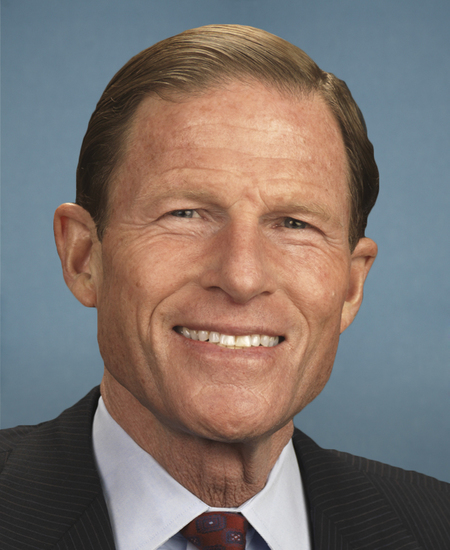
Sen. Richard Blumenthal
Sponsored bills
Maddy summaryThis bill provides emergency financial relief for federal employees affected by government shutdowns. It allows workers on furlough or working without pay during a shutdown lasting at least two weeks to withdraw up to $30,000 (adjusted annually for inflation) from their Thrift Savings Plan (TSP) retirement accounts without the usual 10% tax penalty. The bill also prevents missed TSP loan payments during shutdowns from being treated as taxable distributions, protecting employees from unexpected tax bills. These provisions apply to withdrawals and loan payments made after September 30, 2025, directly supporting federal workers facing income disruption during funding lapses.
Maddy summarySRES 427 designates October 8, 2025, as "National Hydrogen and Fuel Cell Day" through a ceremonial Senate resolution. It does not create new laws, funding, or affect specific groups; it simply establishes a commemorative day to recognize hydrogen and fuel cell technologies. The resolution highlights the U.S. leadership in these technologies and their applications in energy, transportation, and grid resilience, but contains no policy changes or obligations.
Maddy summaryThe Child Care for Every Community Act establishes a national program to provide universal, high-quality child care and early learning services for all children not yet required to attend school, regardless of family income. The bill creates a system where designated "prime sponsors" (such as states, localities, or nonprofits) must provide comprehensive services including health, educational, nutritional, and social support with full-day (10+ hours) and year-round care. It requires fees to be based on family income (capping at 7% of income), ensures no family is denied services due to inability to pay, and mandates specific quality standards for programs and staff qualifications. The bill also includes special provisions for children with disabilities, dual language learners, homeless children, and children from Native American communities, with the federal government covering 90% of costs (100% for specific groups) while requiring states to maintain their own funding levels for child care programs.
Maddy summaryThis bill requires states to allow federal employees who must work during government shutdowns (called "excepted employees") to receive unemployment benefits for those weeks in 2026-2027. If an employee later receives pay from the government for the same period, they must repay the state unemployment fund. The federal government will reimburse states 100% of the unemployment benefits paid to these employees plus related administrative costs. The bill directly affects federal workers required to work during shutdowns and state unemployment systems managing these claims. It creates a clear process for benefits and repayment during shutdowns in 2026-2027.
Maddy summaryThis bill grants permanent resident status (green card) to one specific person, Valent Kolami, bypassing standard immigration requirements. It allows Kolami to apply for an immigrant visa or adjust their status to lawful permanent resident within two years of the bill's enactment, provided they pay required fees. The bill directly affects only Valent Kolami and does not create new general immigration rules. (Procedural bill; summary under 3 sentences as required.)
Maddy summaryS 2956, the Used Car Safety Recall Repair Act, requires manufacturers to reimburse dealers for used vehicles with unresolved safety recalls. If a manufacturer fails to provide a remedy within 60 days of a recall notice, they must pay dealers 1% of the vehicle's fair market value per month (prorated daily) until repairs are made or payments reach the vehicle's full value. The bill prohibits dealers from selling, leasing, or loaning used vehicles with active safety recalls until repairs are completed, unless specific exceptions apply (e.g., recall information wasn't available at sale time). It directly affects dealers selling more than five vehicles annually and used car buyers, ensuring safety fixes are addressed before transactions. The law takes effect one year after enactment.
Maddy summaryThis resolution urges the U.S. executive branch and G7/EU leaders to seize Russian sovereign assets frozen in their jurisdictions and send at least $10 billion monthly to Ukraine until funds are exhausted. It does not create new law but recommends international coordination to repurpose these assets for Ukraine’s defense and recovery, citing Russia’s violations of international law. The resolution specifically calls for countries to harmonize legal frameworks to enable asset seizure and disbursement, aligning with the 2024 REPO for Ukrainians Act. It is a non-binding request, not a legislative mandate, targeting G7/EU nations holding frozen Russian assets.
Maddy summaryThis resolution (SRES 418) expresses the U.S. Senate's support for designating September 20-27, 2025, as "National Estuaries Week." It does not create new laws or funding but aims to raise public awareness about the ecological and economic importance of estuaries. The resolution highlights estuaries' role in supporting jobs, economic output, and coastal protection, while acknowledging ongoing threats like pollution and habitat loss. It is a symbolic gesture directed at the public, government officials, and organizations working to protect estuaries.
Maddy summaryThis bill would reform the H-1B and L-1 visa programs by requiring employers to pay workers at least the highest of three wage standards (local prevailing wage, median wage for all workers in the occupation, or median wage for skill level 2), prohibiting displacement of U.S. workers, and mandating 30-day online job postings before H-1B applications. It limits H-1B extensions to 3 years, eliminates B-1 visas as an alternative to H-1B, and creates new enforcement mechanisms including Department of Labor investigations. Employers would also need to provide H-1B and L-1 workers with benefits on the same basis as U.S. workers. These changes would directly affect employers seeking these visas, foreign workers in these categories, and U.S. workers who might be displaced.