

Maddy summaryThis bill amends the Clayton Act to add a reference to itself within existing antitrust enforcement language. Specifically, it modifies Section 4C(a)(1) to include the phrase "or section 2 of this Act" after "any violation of the Sherman Act." The change directly affects how antitrust enforcement actions under the Clayton Act are referenced in legal proceedings. The bill does not introduce new substantive policy requirements but alters the statutory citation structure for consistency with its own provisions. (1 sentence summary: This procedural bill updates the Clayton Act's reference to itself in antitrust enforcement language.)
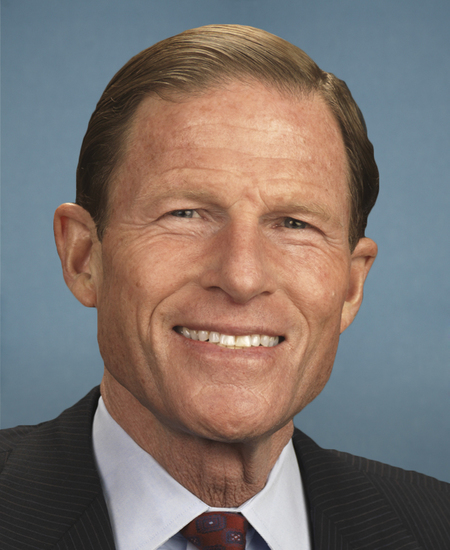
Sen. Richard Blumenthal
Sponsored bills
Maddy summaryS 3544, the Federal Firearm Licensing Act, would require most individuals to obtain a federal license to purchase, receive, or possess a firearm, with exceptions for states that have comparable state licensing systems. To qualify, applicants must complete firearms safety training (including a written test and hands-on shooting demonstration), pass a background check, and provide personal details, firearm specifics, and seller information. Licenses would be valid for one firearm within 30 days and expire after five years, with renewal requiring the same safety training and background check. The bill also mandates point-of-sale background checks through licensed dealers and requires sellers to report all firearm transactions to the federal government within three business days.
Maddy summaryThe GRACE Act (S 3535) sets a minimum annual refugee admission target of 125,000 for the U.S., requiring the President to determine this number based on humanitarian needs and national interest. It introduces community/private sponsorship for refugees, allowing groups to provide initial resettlement services instead of traditional agency support. The bill mandates quarterly public reports to Congress on admissions numbers, regional allocations aligned with UN resettlement needs, processing times, security checks, and any shortfall in meeting targets. This directly affects refugees seeking admission, the Department of Homeland Security (which administers processing), and Congress (through transparency requirements).
Maddy summaryThe Clean Competition Act imposes a carbon intensity charge on covered primary goods produced domestically or imported into the U.S., calculated based on how much a facility's carbon intensity exceeds industry benchmarks. The charge starts at $60 per metric ton of CO2-e in 2026 and increases annually, determined by (excess carbon intensity) x (quantity of goods) x (cost of pollution). The bill includes provisions for rebates on exports, reductions for emissions captured directly from the air, and mechanisms to support decarbonization through investments in clean technology. It also establishes "carbon clubs" for international cooperation on climate policies, affecting manufacturers in specific energy-intensive industries and importers of covered goods.
Maddy summaryThis bill prohibits individuals and companies from bypassing website security measures designed to limit online purchases (like preventing bots from buying all available items) or managing inventory. It also bans selling products obtained through such violations if the seller knew or should have known about the circumvention. The Federal Trade Commission (FTC) and state attorneys general can enforce these rules by suing violators to stop the conduct, recover damages for consumers, or compel compliance. The law specifically targets automated "bot" activity that undermines fair access to online products during high-demand periods.
Maddy summaryThe Shadow Docket Sunlight Act of 2025 would require the U.S. Supreme Court to publish written explanations and disclose each justice's vote when issuing emergency orders about temporary court orders that block government actions (preliminary injunctions) or stays of such orders. The written explanation must address specific factors, such as whether the applicant is likely to succeed on the merits and whether the order serves the public interest. This rule does not apply to routine administrative decisions or requests to hear full cases. The bill also mandates biennial reports to Congress on how well the Court follows these transparency requirements.
Maddy summaryThe Schedules That Work Act would require employers in retail, food service, cleaning, hospitality, and warehouse sectors to provide workers with at least 14 days' advance notice of their schedules and pay predictability pay for last-minute changes. It gives employees the right to request schedule changes for reasons including health conditions, caregiving responsibilities, or enrollment in career training programs. Employers must engage in a good-faith process to address these requests unless they have a legitimate business reason to deny them. The bill aims to address widespread problems with unpredictable schedules that make it difficult for low-wage workers to manage family responsibilities, access healthcare, and secure stable housing and child care.
Maddy summaryThe ENFORCE Act strengthens federal laws against child exploitation by clarifying what constitutes producing child pornography and removing time limits for prosecuting certain crimes involving child sexual abuse material. It adds these offenses to sex offender registration requirements, prohibits reproducing abusive images during legal proceedings, and creates a presumption for detainment before trial for violations. The bill directly affects federal prosecutors, courts handling these cases, sex offenders subject to registration, and victims whose images are involved. Key changes include ensuring evidence remains under court control and allowing victims access to depictions in the same manner as victims of child pornography cases.
FDA Modernization Act 3.0 This bill requires the Food and Drug Administration (FDA) to publish an interim final rule implementing a provision of the Consolidated Appropriations Act of 2023 that authorized the use of certain alternatives to animal testing to support investigational use of a new drug. The rule must replace references to animal tests, data, studies, models, and research with references to nonclinical tests, data, studies, models, and research throughout the FDA’s regulations governing investigational new drug applications, and may make other changes to the regulations as appropriate. The rule must be published within one year of the bill’s enactment, and must take immediate effect as an interim final rule.
Essential Caregivers Act of 2025 This bill prohibits certain health care facilities from limiting the access of essential caregivers to residents of those facilities, including during designated emergency periods. Specifically, the bill generally prohibits Medicare skilled nursing facilities, Medicaid nursing facilities, Medicaid intermediate care facilities, and associated inpatient rehabilitation facilities from restricting the access of essential caregivers to residents of the facilities, including during emergency periods in which visitation rights are otherwise restricted. During emergency periods, facilities may restrict access for an initial period of up to seven days and for one additional maximum seven-day period (if the additional period is approved by the state health department). Facilities may restrict access for a total of 7 days (or 14 days with the approval of the state health department) during an emergency period. Essential caregivers must agree to comply with any safety protocols set by the facility, which may be no more stringent for caregivers compared to those for staff. Caregivers who fail to comply with these requirements may be denied access, subject to an appeals process.