

Maddy summarySRES 615 is a Senate resolution celebrating Black History Month, acknowledging the historical contributions of African Americans to U.S. society across fields like civil rights, arts, science, and leadership. The resolution encourages all citizens to reflect on this history as part of the nation's ongoing journey toward equality, without creating new laws or policies. It specifically recognizes figures such as Frederick Douglass, Maya Angelou, and Rosa Parks, and emphasizes the importance of Black History Month in February as a time for communal learning and inspiration. This ceremonial resolution was introduced by multiple senators and passed unanimously by the Senate in 2026.
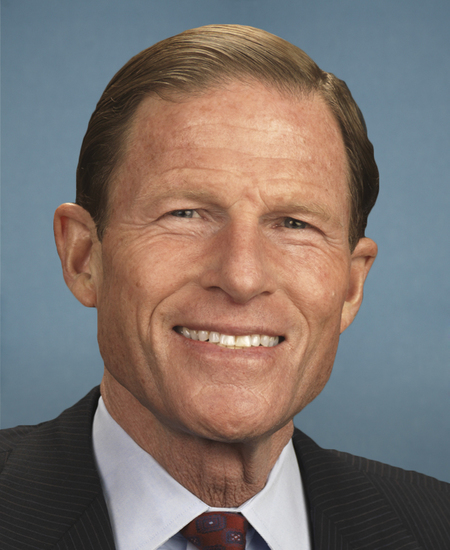
Sen. Richard Blumenthal
Sponsored bills
Maddy summarySRES 613 is a Senate resolution (not a law) recognizing the Army-Navy football game as "America’s Game." It expresses the Senate’s view that the annual game between the U.S. Military Academy and U.S. Naval Academy - held since 1890 - should remain the only major college football game played on the second Saturday of December. The resolution urges broadcasters, athletic conferences, and universities to avoid scheduling competing games during this time slot to preserve the event’s national prominence and its role in honoring military service. It does not create new laws or funding but calls for federal agencies to review policies supporting the game’s civic significance. (Note: This is a symbolic resolution, not a bill with binding effects.)
Maddy summarySRES 602 is a symbolic Senate resolution expressing support for the U.S. Olympic and Paralympic Teams (Team USA) competing in the 2026 Winter Games in Milano Cortina, Italy. It formally applauds Team USA athletes, coaches, and their supporters, commends Italy for hosting the event, and commits to ensuring safety for future U.S. host events (2028 Los Angeles Summer Games and 2034 Utah Winter Games). The resolution does not create new policies, funding, or obligations - it is purely a statement of congressional support. It directly affects Team USA athletes and organizers by acknowledging their efforts and achievements. This is a procedural resolution with no binding effect on government actions.
Maddy summaryS 3914 establishes two new offices within the Supreme Court: an Office of Ethics Counsel to advise justices and their spouses on ethics matters (like financial disclosures, gifts, and conflicts of interest), and an Office of Investigative Counsel to review formal ethics complaints filed by top congressional leaders. The Ethics Counsel provides mandatory biannual training to justices and submits annual reports to Congress on ethics advice given. The Investigative Counsel handles complaints, conducts investigations within 60 days of filing, and submits findings to the Chief Justice (or senior associate justice if the Chief is the subject), with reports also shared with relevant congressional committees. This bill directly affects Supreme Court justices, their spouses, and dependents by creating formal processes for ethics guidance and oversight.
Maddy summarySRES 612 is a non-binding Senate resolution acknowledging the fourth anniversary of Russia’s February 2022 invasion of Ukraine. It reaffirms U.S. support for Ukraine’s sovereignty and territorial integrity within its 1991 borders, condemns Russia’s attacks on civilians and infrastructure, and emphasizes the need for sustained U.S. and transatlantic security guarantees. The resolution does not create new laws or funding but expresses congressional support for Ukraine’s defense and calls for continued international cooperation. It specifically highlights Russia’s targeting of Ukrainian children and U.S. companies as part of its aggression. As a symbolic gesture, it has no legal effect on policy or funding.
Maddy summaryS 3905, the Tariff Refund Act of 2026, requires U.S. Customs and Border Protection (CBP) to refund all duties unlawfully collected under the International Emergency Economic Powers Act (IEEPA) to importers within 180 days of the bill's enactment, including interest. It mandates CBP to reliquidate previously processed imports to calculate refunds and prioritizes small businesses for faster processing, with coordinated outreach to them via the Small Business Administration. The bill also requires CBP to submit regular reports to Congress detailing refund progress and timelines. This directly affects importers who paid IEEPA duties, with specific provisions to streamline refunds for small business importers.
Maddy summaryThe American Homeownership Act restricts tax deductions for interest and depreciation on residential properties owned by institutional investment entities or "large owners" (defined as those holding 50+ single-family units). It creates exceptions for new construction, rehabilitation of uninhabitable properties, sales to individuals for primary residence, and properties serving affordable housing through tax credit programs. The bill also prohibits federal housing agencies from selling properties or providing mortgage loans to these large investors and allocates savings from these tax changes to fund affordable housing programs. These provisions aim to encourage homeownership by limiting tax benefits for large-scale rental property ownership while directing resources toward affordable housing development.
Rotorcraft Operations Transparency and Oversight Reform Act or the ROTOR Act This bill addresses aviation safety by increasing requirements for aircraft tracking and communication using Automatic Dependent Surveillance-Broadcast (ADS-B) technology and expanding oversight. As background, ADS-B for broadcasting (Out) and receiving (In) transmits information (e.g., location and weather information) between aircraft and air traffic control. Under the bill, aircraft must generally operate with ADS-B In equipment to provide the aircraft with location information of other aircraft and traffic advisories. Current law does not require this equipment. Current Federal Aviation Administration (FAA) regulations allow aircraft performing a sensitive government mission to be excepted from requirements for using ADS-B Out equipment. This bill limits which flights may be considered sensitive government missions (e.g., not training flights) and requires additional reporting and notifications for the exception. The Government Accountability Office must review the use of the ADS-B Out exception and the Office of the Inspector General (OIG) of the Department of Transportation must annually audit FAA oversight of operations that use the exception. Further, the bill repeals a 2025 law that exempts certain military helicopters from the ADS-B Out requirements for the Washington, DC, metropolitan area. The bill also requires the OIG of the Army to audit the Army’s coordination with the FAA, the FAA to establish an office to coordinate airspace usage of military aircraft and review the safety of flight operations and routes around airports, and the FAA to enter into memoranda of understanding with military agencies for safety information sharing.
Maddy summaryThe SAVES Act of 2025 establishes a five-year pilot program at the Department of Veterans Affairs (VA) to fund nonprofit organizations that provide service dogs to eligible veterans with specific disabilities, such as blindness, mobility issues, PTSD, or traumatic brain injury. Nonprofits must apply competitively, meet training and animal welfare standards (including ADA compliance), and provide service dogs at no cost to veterans, with the VA covering all program expenses. The VA will also provide ongoing veterinary insurance for the dogs, which continues even after the pilot ends. This program is funded with $10 million annually for five years, targeting veterans as defined by VA medical criteria.
Maddy summaryS 233, the "Restoring Confidence in the World Anti-Doping Agency Act of 2025," requires the U.S. Office of National Drug Control Policy to ensure the World Anti-Doping Agency (WADA) has fair U.S. representation and governance reforms. It mandates a 90-day review to assess WADA’s governance model, conflict-of-interest policies, and inclusion of independent athletes (defined as those not affiliated with major sports bodies) in decision-making roles. If reforms are lacking, the U.S. may withhold full membership dues and issue a report detailing barriers to U.S. representation on WADA’s Executive Committee, Foundation Board, and committees. The bill directly affects U.S. participation in WADA governance and aims to strengthen U.S. influence in anti-doping standards.