

Stop CO Poisoning Exposures Act or the SCOPE Act This bill directs the Department of Transportation to require that automobile manufacturers install technology in each motor vehicle equipped with a keyless ignition device and an internal combustion engine to automatically shut off the motor vehicle after the motor vehicle has idled for a specified period of time to prevent carbon monoxide poisoning.
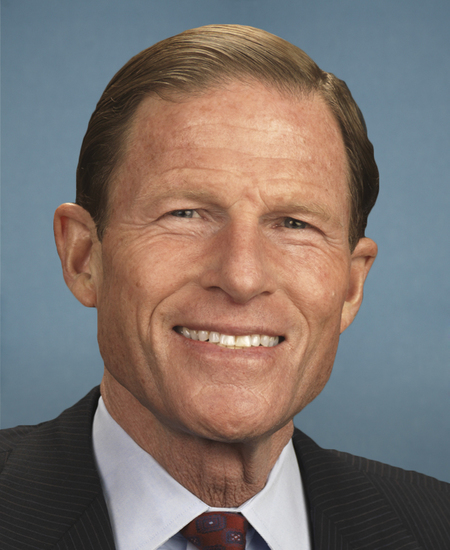
Sen. Richard Blumenthal
Sponsored bills
Servicemember Parental Leave Equity Act This bill modifies Department of Defense parental leave provisions for members of the Armed Forces. Specifically, the bill increases parental leave for primary caregivers to 18 weeks (currently 12) following the birth of a child and to 12 weeks (currently 6) following the adoption of a child. The bill increases parental leave for a secondary caregiver from 21 days to 12 weeks in connection with the birth or adoption of a child. Primary or secondary caregivers of a long-term foster child are authorized to take up to 12 weeks of leave in connection with such placement. Parental leave for a primary or secondary caregiver for a birth, adoption, or foster child placement may be taken in more than one increment. For primary caregivers, the leave must be utilized within one year of the event. The bill authorizes up to 12 weeks of leave to certain service members who would have been secondary caregivers but for a miscarriage, stillbirth, or infant death. The following activities required of an active-duty member within a 12-month postpartum period must have the approval of a health care provider and be at the election of the member or in the interest of national security: (1) an order of temporary duty overnight travel or to participate in physically demanding field training exercises, (2) meeting of body composition standards, or (3) passing a physical fitness test. The bill also reduces the service commitment required for participation in the Career Intermission Program.
Andrew Kearse Accountability for Denial of Medical Care Act of 2021 This bill establishes a new federal criminal offense for failing to obtain medical attention for an individual in federal custody who displays medical distress. Specifically, the bill requires federal law enforcement officers and the Bureau of Prisons' personnel to provide or obtain immediate medical attention for an individual in federal custody who displays medical distress. It criminalizes the negligent failure to obtain or provide such medical attention that results in unnecessary pain, injury, or death. A violator is subject to criminal penalties—a fine, a prison term of up to one year, or both.
Safe Interactions Act of 2021 This bill requires the Department of Health and Human Services to award grants to nonprofit disability organizations to develop training programs for law enforcement officers who may encounter individuals with disabilities.
Jobs and Childcare for Military Families Act of 2021 This bill allows an employer a work opportunity tax credit for hiring an individual who is certified by a designated local agency as being, as of the hiring date, the spouse or domestic partner of a member of the Armed Forces, and requires the creation of programs for uniformed services families to pay for childcare on a pretax basis. Specifically, an employer may receive a tax credit equal to 40% of a new employee's first-year wages if the employer hires a service member's spouse or domestic partner (as recognized under state law or by the Armed Forces). Currently, a similar tax credit exists for employers who hire certain disadvantaged individuals, including disadvantaged veterans. The bill requires the Department of Defense, the Department of Homeland Security (with respect to the Coast Guard), the Department of Commerce (with respect to officers of the National Oceanic and Atmospheric Administration), and the Department of Health and Human Services (with respect to the Public Health Service) to implement flexible spending arrangements that permit members of the uniformed services to use basic pay and compensation to pay for childcare services for their dependent children on a pretax basis.
Universal School Meals Program Act of 2021 This bill revises requirements under the food and nutrition programs of the Department of Agriculture, such as the school lunch and breakfast programs. For example, the bill permanently provides free meals to all school children regardless of income. The bill increases the reimbursement rate for school food authorities participating in the food and nutrition programs. The bill also prohibits school food authorities from (1) physically segregating or otherwise discriminating against any child participating in the free breakfast program, or (2) overtly identifying a child participating in the program with a special token or announcement. Additionally, the bill expands the summer food service program by making all children eligible for participation in the program. Further, the bill revises eligibility determinations for measuring poverty to include runaway or homeless youth, foster children, migratory children, and children participating in specified programs (e.g., Head Start).
America's Red Rock Wilderness Act This bill designates specified lands in the following areas of Utah as components of the National Wilderness Preservation System: (1) Great Basin, (2) Grand Staircase-Escalante, (3) Moab-La Sal Canyons, (4) Henry Mountains, (5) Glen Canyon, (6) San Juan-Anasazi, (7) Canyonlands Basin, (8) San Rafael Swell, and (9) Book Cliffs and Uinta Basin. The bill sets forth administrative requirements for (1) the exchange of state-owned lands within such areas, (2) federal reservation of water rights, (3) measurement of setbacks for roads with adjacent wilderness, (4) authorized livestock grazing, and (5) withdrawal of such lands from disposition under certain public land laws.
Maximizing Outcomes for Moms through Medicaid Improvement and Enhancement of Services Act or the MOMMIES Act This bill establishes a series of programs and requirements under Medicaid and the Children's Health Insurance Program (CHIP) relating to maternal health. For example, the bill expands eligibility for coverage under Medicaid and CHIP from 60 days to one year after the last day of pregnancy and requires such coverage to include oral health services. The bill also establishes a demonstration program in which states receive grants to implement or expand models for maternity care homes that provide services to Medicaid or CHIP beneficiaries. The Government Accountability Office must report on (1) gaps in coverage under Medicaid and CHIP for pregnant and postpartum women, and (2) the use of telehealth by state Medicaid programs to increase access to maternity care.
Voters' Access to Water Act This bill prohibits states from restricting the donation of food or nonalcoholic beverages to individuals who are outside of the entrance of a polling place for a federal election if such items are distributed without regard to electoral participation or political preference. However, states may prohibit individuals who are distributing these items from engaging in political or electioneering activity.
This resolution thanks the teachers of the United States and promotes the teaching profession by encouraging students, parents, school administrators, and public officials to recognize National Teacher Appreciation Week.