

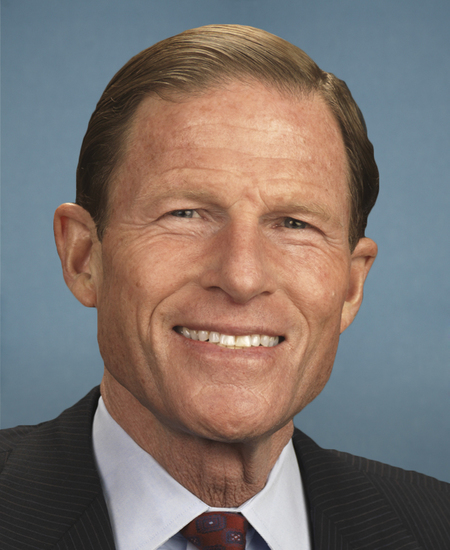
Photo of Richard Blumenthal
D United States Senate · Connecticut

Sen. Richard Blumenthal

Compare
Total votes
1,044
all sessions
Attendance
100%
1 missed
Higher than 82% of chamber peers
With party
97%
of cast votes
Near the chamber average
Bipartisan score
2%
crosses aisle rarely
Near the chamber average
Sponsored
2,845
bills & resolutions
Higher than 99% of chamber peers
Committees
14
assignments
2,845 bills and resolutions

Sponsored bills

Total
2,845
Primary
326
Co-sponsor
2,519
This page
2,845
matching current filters
Co-sponsor S 1584
In committee · Indiana Senate · Co-sponsor
Census FACTS Act

Census Federal Advisory Committee on Transparency and Standards Act or the Census FACTS Act This bill establishes the 2020 Census Federal Advisory Committee on Transparency and Standards to review 2020 Census operations and decision-making in order to make policy and legislative recommendations, assess how decisions concerning the census affected the quality and accuracy of the enumeration of the people of the United States, and consider factors related to the census that may have dampened participation in self-response. For purposes of adopting congressional district boundaries, the legislature of a state or any entity charged by a state with recommending or adopting such boundaries shall make its recommendations or determinations using total population data counting the whole number of persons in the state.

In committee May 12, 2021 1 co-sponsor
Primary S 1588
In committee · Indiana Senate · Lead sponsor
Captive Primate Safety Act

Captive Primate Safety Act This bill limits the trade and possession of nonhuman primates. For example, the bill prohibits most individuals from owning a nonhuman primate as a pet.

In committee May 12, 2021 0 co-sponsors
Co-sponsor S 747
In committee · Indiana Senate · Co-sponsor
Citizenship for Essential Workers Act

Citizenship for Essential Workers Act This bill establishes a mechanism for eligible aliens who worked as essential workers during the declared COVID-19 (i.e., coronavirus disease 2019) public health emergency to apply for and obtain permanent resident status. The bill also narrows certain grounds for deportability and inadmissibility. To be eligible for permanent resident status under this bill, an alien must have earned income at any point during the COVID-19 emergency period doing work deemed essential by the Department of Homeland Security (DHS) or a state or local government. An alien may also be eligible if that alien is a parent, spouse, or child of (1) an eligible alien who died from COVID-19, or (2) a member of the Armed Forces. Certain aliens shall be ineligible, such as an alien who was a refugee on January 1, 2021. To obtain permanent resident status under this bill, an applying alien must satisfy additional requirements, including by passing a background check. Furthermore, the bill repeals provisions providing for three-year bars and permanent bars to admission into the United States. (Generally, these bars apply to aliens who were previously removed or unlawfully present in the United States.) The bill also narrows the scope of certain crime-based grounds for inadmissibility or deportability, such as by redefining the term conviction to exclude expunged convictions. The Department of Justice or DHS may waive certain grounds of inadmissibility or deportability (1) for humanitarian purposes, (2) to ensure family unity, or (3) for the public interest.

In committee May 12, 2021 1 co-sponsor
Primary S 1546
In committee · Indiana Senate · Lead sponsor
Executive Branch Comprehensive Ethics Enforcement Act

Executive Branch Comprehensive Ethics Enforcement Act This bill expands the duties and authorities of the Office of Government Ethics (OGE). Among other things, the bill authorizes the OGE to issue subpoenas during investigations; and order corrective actions (e.g., divestiture) and issue administrative remedies (e.g., suspension or demotion). Additionally, the OGE shall be the central repository of all laws, rules, and regulations relating to conflicts of interest and other ethics issues, recusals, waivers, and exemptions of such laws, rules, and regulations. The OGE shall make available to the public all financial disclosure reports and records relating to conflicts of interest and other ethics issues that are determined to be public information. The OGE must provide ethics education and training to all designated and alternate designated agency ethics officials, who must register with, and report to, the OGE and their appointing authority.

In committee May 11, 2021 0 co-sponsors
Co-sponsor S 1545
In committee · Indiana Senate · Co-sponsor
Disclosure of Tax Havens and Offshoring Act

Disclosure of Tax Havens and Offshoring Act This bill requires certain issuers of securities to annually disclose information related to the tax jurisdiction, income, and assets of their constituent entities on a country-by-country basis.

In committee May 11, 2021 1 co-sponsor
Co-sponsor S 1570
In committee · Indiana Senate · Co-sponsor
HELP Act of 2021

Human-Services Emergency Logistic Program Act of 2021 or the HELP Act of 2021 This bill requires the Department of Health and Human Services (HHS) to allot funding to states, tribal nations, and territories to improve the 2-1-1 and 9-8-8 telecommunication systems. The 2-1-1 system provides callers with information and referrals with respect to health and human services and other provider agencies, and the 9-8-8 system provides callers with mental health or suicide crisis support and resources through the National Suicide Prevention Lifeline. The funds must be used solely for making the call systems available to all individuals in the service area, enhancing community information and referrals with respect to human services, or both. As a condition of this funding, recipients must appoint a lead entity to manage activities to improve the call systems. Recipients must also establish a Human Services State Oversight Council to provide the lead entity with guidance and oversight related to the call systems. In addition, HHS must establish a Human Services National Board, comprised of federal and non-federal representatives, to manage the allocation of funds and evaluate the call systems.

In committee May 11, 2021 1 co-sponsor
Co-sponsor S 1572
In committee · Indiana Senate · Co-sponsor
Military Child Care Expansion Act of 2021

Military Child Care Expansion Act of 2021 This bill modifies and implements policies to update child care facilities and administration at the Department of Defense (DOD). Specifically, the bill removes certain requirements for members of the Armed Forces to receive funding for an in-home child care provider under the DOD pilot program that provides financial assistance to such members who pay for in-home child care. The bill also allows DOD to expand the pilot program to additional locations (currently it is authorized for five). DOD must establish a three-year pilot program to expand access to child care for members of the Armed Forces by entering into agreements with public or private child care facilities or development centers. Under the bill, DOD must determine the (1) root causes contributing to poor or failing facility conditions at its child development centers, and (2) total cost to improve the conditions of such centers. The Government Accountability Office must review the determinations and make recommendations on how to improve DOD child development center conditions. Lastly, DOD must utilize its existing authority to carry out minor military construction projects to construct child development centers.

In committee May 11, 2021 1 co-sponsor
Primary S 1558
In committee · Indiana Senate · Lead sponsor
Untraceable Firearms Act of 2021

Untraceable Firearms Act of 2021 This bill establishes a federal statutory framework to regulate the manufacture, sale, offer to sell, transfer, purchase, and receipt of ghost guns (i.e., guns without serial numbers). Additionally, the bill revises the federal statutory framework regulating the manufacture, possession, sale, import, shipment, delivery, receipt, and transfer of undetectable firearms. Among the revisions, the bill defines undetectable firearm as a firearm without a major component wholly made of detectable material.

In committee May 11, 2021 0 co-sponsors
Showing 2,521 to 2,530 of 2,845 bills